

Last updated: September 2026
An outstanding marketing plan is a written strategy that states where your business stands, who it serves, what it wants to achieve and exactly which marketing activities will get it there. This guide walks you through the seven steps DigiFix uses with Melbourne businesses, from the first audit to the monthly review, so you can build a marketing plan you actually follow.
Key takeaways
- A marketing plan is a practical working document, not a formality: it records your current position, target audience, goals, channels, budget and KPIs in one place.
- Build it in order: audit, audience, SMART goals, channels, budget, KPIs, then a monthly review, because each step makes the next one easier.
- Set goals you can measure, such as “grow email list by 500 subscribers in six months”, so success is never a guess.
- Mix inbound channels like SEO and content with outbound channels like paid ads, based on who your customers are and what you can afford.
- Review the plan every month against agreed KPIs and adjust one thing at a time, so you always know what caused an improvement.
What is a marketing plan?
A marketing plan is a strategic document a business uses to organise, execute and track its marketing over a set period, usually a year or a quarter. It takes the broad ambition of “grow the business” and turns it into specific audiences, messages, channels, budgets and numbers. A marketing plan for a solo tradie in Melbourne will be a couple of pages, while a multi-site retailer will need something far fuller, but both versions answer the same questions.
Every useful marketing plan includes the same core parts:
- A summary of your marketing and promotion objectives for the period.
- An honest overview of your current marketing position and what is already working.
- A description of your target market and what those customers actually need.
- A schedule for completing the tasks in your strategy, with owners and dates.
- The KPIs (key performance indicators) you will track to judge success.
With those parts in one document, every marketing dollar you spend has a reason and a result you can measure, which is exactly what separates an outstanding marketing plan from a wish list.
How do you create an outstanding marketing plan step by step?
DigiFix builds every outstanding marketing plan using the same seven steps below. Work through them in order, because each step feeds the next: the audit informs the audience work, the audience informs the goals, and the goals decide the channels, budget and KPIs.
Step 1: Audit where your business stands today
Before planning where to go, you need an honest picture of where you are. Run a SWOT analysis, which reviews your internal Strengths and Weaknesses and the external Opportunities and Threats around your business. Even a one-page version done in an hour gives you the raw material for the rest of the plan, and it works for a small local business just as well as for a large one.
| Part | Question to ask | Example answer |
|---|---|---|
| Strengths | What do we do better than rivals? | Fast turnaround and 200 five-star Google reviews |
| Weaknesses | What holds us back? | Website is slow and rarely updated |
| Opportunities | What could we take advantage of? | No competitor ranks for our suburb keywords |
| Threats | What could hurt us? | A new chain store opening two streets away |
While you audit, also list the marketing assets you already own: your website, email list, social profiles, reviews and past campaigns. Knowing what exists shows you what can be improved quickly and what must be built from scratch, and it often reveals cheap wins, like an out-of-date Google Business Profile that a single afternoon can fix.
Step 2: Define and research your target audience
Once you know your position, describe exactly who your marketing is for. A plan that targets “everyone” reaches no one, so write down the type of customer you most want to attract. Start with these four questions:
- Who is your ideal customer, in age, location and situation?
- What are they trying to achieve?
- What pain points stand between them and that goal?
- How does your business remove those pain points?
Then back your assumptions with real research: survey existing customers, run a small focus group, read every review you have, and study how similar businesses communicate. Collate the answers into a short customer persona, one paragraph per audience type, and keep it next to your plan so every message you write is aimed at a real person.
The seven steps at a glance
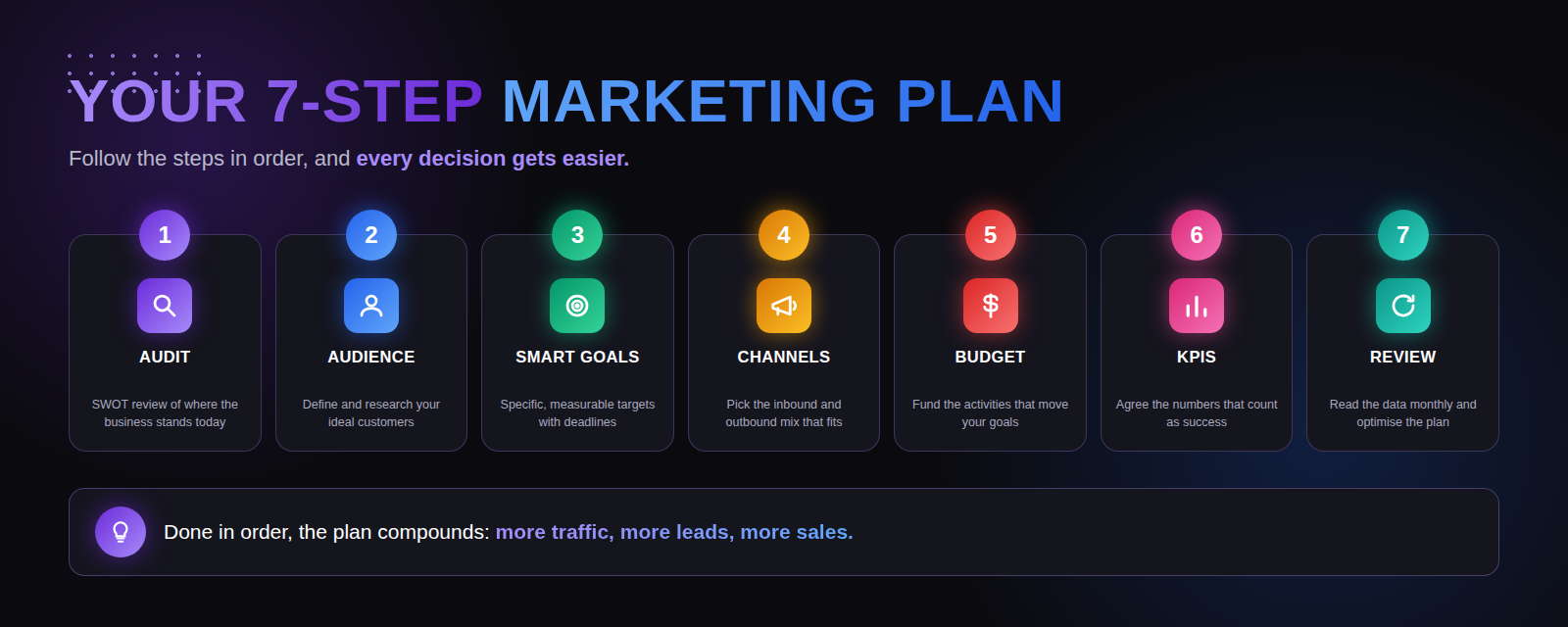
| Step | What you do | What you get |
|---|---|---|
| 1. Audit | Run a SWOT review of where the business stands today | An honest starting point |
| 2. Audience | Define and research your ideal customers | Written customer personas |
| 3. SMART goals | Set specific, measurable targets with deadlines | Goals you can score |
| 4. Channels | Pick the inbound and outbound mix that fits | A focused channel list |
| 5. Budget | Fund the activities that move your goals | A spend plan with limits |
| 6. KPIs | Agree the numbers that count as success | A simple scorecard |
| 7. Review | Read the data monthly and optimise the plan | A plan that improves itself |
Step 3: Set SMART marketing goals
Goals are the hinge of the whole plan, so write them using the SMART criteria: Specific, Measurable, Achievable, Relevant and Time-bound. “Get more customers” is not a goal, but “increase monthly online sales by 10 percent within two months” is, because you can check it on a date and know exactly whether it happened.
Two more examples that work well for small businesses: “grow the email list from 800 to 1,300 subscribers in six months” and “lift Google Business Profile calls by 20 percent this quarter”. Keep the list short, three to five goals is plenty, and attach one owner and one deadline to each.
Want a professional pair of eyes on your goals and current position before you go further?
Step 4: Choose the right mix of marketing channels
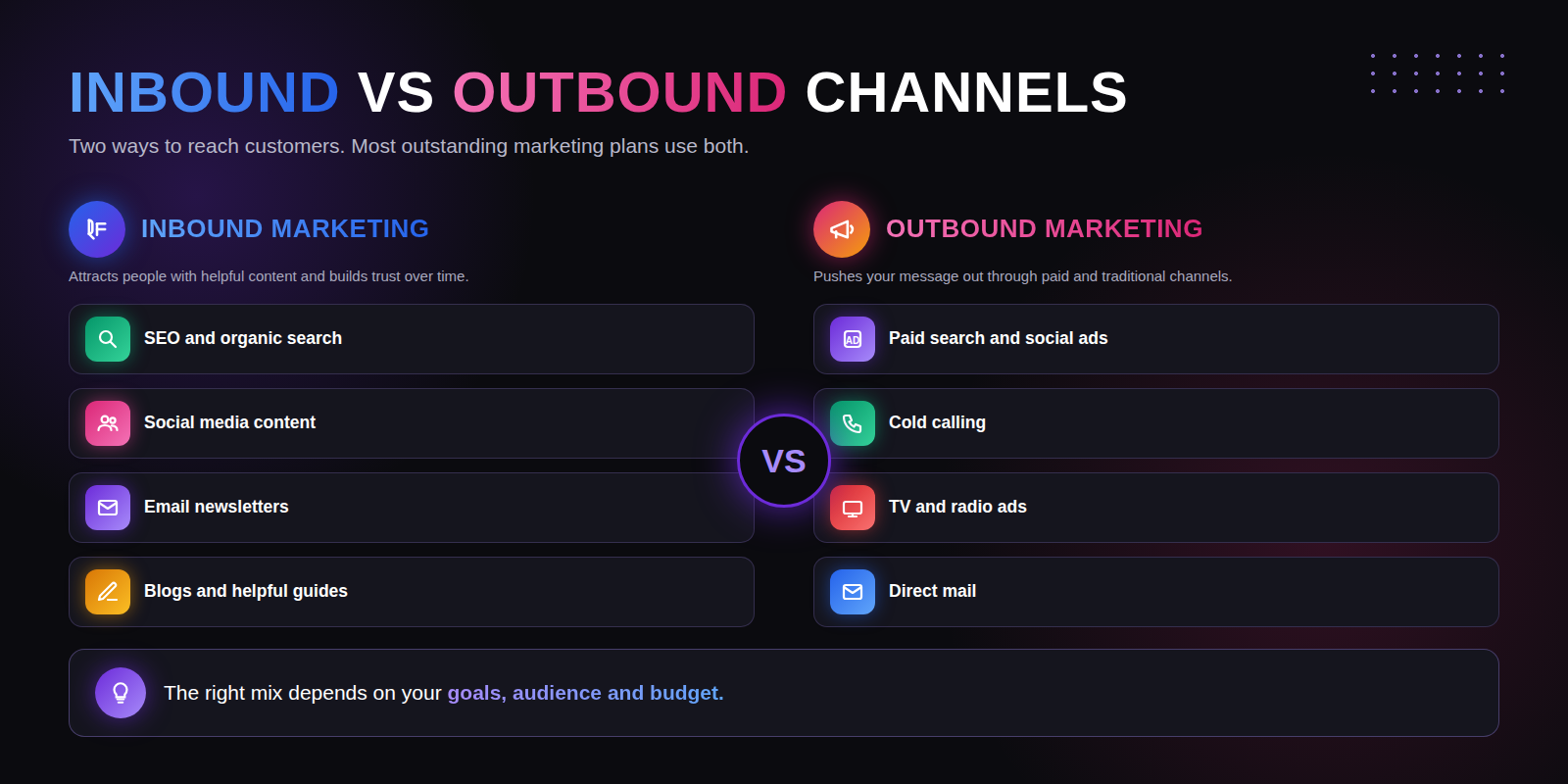
With goals set, pick the channels that will reach your audience. Most channels fall into two groups. HubSpot defines inbound marketing as attracting customers by creating valuable content and experiences tailored to them, such as SEO, social content and email. Outbound marketing pushes your message out through paid and traditional channels, such as ads, cold calling and direct mail.
Match the mix to your audience, not to fashion. If you sell to teenagers, radio is money wasted and social video is home ground; if you launch a product to a broad local market, pairing a paid campaign with organic content reaches people twice. One more point matters here: consistency beats volume. Three channels updated regularly will outperform eight channels updated sporadically, so when in doubt, choose fewer channels and commit to them for at least six months. The infographic below compares the two groups side by side.
| Channel | Type | Best for |
|---|---|---|
| SEO and organic search | Inbound | Capturing demand that already exists |
| Social media content | Inbound | Building trust and community over time |
| Email newsletters | Inbound | Turning past customers into repeat buyers |
| Blogs and helpful guides | Inbound | Answering questions before a sales call |
| Paid search and social ads | Outbound | Fast, targeted reach for offers and launches |
| Cold calling | Outbound | B2B pipelines with a clear list |
| TV and radio ads | Outbound | Broad awareness for bigger budgets |
| Direct mail | Outbound | Hyper-local campaigns in a defined suburb |
Step 5: Set a realistic marketing budget
A plan without a budget is a fantasy, so decide what you can genuinely afford before choosing activities. Work out a monthly figure you can sustain for at least six months, then split it across the channels you chose in Step 4. A sensible starting split we often use at DigiFix is roughly half on growth channels such as SEO and content, a third on paid media, and the rest on tools, design and testing, then adjust that split as results come in.
Only fund activities that move one of your SMART goals, and keep a small reserve for testing new ideas, so a promising channel never gets blocked by a rigid spreadsheet.
Step 6: Agree your KPIs before you launch
Key performance indicators are the numbers that tell you whether the plan is working, and they must be chosen before launch, not after. Each KPI should connect directly to a goal and a channel: if the goal is more online sales through a landing page, the KPIs are visits, conversion rate and sales.
For context on one common KPI, Unbounce’s conversion benchmark report, which analysed 464 million visits to 41,000 landing pages in 2024, puts the median landing page conversion rate at 6.6 percent across industries, so a page converting far below that band deserves a closer look before you blame the ads.
| Goal | KPIs to track | Where to read them |
|---|---|---|
| Grow organic traffic | Sessions, keyword positions, clicks | Google Search Console and GA4 |
| More leads from ads | Cost per lead, conversion rate | Ads platform plus GA4 |
| Grow the email list | New subscribers, open rate | Your email platform |
| More local enquiries | Calls, direction requests, reviews | Google Business Profile |
Step 7: Review, measure and optimise every month
The final step is the one most businesses skip, and it is the reason DigiFix-built plans keep improving. Put a monthly review in the diary: read the KPI scorecard, compare it against targets, and change one thing at a time so you always know what caused the difference. Tag every campaign properly so the data is trustworthy; Google’s campaign URL builder documentation shows how to add UTM parameters so GA4 attributes each visit to the right campaign.
Over a year, twelve small monthly corrections compound into a marketing plan that is sharply tuned to your market, and that habit is the quiet difference between an average plan and an outstanding one.
Curious what these steps produce in the real world? See the results DigiFix has delivered for Australian businesses.
What does an outstanding marketing plan look like in practice?
Picture a family-owned cafe in Clayton, Melbourne, with loyal locals but flat weekday trade and almost no online presence. Their goal is simple on paper: lift weekday revenue by 15 percent within six months without discounting the menu into unprofitability.
Working through the seven steps, DigiFix would move in this order: weeks one and two cover the audit and a customer survey of weekend regulars; weeks three and four set the SMART goal and build two personas, the nearby office worker and the weekend family; month two launches local SEO and a Google Business Profile push for “weekday lunch near me” searches, plus a small geo-targeted ad campaign within three kilometres; month three adds a weekday loyalty email; and from month one onward, a monthly review reads the scorecard of weekday transactions, search clicks and ad cost per visit. The cost of doing nothing is quieter but real: the new office block two streets away fills its lunch habits somewhere else, and flat revenue becomes falling revenue. By month six, the cafe’s scorecard shows which of the three acquisition channels earned its budget, and the next quarter’s plan writes itself from that data.
Which marketing channels should Australian small businesses prioritise?
The numbers explain why digital channels dominate most Australian marketing plans. According to DataReportal’s Digital 2025 Australia report, Australia had 26.1 million internet users, 97.1 percent of the population, and 20.9 million social media user identities, 77.9 percent of the population, in January 2025. The same report recorded 17.0 million LinkedIn members in Australia, which makes it the default outbound channel for most B2B plans.
For most small businesses we therefore start with the channels your customers already live in: organic search through well-planned SEO, a consistent social media presence, and a measured dose of Google Ads where demand is ready to convert. If your pages are not turning that traffic into enquiries, our guide on improving landing page conversion rates is the natural next read.
What mistakes should you avoid in a marketing plan?
- Targeting everyone. A plan with no defined audience produces messages that move nobody.
- Goals without numbers. If success cannot be measured, it cannot be managed.
- Copying a competitor’s channels. Their audience and budget are not yours.
- Setting the budget after choosing tactics. That is how plans die half-funded.
- Never reviewing. A plan that is not read monthly becomes a document, not a strategy.
How can DigiFix help you build your marketing plan?
DigiFix is a Melbourne digital agency that plans, builds and runs marketing for Australian businesses, covering SEO, web design, social media, Google Ads and reputation management under one roof. If you would rather have the seven steps done for you, or want a second opinion on a plan you have already drafted, our team can audit your current position and turn it into a working plan with clear KPIs and a realistic budget, then stay on to run and measure it month by month.
How long should a marketing plan be?
Long enough to answer the seven questions in this guide, and no longer. For most small businesses that is three to ten pages: a one-page summary, a persona paragraph each, a goals table, a channel list, a budget table and a KPI scorecard. Brevity is a feature, because a plan people actually read gets followed.
How often should a marketing plan be updated?
Review the numbers monthly and rewrite the plan quarterly at most. Monthly reviews adjust tactics, such as shifting budget between two ad sets, while the quarterly rewrite is where goals, channels and budgets get properly revised. Rewriting more often than that usually means the original plan was never given time to work.
What is the difference between a marketing plan and a marketing strategy?
The strategy is the thinking: who you serve, why they should choose you and where you will compete. The marketing plan is the working document that turns that thinking into audiences, goals, channels, budgets, dates and KPIs. You need both, but the plan is the part your team uses every week.
How much should a small business spend on marketing?
Start with what you can sustain for six months, not with a percentage you read somewhere. Many growing small businesses land between 5 and 10 percent of revenue on marketing, but the honest answer is the figure that fully funds your chosen channels without starving cash flow. A smaller budget spent on a focused plan beats a bigger budget scattered everywhere.
Do I still need a marketing plan if I only use social media?
Yes, arguably more. A single-channel plan still needs an audience definition, goals, a content budget of time and money, and KPIs such as reach, saves, clicks and enquiries. The seven steps in this guide take an afternoon to complete for one channel, and they stop your social activity from being a hobby with expenses.
Ready to build your outstanding marketing plan?
The DigiFix team plans, runs and measures marketing for Australian businesses every day. Book a free consultation and we will walk through your audit, goals and channel mix together, or keep learning with more guides on the DigiFix blog.