

What is LLM Visibility and why does it matter? Learn how brands get mentioned in ChatGPT, Perplexity, and Google AI Overviews, and how it complements SEO.
For a long time, I didn’t need to overthink visibility. If a web page ranked well, it got clicks. If it got clicks, it drove leads. That was the loop, and it worked for years.
But, recently, I’ve watched that loop break in a way that’s easy to miss if you’re only looking at the usual SEO dashboards. I’ve seen businesses lose organic traffic while branded searches stayed steady. I’ve seen some pages drop, yet enquiries didn’t fall the way they “should.”
That’s the new reality: people still search, but they don’t always click the links. They ask ChatGPT. They check Perplexity. They read Google’s AI Overviews. And often, they decide without ever visiting the websites behind the answer.
So the game isn’t only about rankings anymore. Rankings still matter, but they’re no longer the full story. The real question has shifted to something most businesses haven’t had to think about before: What is LLM visibility, and why is it important?
Don’t forget to check out our latest blog on how to optimize for LLM visibility : Click Here

What is LLM visibility?
LLM visibility is your brand’s presence inside large language models (LLMs) like ChatGPT, Claude, Perplexity, and Google’s AI-driven search experiences.
In simple terms, it means this:
- When someone asks AI for recommendations in your space, does your brand get mentioned?
- When the AI explains a topic you’re known for, does it pull from your content or ideas?
- When buyers compare options, do you appear in the “shortlist” the AI gives them?
In my experience, this is the new layer of discovery. It’s not just “search traffic.” It’s a search influence.
Think about what happens when someone types something like “Chinese restaurant in Balaclava, Melbourne.” Google’s AI Overview often gives a direct answer and recommends a place, without the user clicking ten links.
For example, when I search “Chinese restaurant in Balaclava, Melbourne,” Google’s AI Overview gives a restaurant named “Moonhouse” as the answer for the “Chinese restaurant in Balaclava, Melbourne” search query.
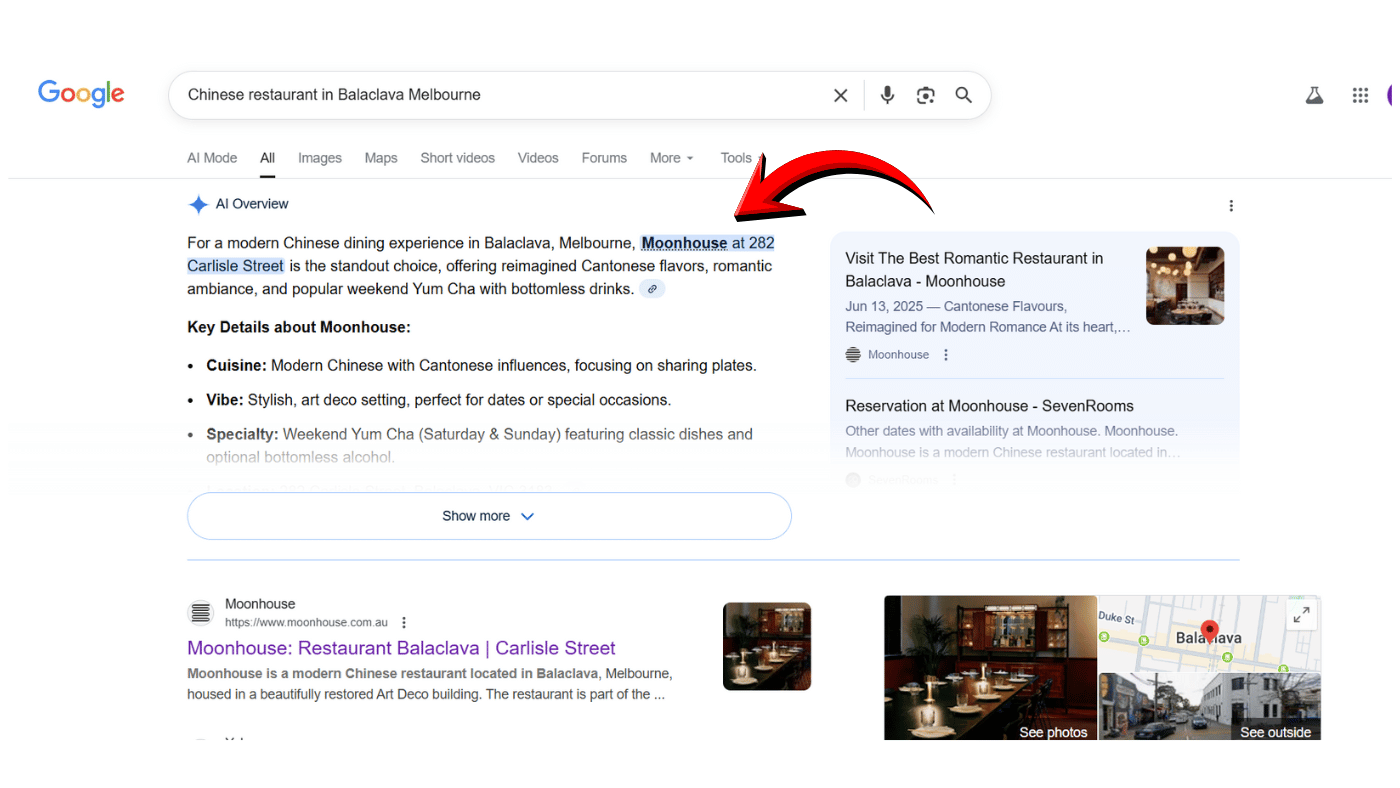
That’s LLM visibility in action.
LLM visibility is no longer mainly about where you rank. It’s about whether your brand, expertise, and content are usable by AI at all.
If systems like ChatGPT, Claude, Perplexity, or Google’s AI Overviews don’t recognise you as a reliable source, you won’t appear in their answers. And from the customer’s point of view, it’s simple: If AI doesn’t mention you, you don’t exist.
Why Does LLM Visibility Matter Now?
LLM-driven discovery is poised to surpass traditional organic search. Semrush’s AI search study projects that AI/LLM search traffic could surpass traditional organic search within the next 2–4 years (which lines up with the 2027 timeframe many teams are planning around). (Semrush)
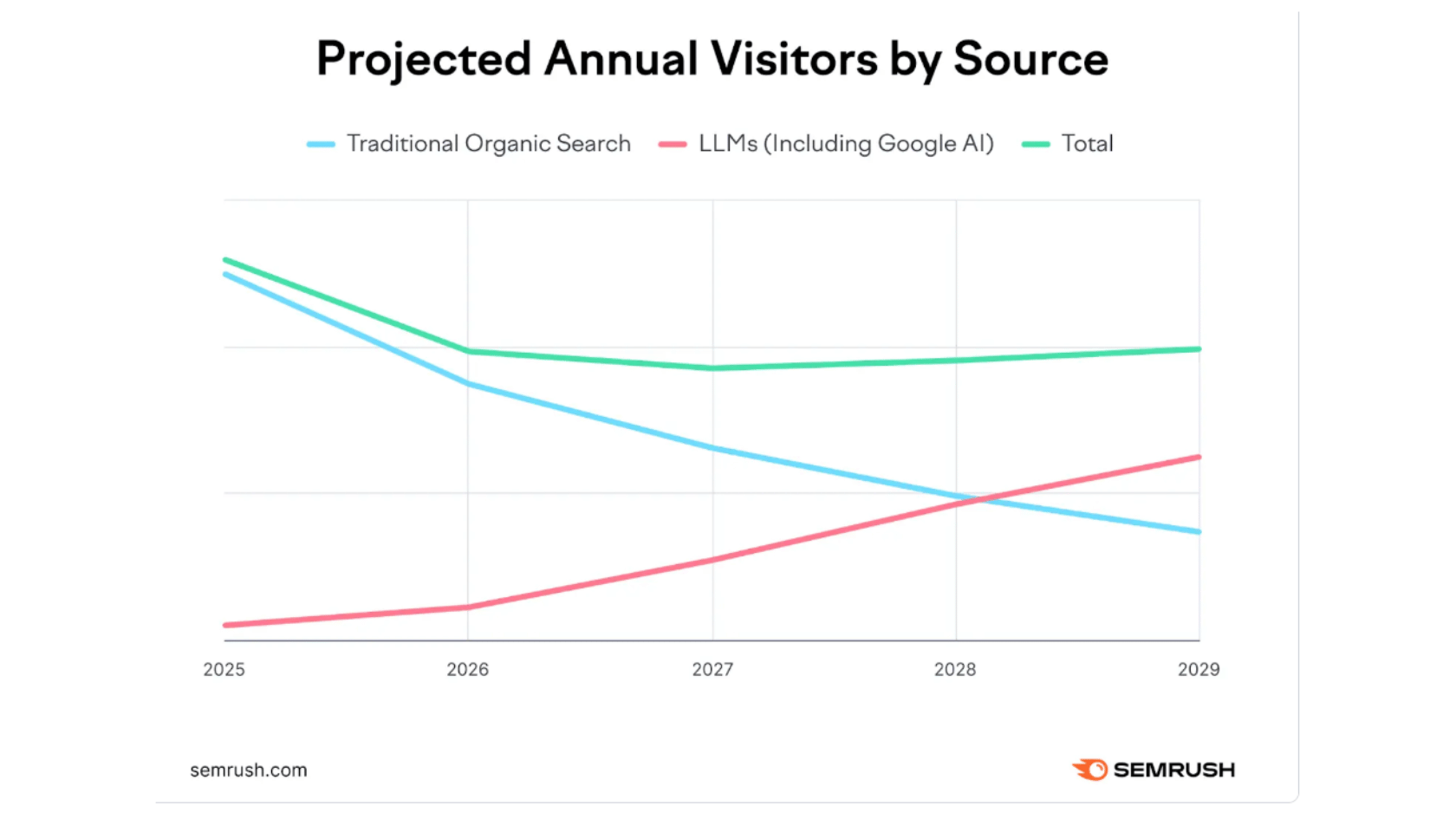
AI Search Visitors to Surpass Traditional Search Visitors in 2028
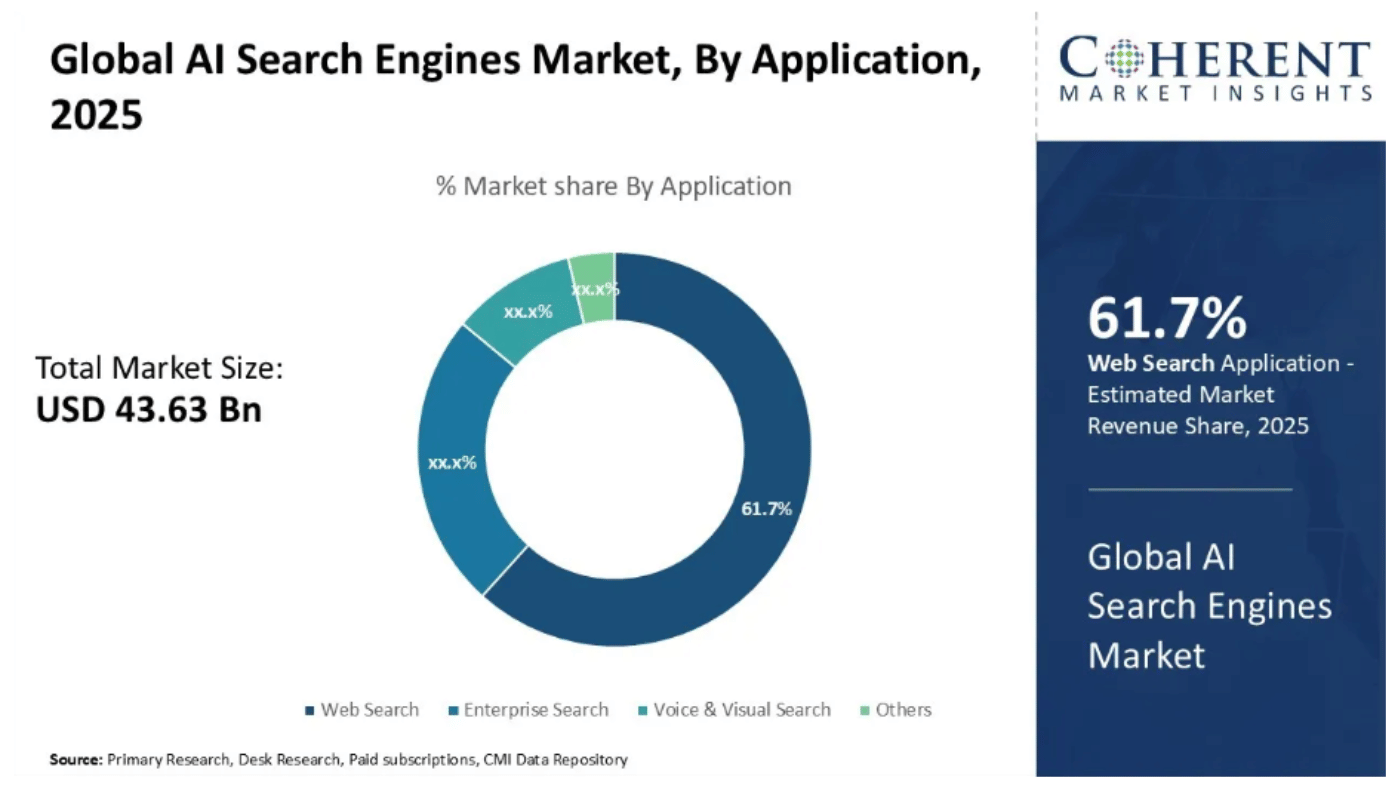
The AI search market is scaling quickly. Coherent Market Insights projects the AI search engines market to reach approximately USD 43.63 billion in 2025, growing to approximately USD 108.88 billion by 2032. That’s a strong signal this shift isn’t hype, it’s investment and adoption moving in one direction.
Also, Clicks are being replaced by “zero-click” answers. Bain and Company’s research found 80% of consumers rely on zero-click results in at least 40% of searches, and estimates this can reduce organic web traffic by 15%–25%. That’s the real reason many brands feel traffic slipping even when interest hasn’t disappeared.
Gartner predicts that by 2026, traditional search engine volume will drop 25% as people move questions to AI chatbots and other virtual agents.
McKinsey & Company reports that half of consumers intentionally seek out AI-powered search, and many describe it as a top source they use to make buying decisions. In other words: AI isn’t just “research.” It’s shaping choices.
All these stats show that if you are not visible inside AI answers, you’re missing the moment where buyers form their shortlist, often before they ever click a website.
The “invisible growth” pattern you should watch for
This is the pattern that confuses most business owners and even SEO teams.
Your Google traffic drops, but the business doesn’t drop the same way. In some cases, leads hold steady or even improve. That’s usually a sign that discovery is happening somewhere you can’t properly track, and right now, that “somewhere” is often AI.
When LLM visibility is working behind the scenes, I’ve seen four signals show up again and again:
1) Declining organic traffic + stable (or rising) branded searches
This is the clearest one.
If fewer people are clicking your pages from Google, but more people are searching your brand name (or your branded service), it usually means they already heard about you elsewhere.
What’s happening in real life:
- They ask ChatGPT or Perplexity for options
- Your brand is mentioned
- They later go to Google and search your name to verify you, check reviews, or find your site
So, the discovery didn’t appear as “organic traffic.” It showed up as brand demand.
2) Sales calls saying, “I found you through AI.”
This is the proof you can’t ignore.
When prospects say things like:
- “ChatGPT recommended you.”
- “I asked AI who the best agency was.”
- “Perplexity showed your name.”
That’s LLM visibility creating a lead. But GA4 won’t label it nicely because:
- They often come back later through direct, branded search, or another channel
- The original “AI mention” isn’t always tracked as a referrer
Practical action: add a simple question on forms and in calls:
“Where did you first hear about us?” (include “ChatGPT/AI” as an option)
3) Direct traffic holding steady while SEO clicks drop
This is a strong signal of AI-driven behaviour.
If SEO clicks fall, you’d expect direct traffic to fall too. But when LLM visibility is strong, direct traffic often stays stable because people are skipping the old journey:
Old journey: Google → clicks → compare → decide
New journey: AI answer → shortlist → direct visit → decide
So your website still gets visited, but the path is different. Buyers are arriving with intent, not browsing.
4) Competitors winning mindshare with weaker traditional SEO
This one hurts, but it is common.
You look at competitors and think:
“How are they getting mentioned? Their SEO isn’t even that good.”
But LLMs don’t only reward “best ranking pages.” They often reward:
- clearer explanations
- more direct comparisons
- more quoted, reusable information
- consistent brand mentions across the web
So while you’re fighting for position #1, they’re showing up inside the answers buyers trust first.
What does this mean in practice?
If you’re seeing these signals, it’s not random. It usually means:
- Your content may still be good, but not “AI-usable.”
- Your brand might not be mentioned enough across credible sources
- Your tracking is fine, buyer behaviour has changed
The smarter move is to treat LLM visibility like a new distribution channel, not a trend. You want your brand to appear early in the decision process, not just at the “click” stage.
How LLM visibility complements SEO (not replaces it)
LLM visibility is not “the new SEO.” It’s the next layer that sits on top of SEO.
In practice, SEO is still the foundation. LLM visibility is the extra reach you get when AI tools start using your content to answer questions and recommend options.
If your SEO fundamentals are weak, LLM visibility becomes difficult. Here’s why.
1) SEO is how your content gets discovered in the first place
LLMs don’t magically “find” your website. Most of what they surface is pulled from content that is:
- accessible (not blocked by technical issues)
- clearly written and structured
- trustworthy and consistent
- easy to extract into a direct answer
Those are SEO fundamentals:
- crawlability and indexing
- clean site structure
- fast, mobile-friendly pages
- strong internal linking
- content that actually answers the query
If your site is messy, thin, or hard to understand, AI systems have less to work with.
2) The goal is different, even if the building blocks overlap
This is the key shift:
SEO = “Get the click now.”
You want to win the search result and pull the user onto your page.
LLM visibility = “Be the trusted answer, so the click comes later.”
You want the AI to mention you, summarise you correctly, and position you as an option worth choosing.
So instead of only competing for rankings, you’re competing for:
- inclusion in the AI answer
- accuracy of how you’re described
- Being part of the shortlist, AI gives people
3) LLM visibility fills the gap SEO can’t cover anymore
Today, many searches end without a click because the answer is delivered directly (AI Overviews, chatbots, summaries).
That means you can “rank” and still lose the moment of attention if the user never clicks.
LLM visibility protects you here because it helps you show up inside the answer, not just below it.
4) They work best when you run them together
The smartest approach is not “SEO or LLM.” It’s SEO + LLM visibility with different outputs.
SEO work focuses on:
- ranking pages and landing pages
- local SEO and service pages
- high-intent keywords that convert
- technical health and indexing
LLM visibility work focuses on:
- clear, quotable explanations (so AI can reuse them)
- comparison content (“X vs Y”, “best for”, “how to choose”)
- consistent brand signals (so AI describes you correctly)
- topical coverage across a cluster, not one mega page
5) A simple example (how both win together)
Let’s say you’re a marketing agency.
- SEO might target: “SEO agency Melbourne” and drive clicks from people ready to buy.
- LLM visibility might be: “Which agency is best for local SEO and AI search?”
The AI mentions you, and the user later searches your name or visits directly.
Same buyer. Different steps in the journey.
SEO is still the engine that builds your website’s authority and discoverability.
LLM visibility is how you ensure that authority shows up where buyers are now making decisions, inside AI answers, often before they ever visit a website.
Which industries benefit most from LLM visibility?
The short answer: almost all of them.
In my experience, if people search for what you sell or ask questions related to what you do, LLM visibility matters.
It shows up strongly in:
- Tech and SaaS (comparisons, “best tools,” integrations)
- Healthcare (services, symptoms, clinics, “what should I do if…”)
- Finance (trust-based research, service comparisons)
- Retail and eCommerce (product discovery, “best for…,” alternatives)
- Local services (tradies, agencies, clinics, anything “near me” becomes “best in…”)
Same principle every time: if people care, AI will notice.
Final thoughts (and how DigiFix can help)
So, what is LLM visibility really?
It’s the new battleground for attention, where buyers ask questions and form opinions before they ever reach your website.
If you only optimize for rankings, you’ll miss the shift that’s already happening. If you build for both SEO and LLM visibility, you get the best of both worlds: visibility in search results and visibility inside the answers people now trust.
At DigiFix, this is exactly what we do. We help businesses:
- Identify the prompts that drive buyer decisions in their niche
- Build content that gets cited and mentioned in AI answers
- strengthen brand signals so AI describes them accurately
- keep SEO performance strong while expanding into LLM visibility
At DigiFix, we help businesses assess how their content appears in large language models and reshape it so it’s clear, credible, and usable by AI systems, without losing its human voice.
If you’re ready to future-proof your content and stay visible as search continues to change, start with a conversation.
FAQ (Frequently Asked Questions)
1) What is LLM visibility?
It’s how often your brand and content show up inside AI answers from tools like ChatGPT, Claude, Perplexity, and Google’s AI Overviews. If AI doesn’t mention you or use your content, you’re effectively invisible during a big part of the buying journey.
2) Is LLM visibility the same as SEO?
No. SEO is about rankings and clicks from search engines. LLM visibility is about being mentioned and recommended inside AI answers, even when the user never clicks a website. They overlap, but the goal is different.
3) Do I need strong SEO to improve LLM visibility?
In most cases, yes. If your site has a weak technical setup, thin content, or unclear structure, it’s harder for AI systems to use your pages confidently. Strong SEO makes your content easier to find, trust, and reuse.
4) Why is my organic traffic dropping, but leads feel the same?
This is a common “invisible growth” pattern. People may discover you through AI, then return later via branded searches or direct visits. That discovery often doesn’t show up clearly in GA4 as an “AI-driven” source.
5) How can I tell if AI is sending me customers?
Look for signals like:
- prospects saying, “I found you through ChatGPT/AI.”
- Branded searches are rising while organic clicks fall
- direct traffic staying stable
- more “typed-in” or bookmarked visits
Also, add a form question: “Where did you first hear about us?” and include “AI/ChatGPT” as an option.
6) How do I improve LLM visibility?
Focus on being the easiest brand for AI to understand and cite:
- write clear, direct answers to real questions
- build topic clusters (not just one big page)
- add comparisons, “best for,” and decision-support content
- strengthen consistent brand mentions across the web
- keep your brand facts consistent everywhere (services, locations, claims)
7) What type of content performs best for LLM visibility?
In my experience, these formats work well:
- “What is…” definitions and explainers (short, clear sections)
- “How to…” guides with steps and examples
- comparison pages (A vs B, alternatives, best tools)
- FAQ sections (yes, they help)
- pricing, process, and “how it works” pages written plainly
8) Can small local businesses benefit from LLM visibility?
Absolutely. People ask AI for local recommendations now (restaurants, tradies, clinics, agencies). If you’re not being mentioned, you miss early discovery. Local businesses that explain their services clearly and show consistent brand information tend to benefit.
9) Does LLM visibility replace Google Ads or paid marketing?
No. It’s not a replacement. Think of it as strengthening your organic brand presence in a new channel. Paid still works, but LLM visibility can lower your reliance on paid traffic by building trust earlier in the journey.
10) Can DigiFix help improve our LLM visibility?
Yes. DigiFix helps businesses build LLM-friendly content and brand signals that increase the chance of being mentioned accurately in AI answers, without sacrificing SEO fundamentals.