

Learn how to optimize for LLM visibility as AI search grows. Discover practical strategies to get your content cited in ChatGPT, Google’s AI Overviews, and more.
For most of my career, visibility meant one thing: ranking on Google and earning the click. That model worked for years. Over the last couple of years, I’ve watched that definition quietly break.
People still search, but they don’t always click. They ask ChatGPT. They skim Perplexity. They trust Google’s AI Overview. And often, they never leave the answer box.
That shift is why more SEO teams are now asking how to optimize for LLM visibility, even if they haven’t used that exact phrase yet.
In this article, you will learn LLM optimization strategies like,
- Producing Original Content
- Using natural, conversational language
- Building Offsite mentions
- Creating LLM preferred content
- Enhancing content with visuals
What is LLM visibility, and why does LLM visibility matter now?
First, it’s important to understand what LLM visibility actually means. LLM visibility is whether your brand or content is mentioned and referenced in large language models (LLMs) such as Google’s AI Overviews, Google’s AI Mode, ChatGPT, and Perplexity.
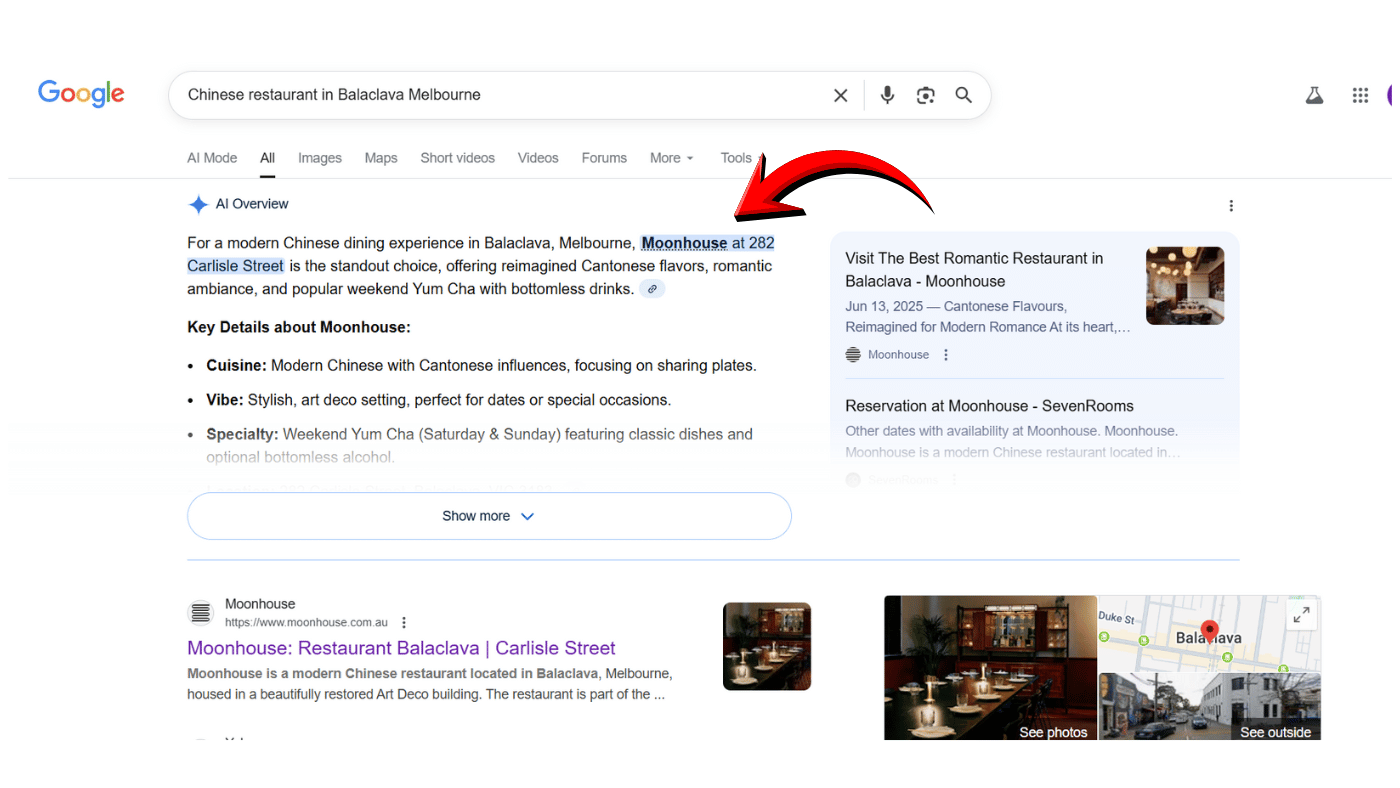
For example, let’s type “Chinese restaurant in Balaclava, Melbourne.” This is what Google’s AI overview provides as a summary answer.
As you can see, it gives a restaurant named “Moonhouse” as the answer for the “Chinese restaurant in Balaclava, Melbourne” search query.
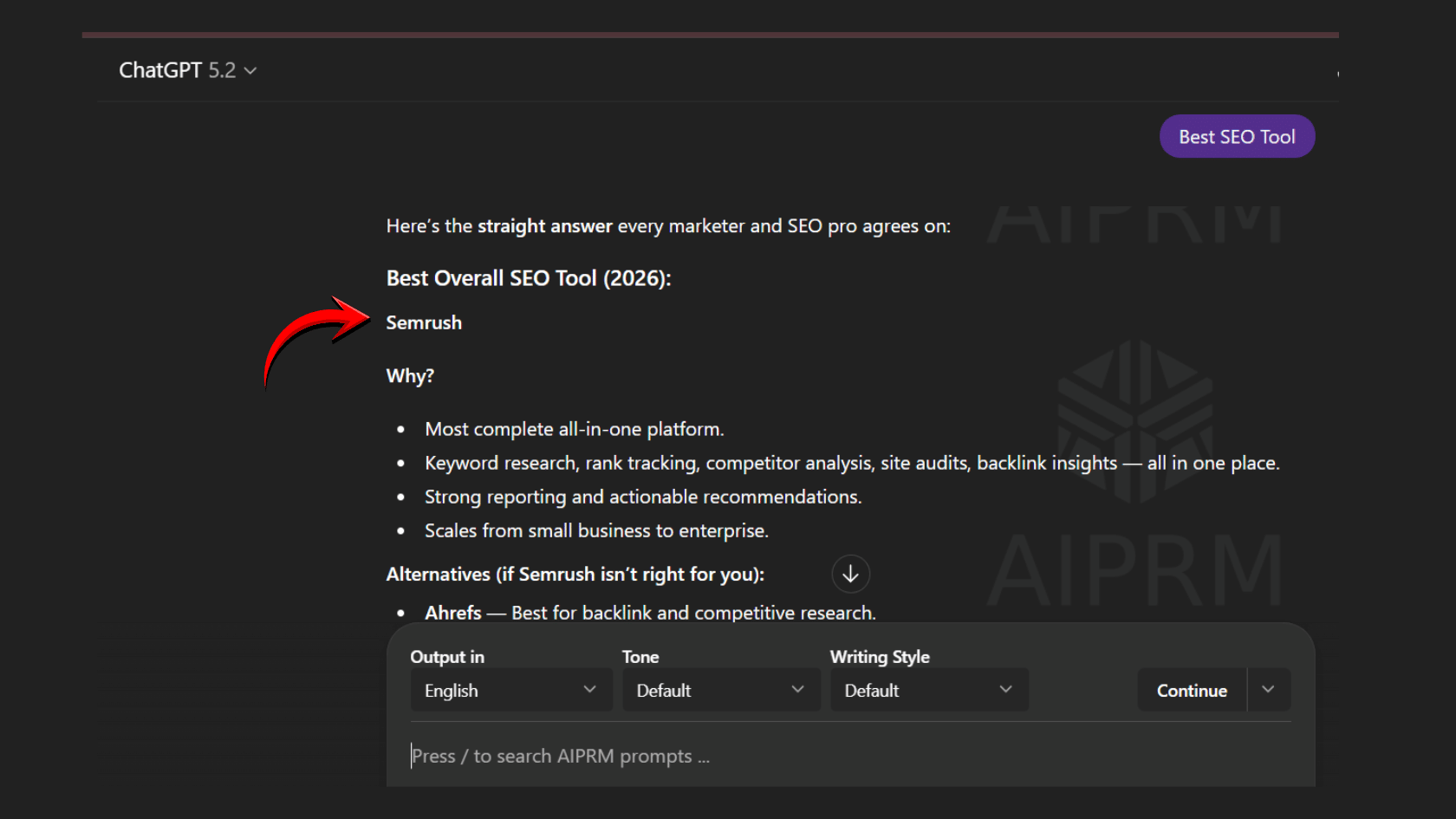
As another example, let’s ask ChatGPT, What is the best SEO Tool. The image below shows “Semrush” as the best SEO tool.
In simple terms, if you don’t appear in the LLM answers or citations, you are missing out on potential leads, conversations, and sales.
LLMs pull from vast amounts of crawled web content and reuse that information to generate answers. They don’t just rank pages the way search engines do. That changes the rules.
LLM visibility is no longer about where you rank. It’s about whether your brand, ideas, and expertise are used by large language models at all. If systems like ChatGPT, Claude, Perplexity, or Google AI Overviews don’t recognise you as a reliable source, you don’t appear in their answers. For the user, it’s as if you don’t exist.
This matters because usage is shifting fast. According to Coherent Market Insights, the global AI search engine market is projected to grow from USD 43 billion to USD 108 billion by 2032, driven by rapid adoption and a strong annual growth rate.
At the same time, research from Bain & Company shows that 80% of consumers already rely on AI-generated results for a significant portion of their searches, leading to a measurable drop in traditional organic traffic.
What I’ve seen is simple: when answers are delivered directly, visibility shifts from clicks to influence. If your content isn’t clear, identifiable, and usable by LLMs, you’re losing presence at the exact moment decisions are being shaped.
How to Optimize for LLM Visibility | Practical Strategies
1. Produce original content
Original content matters more than ever. From what I’ve seen, LLMs prefer content that adds something new, not content that repeats what already exists online.
Language models are more likely to use content that includes:
- Real numbers or statistics
- Direct quotes from people with experience
- Clear insights based on real situations
Businesses can do this without overthinking it. You can review trusted industry studies and explain what they mean in your own words. You can analyse your own internal data and share what you’ve noticed. You can also speak directly with senior leaders or frontline staff and turn their experience into clear, useful content.
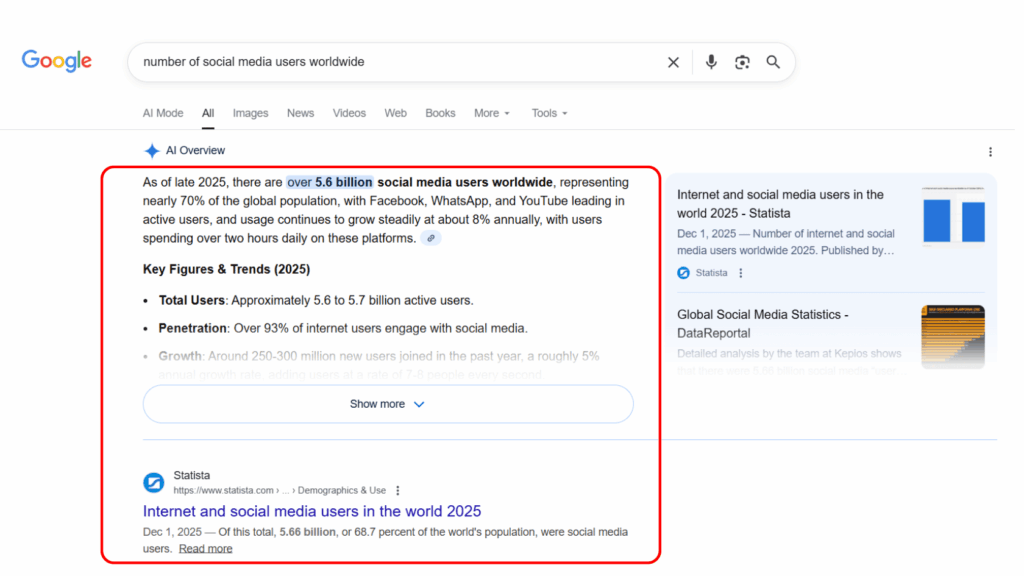
For example, check out how Google’s AI overview shows data from the Statista website as a result for the query “number of social media users worldwide.”
In practice, simple and original explanations are far more likely to appear in LLM responses than polished but generic articles.
2. Use natural, conversational language
LLMs tend to favour content that sounds like it was written by a real person. Clear explanations and natural wording work better than stiff or overly technical language. Repeating the same keywords over and over doesn’t help.
What I’ve noticed is that content written the way people actually speak is easier for LLMs to understand and reuse. Varying how questions and ideas are phrased makes a difference.
When you support your points with real research, examples, or short case studies, the content feels more trustworthy. That credibility helps both human readers and AI systems see your content as reliable.
3. Build off-site mentions
This is one of the most important things you can do to improve LLM visibility.
From what I’ve seen, LLMs don’t just learn about your brand from your website. They learn from how often you’re mentioned elsewhere, and in what context. If your brand keeps appearing in relevant discussions across the web, models are far more likely to recognise when to include you in their answers.
Research from Ahrefs, based on an analysis of 75,000 brands, supports this. They found that brand mentions across the web had the strongest link to visibility in AI Overviews. In simple terms, the more your brand is mentioned in the right places, the more likely it is to show up in AI-generated responses.
You don’t need to be everywhere at once. A smart starting point is to focus on platforms that LLMs reference. Across different models, the same types of sites come up again and again:
- User-driven platforms like Reddit and Quora
- Independent review sites such as G2 and CNET
- Video platforms like YouTube
Being active on these platforms matters. That means contributing genuinely helpful answers, creating useful videos, or encouraging customers to share honest reviews based on real experiences.
Once you step back, this isn’t a new trick. It’s simply good digital marketing done consistently. The difference now is that those efforts don’t just influence people, they influence the systems people rely on for answers.
4. Create LLM-preferred content
LLM-preferred content is content that AI systems can easily read, understand, and reuse in their answers. As AI-driven search tools like ChatGPT, Perplexity, and Google AI Overviews become more common, content needs to be clearer and more structured than before.
From what I’ve seen, LLMs consistently prefer content that is easy to scan and easy to summarise. That means clear headings, short sentences, bullet points, and numbered sections. Step-by-step explanations work well, not because they are clever, but because they remove ambiguity.
People also heavily use LLMs for comparisons before making decisions. Questions like “X vs Y,” “Is A better than B,” or “What’s the difference between X and Z” come up again and again. Content that lays out simple, side-by-side comparisons has a much higher chance of being reused.
One thing to remember: overly promotional content rarely gets picked up. If the tone feels biased or sales-driven, LLMs tend to ignore it. Clarity matters more than hype.
Question-and-answer content also performs well. FAQ sections, real examples, and short scenarios help LLMs explain concepts with confidence. Even basic before-and-after examples can be effective if they clearly show what changed and why it mattered.
Case studies add another layer of trust. They give your content real-world weight and show that your claims are based on experience, not theory. Over time, this kind of grounded content is far more likely to be cited than generic blog posts.
5. Enhance content with visuals
Visuals are often overlooked, but they play a growing role in LLM visibility. From what I’ve seen, content supported by clear visuals is easier for AI systems to understand and reuse, especially in environments like AI Overviews or ChatGPT.
Charts, diagrams, simple graphics, or even short interactive elements help explain ideas faster than text alone. They add context and make your content more memorable. In some cases, they also drive referral traffic when AI tools surface or reference visual sources.
The key is usefulness, not decoration. Visuals should clarify a point, show a comparison, or explain a process. When they do that well, they strengthen both human understanding and how LLMs interpret your content.
What doesn’t improve LLM visibility?
Over time, I’ve noticed that many well-intended efforts don’t translate into LLM visibility. Not because they are wrong, but because they were designed for an older version of search. Here is what doesn’t improve LLM visibility.
- Keyword stuffing and forced optimisation
Repeating the same keywords or phrases doesn’t help LLMs understand your content. In fact, it often does the opposite. Content written to “hit terms” instead of explaining ideas clearly tends to be ignored. LLMs look for meaning, not repetition.
- Overly promotional or sales-driven content
If a page reads like a pitch, it rarely gets reused. LLMs are cautious about biased sources. When everything is framed as “the best” or “leading,” the content loses credibility. What I’ve seen consistently is that neutral, experience-based explanations get cited far more often than marketing copy.
- Generic content that adds nothing new
Articles that rehash what’s already online don’t stand out. If your content could apply to any business in any industry, it’s unlikely to be reused by a language model. LLMs favour content that brings original insight, real examples, or a specific point of view shaped by experience.
- Thin content built for volume
Publishing large amounts of shallow content doesn’t improve visibility. LLMs don’t reward frequency. They reward usefulness. A single, well-explained page often performs better than dozens of lightweight posts.
- Unclear structure and long, dense paragraphs
Content that is hard to scan is hard to reuse. Long blocks of text without headings, lists, or clear sections make it difficult for LLMs to extract key points. If the idea isn’t easy to isolate, it’s less likely to appear in an AI-generated answer.
- Relying only on on-site optimisation
Focusing entirely on your own website limits visibility. LLMs learn from the broader web. If your brand isn’t mentioned elsewhere in relevant contexts, models have little reason to surface it in their responses.
Looking back, the pattern is consistent. Efforts that worked for traditional SEO alone don’t automatically carry over. LLM visibility improves when content is clear, useful, and reinforced by how others talk about you, not by how loudly you talk about yourself.
The risk of ignoring LLM visibility
This isn’t about panic. It’s about realism.
If your strategy still assumes every question leads to a click, you’re planning for a world that’s fading. I’ve seen businesses with excellent SEO foundations slowly lose influence without noticing, because their analytics still “look fine.”
But influence doesn’t always show up as traffic anymore.
If you’re not optimising for how language models consume and reuse information, you risk becoming invisible at the exact moment buyers are forming opinions.
The opportunity for early movers
The upside is that this shift rewards discipline.
From what I’ve seen, brands that communicate clearly, consistently, and practically are already benefiting, often without realizing it. Their explanations get reused. Their framing shows up again and again.
Early movers aren’t gaming anything. They’re simply writing like real experts for real people.
That’s why learning how to optimize for LLM visibility now creates leverage later. Once a model “knows” you, that recognition compounds.
Final thoughts
Looking back, the biggest shift isn’t technical, it’s behavioural. Visibility is no longer just about ranking and clicks. It’s about whether your ideas, explanations, and experience are trusted enough to be reused by AI systems that now shape how people make decisions.
Learning how to optimize for LLM visibility means thinking beyond traditional SEO. It means writing clearly, adding real insight, earning mention across the web, and structuring content so it can be understood and summarised without distortion. The businesses that adapt early won’t just protect traffic, they’ll protect influence.
The rules are changing quietly. Those who recognise it now will still be visible when others start asking why they disappeared.
If you want to understand how visible your brand really is inside AI-generated answers, now is the time to take a closer look.
At DigiFix, we help businesses assess how their content appears in large language models and reshape it so it’s clear, credible, and usable by AI systems, without losing its human voice.
If you’re ready to future-proof your content and stay visible as search continues to change, start with a conversation.
Frequently Asked Questions
- What is LLM visibility?
LLM visibility is about whether your brand, content, or expertise is mentioned or referenced in answers generated by large language models like ChatGPT, Perplexity, and Google’s AI Overviews. It goes beyond rankings and focuses on influence within AI-generated responses.
- How is LLM visibility different from traditional SEO?
Traditional SEO focuses on ranking pages to earn clicks. LLM visibility focuses on whether your content is used to generate answers, even when no click happens. Both matter, but they serve different purposes.
- Does LLM visibility replace SEO?
No. SEO is still important, but it’s no longer enough on its own. LLM visibility builds on SEO by ensuring your content is clear, trustworthy, and reusable by AI systems.
- What type of content performs best for LLM visibility?
Content that performs best is clear, original, and experience-based. Structured explanations, FAQs, comparisons, case studies, and real-world examples are more likely to be reused than generic or promotional content.
- Do off-site mentions really matter for LLMs?
Yes. LLMs learn from how often and where your brand is mentioned across the web. Mentions on forums, review platforms, and trusted third-party sites help models understand when and why to recommend you.
- Can small businesses improve LLM visibility?
Absolutely. You don’t need a large brand to be visible. Clear positioning, useful content, and consistent mentions in relevant spaces can make a significant difference, even for smaller businesses.
- How long does it take to see results?
LLM visibility builds over time. Unlike traditional SEO, there isn’t a single ranking to track. What you’ll notice first is your brand appearing more often in AI answers and comparisons as your content and mentions accumulate.
- How does DigiFix help with LLM visibility?
DigiFix helps businesses audit their existing content, identify gaps, and create LLM-friendly content that reflects real expertise. The focus is on clarity, credibility, and long-term visibility, not quick wins.