

Most business blogs are written on a hunch rather than on data, and it shows in the traffic numbers. SEO content built on keyword research starts from what people actually type into Google, not from what sounds good in a meeting. That single shift changes which pages get found and which ones sit quietly on page four.
Key Takeaways
- Almost all web pages, 96.55 percent, get zero search traffic from Google, usually because they target no real keyword at all.
- Search intent matters more than word count. A short page that answers the right question can outrank a long one that answers the wrong one.
- Fresh pages rarely rank fast. Only 1.74 percent of newly published pages reach the top 10 within a year, so topic selection has to be deliberate.
- Nearly 97 percent of clicks happen within the top 10 results, which means ranking twelfth is close to ranking nowhere.
- Mapping one primary keyword and a handful of related terms to each page avoids the common trap of several posts competing with each other.
- A content calendar built around researched keywords is easier to plan, easier to brief, and easier to measure than one built around guesses.
Melbourne business owners often ask the same question after months of blogging with little to show for it. Why isn’t anyone finding these posts. The honest answer is usually that the blog was never built on keyword research in the first place, so it was never aimed at a question people were searching for. SEO content built on keyword research flips that order. Research comes first, the brief comes second, and the writing comes last.
Why Guesswork Fails Even When the Writing Is Good
A well written paragraph with no demand behind it still gets no traffic. Ahrefs has found that 96.55 percent of all indexed pages receive zero organic search visits, and the usual cause is not bad writing. It is writing aimed at a topic nobody is searching for, or a topic so broad that a page can never compete for it.
Melbourne service businesses feel this acutely because local competition is specific. A generic post about marketing tips competes with the whole internet. A post built around a researched local keyword competes with a much smaller, much more winnable field.
If your blog has plenty of posts but little traffic to show for them, a short conversation can usually explain why. Book a free content review with DigiFix and we will walk through what is and isn’t being found.
What SEO Content Built on Keyword Research Actually Looks Like
In practice, it starts with a list of real search terms pulled from keyword tools, Google’s own autocomplete, and the questions customers ask on the phone. Each term gets checked for search volume, difficulty, and most importantly, intent. Is the person searching ready to buy, comparing options, or just learning.
Matching the keyword to the right page
A keyword with buying intent, such as a search including a suburb and a service, usually belongs on a service page. A keyword with learning intent, such as a how-to question, usually belongs on a blog post that can link back to that service page. Mixing the two up is one of the most common reasons content underperforms.
Avoiding keyword cannibalisation
When several posts chase the same term, they split the ranking signal between them instead of combining it. A proper keyword map assigns one primary term per page, with supporting terms folded in naturally, so every post pulls in the same direction rather than competing with its own siblings. If this sounds like a bigger job than you have time for, you can always ask DigiFix to map it out for you during a short, no obligation call.
The Keyword Research Process DigiFix Uses
Our SEO services start every content project the same way, with research before a single sentence is written. We pull search volume and difficulty data, check what is already ranking, and look for the gap a new or improved page could fill. Only then does a brief go to the writer.
We also check seasonal patterns using Google Trends, since some keywords spike around specific months and a post timed badly misses most of its potential audience. The chart below shows how that kind of trend data can shape a publishing calendar.

| Keyword Type | Typical Intent | Best Page Type |
|---|---|---|
| Service plus suburb | Ready to book | Service page |
| How to or what is | Learning | Blog post |
| Brand or competitor name | Comparing | Comparison post |
| Problem description | Early research | Guide or FAQ |
Swipe to scroll the table on mobile
How Search Engines Decide What to Rank
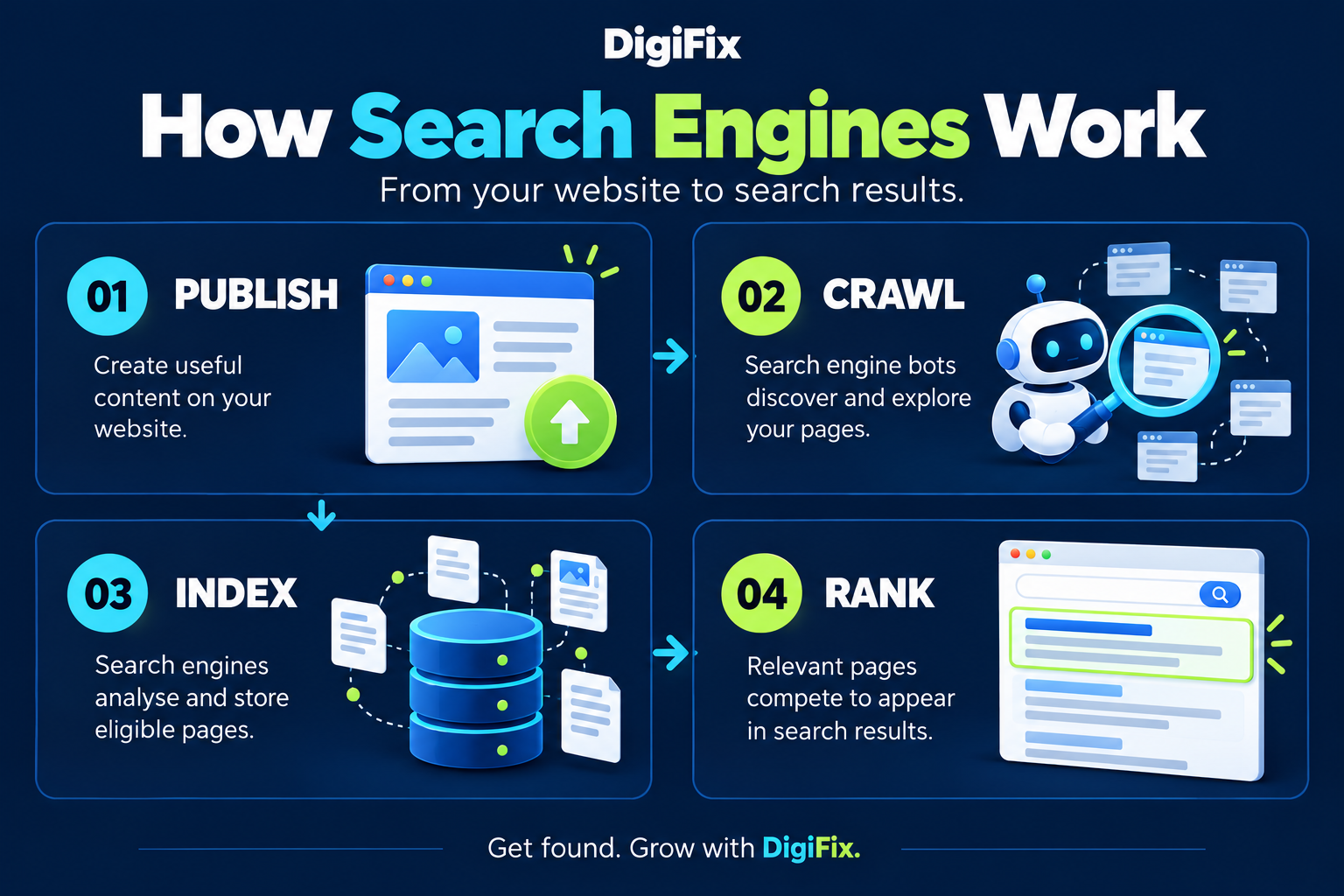
Understanding the mechanics helps explain why keyword research matters so much. Google has to publish, crawl, index, and then rank a page before anyone can find it, and each step favours content that clearly matches a real search term.
Research real search terms before writing anything.
Match each keyword to the page type that fits its intent.
Write, publish, then measure against the original search data.
The three step loop behind every piece of SEO content built on keyword research.
Not sure which of your existing posts are chasing the wrong keywords. Get a free keyword audit from DigiFix and find out before you write another word.
Common Mistakes We See in Melbourne Business Blogs
The same handful of mistakes come up again and again when a blog has no keyword strategy behind it. Topics are picked because they sound interesting to the business owner, not because anyone is searching for them. Posts are published once and never checked against performance data. And headings are written for style rather than for the words customers actually use.
DigiFix sees this pattern across almost every industry we work with, from tradies to clinics, and the fix is rarely a full rewrite. It is usually a realignment of the existing content around better researched terms.
Another common issue is writing a strong page and then forgetting about internal links entirely. A new post that never links to a related service page, or never receives a link from an older, stronger page, misses out on signals that could have helped it rank sooner. Internal linking is a small habit that compounds over a long content calendar, and it costs nothing extra once the keyword map already exists.
Our team at DigiFix has rebuilt content calendars for Melbourne businesses that had been blogging for years with almost nothing to show for it, simply by rebuilding the keyword map first.
Is Your Blog Built on Keyword Research or Guesswork
Tick anything that sounds like your current blog, then see where you land.
Whatever your score, the fix is the same. Go back to the keywords before you touch the content. DigiFix built this guide around that exact principle, and it is the same approach we use with every client we take on for ongoing SEO.
Turning Research Into a Publishing Schedule
Once the keyword map exists, scheduling content becomes far simpler. Each slot on the calendar already has a target term, a page type, and a rough word count, so writers are briefed instead of guessing. This is also where internal linking pays off, because every new post can point back to the SEO blog hub and relevant service pages.
Reviewing results every few months closes the loop. Posts that underperform against their original keyword target get updated or merged, rather than left to quietly sit on page four forever.
For a business covering several suburbs across Melbourne, the calendar can also be organised by location, so a service term gets its own properly researched page for each area that genuinely brings in enquiries, rather than one thin page trying to cover every suburb at once. That structure tends to perform better in local results and gives customers a page that actually answers their specific question.
It also makes briefing easier for anyone writing the content, whether that is an in-house marketer or an outside agency. A clear brief built from real search data takes the guesswork out of the writing process itself, which tends to produce more consistent results across a whole content calendar rather than one lucky post surrounded by several quiet ones.
Measuring Whether the Research Is Actually Working
Publishing a keyword researched post is only half the job. The other half is checking it against the numbers that justified writing it in the first place. Search Console data shows which queries a page is actually appearing for, and that list rarely matches the keyword guesses people make without research.
A page built around SEO content built on keyword research should start picking up impressions for its target term within a few weeks, even before it climbs into the top positions. If impressions never arrive at all, that is usually a sign the keyword was either too competitive or too small to matter, and the research step should be revisited before more time goes into writing around it.
Watching position, not just rank
A page sitting at position fourteen is invisible to almost everyone, since close to 97 percent of clicks happen within the top 10 results. Tracking average position over time, rather than checking once and moving on, shows whether a page is slowly climbing toward that visible zone or stuck where nobody will ever scroll to find it.
Updating instead of abandoning
Most keyword researched content does not need to be deleted when it underperforms. It usually needs a refresh, a clearer answer to the original search intent, an updated statistic, or a stronger internal link back to a relevant service page. Treating the keyword map as a living document, rather than a one-off exercise, is what separates businesses that keep improving their rankings from those that publish once and wonder why nothing changed.

For a Melbourne business trying to compete locally, this ongoing review matters even more, because local search results shift as competitors publish their own keyword researched pages. Staying still is rarely a neutral choice. It usually means slowly losing ground to whoever is reviewing their keyword data more often.
Want Your Next Twelve Months of Blogs Backed by Real Data
This consultation is completely free, with no obligation to sign up for anything. We will look at your current content and show you exactly where researched keywords could change the results.