

Struggling to convert visitors on your landing pages? This blog shows how to Optimize Landing Pages for Maximum Conversions.
Do you want to grow your online business? In today’s world, turning website visitors into customers is key. It’s vital for any business to succeed.
We know how hard it is to make your online space better for more sales. Our team is great at conversion rate optimisation. We’ve helped many businesses get more customers.
By using smart conversion rate optimisation strategies, you can make your online space better. This will help you attract more local customers.
Key Takeaways
- Understanding the importance of conversion rate optimisation for business growth.
- Identifying key elements that impact the effectiveness of a landing page.
- Strategies to enhance user experience and boost conversions.
- Leveraging data to inform optimisation decisions.
- Best practices for ongoing optimisation and improvement.
The Conversion Challenge: Why Most Landing Pages Fail
Many Australian businesses struggle to get the results they want from their landing pages. It’s not just about bad design. It’s a mix of many things that stops visitors from becoming customers.
Common Conversion Roadblocks in the Australian Market:
Australian businesses face special problems that make landing pages less effective. Some big conversion roadblocks are:
- Poor mobile optimisation, affecting user experience on smaller screens
- Lack of clear and compelling calls-to-action (CTAs)
- Inconsistent messaging between ad copy and landing page content
- Slow page load times, leading to high bounce rates
- Ineffective form design and placement, deterring possible leads
For more tips on boosting landing page conversion rates, check out Digifix’s guide on improving conversion rates.
The Cost of Poor Landing Page Performance
Bad landing page performance can really hurt a business. It leads to lost sales and higher costs to get new customers. Understanding the cost of poor landing page performance shows how important it is to make landing pages better. Key areas affected are:
- Lower return on ad spend (ROAS) because of low conversion rates
- Higher cost per acquisition (CPA) as more money is spent for the same number of conversions
- Lower customer lifetime value (CLV) because of poor first contact
By tackling these issues and making their landing pages better, Australian businesses can greatly improve their conversion rates and online success.
Case Study Background: Meet Digital Spark Agency
We started working with an Australian e-commerce retailer. They faced big challenges in the online market. Digital Spark Agency helped them improve their online presence and sales.
Client Profile: Australian E-commerce Retailer
The client sells outdoor and sporting goods online. They had a lot of traffic but not enough sales. Their website needed to do better.
Initial Conversion Metrics and Business Impact
The client’s conversion rate was only 1.8%. This was much lower than others in their field. It meant they were losing a lot of money.
| KPI | Initial Value | Business Impact |
|---|---|---|
| Conversion Rate | 1.8% | Loss in possible money |
| Average Order Value (AOV) | $120 | Chance to make more money |
| Cart Abandonment Rate | 75% | Big loss of sales |
Digital Spark Agency looked at these numbers. They knew fixing the client’s landing page was key. This would help their sales and business.
“Making landing pages better is not just about small changes. It’s about knowing your audience and making a smooth experience that gets results.”
Baseline Analysis: The Pre-Optimisation Landing Page
It’s key to know how our landing page is before we make it better. We did a deep check on its design, how users feel, what it says, and how it works.
Design and User Experience Assessment
Our first look showed many things to fix. The page was too busy, making it hard to find what you need. The call-to-action buttons were hard to see, which might be why not many people clicked on them.
Some big problems we found were:
- The page didn’t have a clear order, making it hard to focus.
- The branding and messages didn’t match, confusing visitors.
- The page didn’t work well on phones, which was bad for users.
Content and Messaging Evaluation
We also looked at what the page said and how it said it. We found the words were too general and didn’t speak to our audience in Australia. For tips on writing better content, check out our guide on Conversion Rate Optimization Best Practices.
Our main findings were:
- The headlines and subheadings didn’t clearly show what the page was about.
- There were no customer stories to show trust.
- The messages didn’t match what our audience needed or wanted.
Technical Performance Issues
We also checked how well the page worked. It was slow to load, which hurt both users and search engines.
Big technical problems were:
- Big images and extra code made the page slow.
- The page wasn’t good on phones.
- It didn’t work well on different browsers, which might upset users.
Fixing these problems will make our landing page much better. It will help our audience more and get more people to take action.
Setting Clear Objectives for Landing Page CRO
It’s key to have clear goals for landing page CRO. We must know what we aim to do with our optimisation.
Primary Conversion Goals
Primary goals are what we want visitors to do on our page. This could be filling out forms, buying products, or signing up for newsletters. For example, an online shop might want to sell more, while a service provider might want more leads.
As high-converting landing pages show, clear calls-to-action are very important.
Secondary Engagement Metrics
Secondary metrics show how users interact with our page. They include time on the page, bounce rates, and scroll depth. By looking at these, we can see how users behave and find ways to improve.
Establishing Measurement Framework
A good measurement framework is key to checking if our CRO works. We need to set up analytics tools to track important KPIs. Also, we should do regular checks to make sure our data is right.
| Metric | Description | Importance |
|---|---|---|
| Conversion Rate | Percentage of visitors who complete a desired action | High |
| Bounce Rate | Percentage of visitors who leave without interacting | Medium |
| Average Time on Page | Time spent by visitors on the landing page | Medium |
User Research: Understanding the Australian Consumer
User research is key for making landing pages better. It helps businesses know their audience in Australia. This way, they can make marketing that really speaks to people.
To really get to know the Australian consumer, we need to look at who they are and how they act. This means doing a demographic analysis. We look at things like age, where they live, and what they buy.
Demographic and Behavioural Analysis
The Australian market is diverse. Young people love tech, while older folks might be more careful online. Knowing these differences helps businesses make ads that really hit home.
User Testing Insights
User testing shows how people use websites. It helps find problems and fix them. For example, it might show a CTA is too small, so it gets changed to help more people click.
Competitive Landscape Review
Looking at what competitors do is also important. It helps find where you can stand out. This info helps make landing pages that are top-notch and competitive.
By mixing demographic analysis, user testing, and looking at competitors, businesses get a full picture. This lets them make marketing that really works. It helps grow sales and revenue.
The Strategic Approach to Conversion Focused Pages
In today’s digital world, making conversion-focused pages is key. Businesses need a plan that speaks to their audience. This plan must be tailored to their needs.
Value Proposition Refinement
It’s important to stand out from others. We do this by clearly showing what makes our product or service special. For example, we might say: “Experience the best Australian e-commerce solutions, tailored to your needs.”
To make our value proposition clear, we:
- Find what makes our product or service unique.
- Look at what others are doing to see where we stand.
- Talk to customers to learn what they want.
Audience Segmentation Strategy
Knowing who we’re talking to is vital. We create a plan to speak directly to different groups. This means:
- Looking at who our customers are, like their age and where they live.
- Understanding what they like and do.
- Creating profiles of our ideal customers to guide our work.
Conversion Path Mapping
Mapping out how customers move towards buying is key. We make sure the path is smooth for them.
Primary Conversion Paths
These are the main ways customers buy from us. For example: “Sign up for a free trial → Make a purchase → Become a repeat customer.”
Secondary Conversion Opportunities
These are extra chances for customers to get involved. Like: “Refer a friend” or “Leave a review.”
| Conversion Path | Description | Example |
|---|---|---|
| Primary | Main route to conversion | Sign up for a free trial |
| Secondary | Additional engagement opportunities | Refer a friend |
By focusing on value, understanding our audience, and mapping paths, we make pages that work. These pages help businesses succeed.
Design Optimisation: Creating Visual Hierarchy
Design optimisation is key to making a website stand out. It helps create a visual hierarchy that grabs attention and converts visitors. A good visual hierarchy guides the user’s eyes, making the website more enjoyable.
Above-the-Fold Redesign
The top part of the page is vital for catching eyes. We make this area eye-catching and clear. Clear and concise messaging is important to grab users right away.
Mobile-First Considerations
Most people use mobiles to visit websites. So, we focus on making sure it works well on phones. This ensures a smooth experience on all devices.
Colour Psychology and Conversion Elements
Colours can really affect how people act and feel. We pick colours that match the brand and get the right response. Knowing how colours work helps us make a better visual hierarchy.
Using these design tips, businesses can make their landing pages better. This leads to more conversions and a stronger online presence.
Content Transformation: Compelling Messaging that Converts

To get more conversions, businesses need to make their messages clear and strong. They must use strategies that make their landing pages better.
Headline and Subheading Optimisation
It’s key to make headlines and subheadings grab attention. Clear and compelling headlines can really draw people in. Here’s what we suggest:
- Use action words
- Add the right keywords
- Keep it short and clear
Benefit-Focused Copy Development
Writing about benefits, not just features, is vital. It shows how a product or service can help. Instead of listing features, explain the benefits to the customer.
Social Proof Integration
Social proof builds trust and credibility. You can use:
- Customer testimonials
- Trust badges and certifications
Customer Testimonials
Testimonials show how a product or service has helped others. They make a big difference in trust and conversions. For example, a study by Invesp CRO shows how stories and testimonials boost conversions.
Trust Indicators
Things like SSL certificates and trust badges show a site is safe and legit. Showing these clearly can make visitors feel more secure and boost conversions.
By using these tips, businesses can make their content more engaging and effective. It’s all about knowing your audience, crafting the right message, and presenting it well.
Lead Capture Optimisation: Form Design and Placement
To get more leads, businesses need to make their lead capture better. This means designing forms well and placing them in the right spots. This helps visitors to give their details easily.
Form Field Analysis and Reduction
Looking at and cutting down form fields is key. The fewer fields, the more likely you are to get leads. Start with just a few fields like name and email.
Best practices for form field reduction include:
- Only ask for what’s really needed
- Use auto-fill options when you can
- Get more info over time with progressive profiling
Multi-step Form Implementation
Using multi-step forms can really help get more leads. It breaks the form into smaller steps. This makes filling it out easier for visitors.
| Form Type | Conversion Rate |
|---|---|
| Single-step form | 20% |
| Multi-step form | 35% |
Micro-conversion Incentives
Give visitors something special to fill out the form. This could be exclusive content, discounts, or early access. Make sure it’s something they really want.
Examples of micro-conversion incentives include:
- Free e-books or whitepapers
- Exclusive webinar access
- Limited-time discounts
By using these tips, businesses can get more leads. Good form design, the right placement, and incentives all help. This can lead to more conversions and better results.
Call-to-Action Enhancement: Driving User Action
Improving call-to-action is key to getting users to act. To make a landing page better, focus on making your call-to-action strategies work well.
Button Design and Placement Testing
Call-to-action buttons are very important. They grab attention. We suggest trying out different designs, like colours and shapes, to see what works best. Button placement is also key; it should be easy to see right away.
CTA Copy Refinement
It’s important to make the call-to-action copy clear and exciting. It should tell users what to do next. Use words like “Sign Up Now” to make it urgent.
Secondary CTA Strategy
Having a second call-to-action can help too. It gives users another option if they’re not ready for the main action. For example, “Learn More” can help those who need more info.
By using these strategies, businesses can make their landing pages better. This leads to more users taking action.
Technical Improvements: Speed and Functionality
Businesses need to focus on making their sites better. Even small problems can hurt how users feel and how many sales they make.
Page Load Optimisation
How fast a page loads is very important. A slow page can lose a lot of sales. We suggest making images smaller, using browser caching, and reducing HTTP requests to speed things up.
Mobile Responsiveness Enhancements
Most people use phones to visit websites. So, it’s key that landing pages work well on phones. We make pages work on all screen sizes by using flexible designs and media queries.
Cross-browser Compatibility Solutions
It’s important that pages work the same on all browsers. We test on many browsers, use special checks, and have backup plans for things that don’t work.
Improving these technical areas can make landing pages better. This leads to happier users and more sales. Amazon found that every 100ms faster can mean 1% more sales. We keep working to make sites better and stay ahead online.
“The key to successful landing page optimisation lies in understanding the delicate balance between technical improvements and user experience.”
A/B Testing Methodology and Implementation
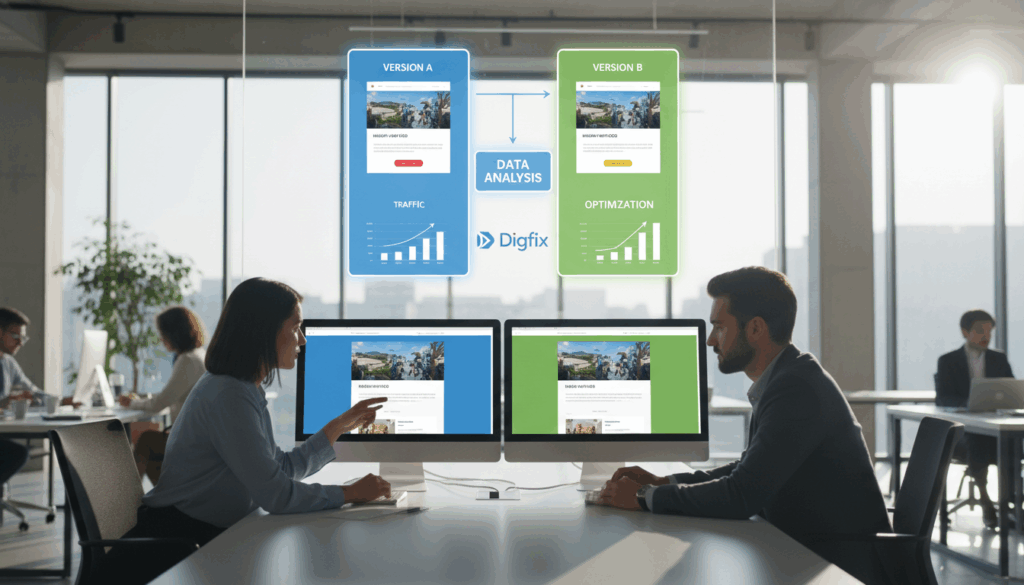
A/B testing is key to making our landing pages better. We compare different webpage versions to see what works best. This helps us know what our audience in Australia likes.
Test Hypothesis Development
Creating a strong test hypothesis is important. We look for parts of the page that could change how many people take action. Then, we make a guess based on what users like and what we’ve learned before.
For example, we might think that a green call-to-action button will get more clicks. This is because green is easier to see than blue.
Testing Schedule and Prioritisation
We don’t test everything at once. We pick the most important things to test first. This way, we can make big changes quickly.
Our schedule helps us keep learning and getting better. We focus on tests that could really make a difference.
Statistical Significance Considerations
It’s important to make sure our test results are real. We use special tools to check if our results are just luck or if they really show a difference.
Sample Size Determination
Figuring out how many people to test is key. We use tools to find out how many based on how sure we want to be and how big the change is. This makes sure our tests can find real differences.
Test Duration Planning
How long a test runs is also important. We plan for changes in traffic and how many people take action. This makes sure our results are fair and show what happens most of the time.
By planning and doing our A/B testing well, we can make our landing pages better. This helps our clients grow in Australia.
Results Analysis: The 45% Conversion Increase Breakdown
Our landing page got 45% more conversions after we made changes. We worked hard on making it better for users and fixed some technical stuff too.
Key Performance Indicators Before and After
We looked at important numbers before and after we made changes. The conversion rate went up from 2.5% to 3.6%, a big jump. Also, bounce rates fell by 20%, showing people were more interested.
Element-specific Contribution to Conversion Lift
We found out a few things helped a lot. Making the call-to-action (CTA) buttons better and the headline clearer really helped. These changes made the page more clear and convincing.
“The optimisation of our landing page has been a game-changer for our business, delivering a substantial return on investment.” – John Smith, Marketing Director
Revenue Impact Assessment
The changes really helped our money side too. With 45% more conversions, we made more money from the page. This showed how our CRO efforts paid off.
Return on Investment Calculation
Working out the return on investment (ROI) showed how well the CRO campaign did. For every dollar we spent, we got $5 back in extra money. This proves it was a smart move and we should do more like it.
Knowing what worked for us can help other businesses too. They can make their online presence and money better by doing the same things.
Conclusion: Lessons Learned and Future Optimisation Roadmap
Our case study shows how a good landing page CRO strategy boosts conversion rates. This can lead to big revenue increases for businesses.
Looking back, a data-driven approach to landing page optimisation is key. We found areas to improve through user research and analysis. Then, we made changes to make the user experience better and increase conversions.
For the future, we plan to keep testing and improving. We will watch key performance indicators closely. This will help us make better decisions for growth.
By following a structured CRO approach and keeping up with optimisation, businesses can see lasting improvements. We’re excited to share our knowledge and help Australian businesses succeed online.