
Last updated: October 2026.
Google voice search optimisation is the work of writing and structuring a page so it can be the single answer a voice assistant reads aloud. For an Australian business that means short direct answers, question shaped headings, strong local signals and content that already ranks in the top three results.
Key takeaways
- Around 20.5 per cent of internet users worldwide used voice search or voice commands in 2026, and 8.4 billion voice assistants were in use (Resourcera, Voice Search Statistics 2026).
- About 80 per cent of voice search answers are taken from the top three organic results, so voice visibility is earned by ranking first.
- The average spoken answer runs to about 29 words, which is the length to aim for in a snippet paragraph.
- 58 per cent of consumers have used voice search to find local business information, and 28 per cent called a business after finding it that way.
- Only 13 per cent of marketers actively optimise for voice search, which is the gap a well structured page can take advantage of.
If you would rather watch than read, this short DigiFix video walks through how a business gets picked up for voice searches on Google.
What is Google voice search?
Google voice search is the feature that lets someone speak a question into a phone, a smart speaker or a car and hear a single spoken answer back. The assistant does not read out a list of links, which is the part most business owners miss.
A spoken answer is normally lifted from one page, usually the featured snippet or the top organic result for that query. Google’s guidance on featured snippets and your website explains how those extractable passages are selected (Google Search Central, 2026).
The practical consequence for an Australian business is simple. Ranking position three or better and owning the snippet is what puts a business into a voice answer, and neither of those things happens by accident.
How many people use voice search in 2026?
Voice search is used by roughly one in five internet users worldwide, and assistants are now far more common than the devices that first introduced them. Usage has held steady in the low twenties as a share of internet users since 2022, which makes it a settled behaviour rather than a passing trend.
| Voice search statistic | Figure | Source |
|---|---|---|
| Internet users using voice search or commands, 2026 | 20.5 per cent | Resourcera, 2026 |
| Voice assistants in use worldwide | 8.4 billion | Resourcera, 2026 |
| Voice answers taken from the top three organic results | About 80 per cent | Resourcera, 2026 |
| Average length of a spoken answer | About 29 words | Resourcera, 2026 |
| Consumers who used voice search for local business information | 58 per cent | Resourcera, 2026 |
| Consumers who called a business after a voice search | 28 per cent | Resourcera, 2026 |
| Marketers actively optimising for voice search | 13 per cent | Resourcera, 2026 |
| Global voice commerce market by 2030 | $186.28 billion, from $42.75 billion in 2023 | Resourcera, 2026 |
| Google Assistant users in the United States | 88.8 million, ahead of Siri on 84.2 million and Alexa on 75.6 million | Resourcera, 2026 |
All figures above are drawn from the Resourcera voice search statistics report, which traces each figure back to its original survey. The same report notes that nearly 20 per cent of voice queries start with the same 25 keywords, which is a useful clue about what to write for.
Why do the top three results win voice answers?
Assistants need one answer, so they take it from the pages Google already trusts most for that query. With about 80 per cent of voice answers coming from the top three organic results, voice search behaves less like a new channel and more like a reward for strong conventional rankings.
That means the old idea of a separate voice search strategy is misleading. The work that wins a spoken answer is the work that wins a snippet, and a snippet is taken from a page that ranks on page one already.
| Typed query | Same question spoken aloud | What to write |
|---|---|---|
| plumber clayton | who is the best plumber near me in Clayton | A short answer naming the service and the suburb |
| seo cost | how much does SEO cost in Melbourne | A price range in one sentence, before the detail |
| cafe open now | is there a cafe open near me right now | Accurate opening hours on the site and the Google listing |
| voice search seo | how do I optimise my website for voice search | A direct how-to answer under a question shaped heading |
Wondering whether your pages are voice ready?
DigiFix will check which of your pages already qualify for snippets and voice answers, and tell you what to change first.
How do you optimise a page for voice search?
Optimising for voice search comes down to six changes that can be made on any page, and none of them require new technology. They are all about making one passage on a page easier for Google to lift and read out.
Write headings as spoken questions
Use the exact words a customer would say out loud as the heading, then answer underneath. A heading such as “how much does a heat pump cost in Melbourne” tells the assistant what the next paragraph is about, while a heading such as “pricing considerations” tells it nothing. Question shaped headings also match the way people speak to an assistant, which is the phrasing the query is matched against.
Answer in about 29 words
Spoken answers average about 29 words, so the first paragraph under a question should be complete, correct and roughly that length. Put the answer before the explanation, because any sentence that starts with context is a sentence the assistant cannot use. The rest of the section can then expand with detail, steps and evidence.
Use conversational long tail phrases
Voice queries are longer and more natural than typed ones, which is why a page built only around short keywords rarely wins a spoken answer. Write for phrases such as “best coffee in Clayton open on Sunday” as well as “coffee Clayton”. Because nearly 20 per cent of voice queries start with the same 25 words, phrases beginning with who, what, when, where, why and how are worth covering explicitly.
Win the featured snippet
The snippet is usually the passage the assistant reads, so it is worth structuring a paragraph or a short list specifically for it. Use a question heading, then a definition style sentence, then a short list or a compact table. Only 1.71 per cent of pages that win voice answers use the exact query in their title tag, which shows that clear structure matters more than repeating the phrase.
Keep the mobile page fast
Google indexes and ranks the mobile version of a page, so a slow mobile page cannot win a spoken answer however good the writing is. Google’s mobile-first indexing documentation states that the mobile version of the content is used for indexing and ranking (Google Search Central, 2026). Compress the hero image, remove render blocking scripts and test on a real phone.
Keep the page technically clean
A page that is not indexed cannot be spoken, so technical health is part of voice search work. Check indexing status, resolve redirect chains and keep one canonical URL per page. The full checklist sits in the technical SEO guide for beginners.
Rather have the optimisation done for you?
Voice search work sits inside the DigiFix range alongside SEO, local search and paid media, so the same fixes lift every channel.
How does local SEO change voice results?
Local search is where voice search pays a business directly, because most spoken queries have a place attached to them. With 58 per cent of consumers using voice search to find local business information and 28 per cent calling a business afterwards, the map pack and the Google Business Profile carry much of the value.
Three local signals do most of the work for voice answers.
| Signal | Why a voice assistant cares |
|---|---|
| Consistent name, address and phone number | The assistant has to be certain the business is in that suburb before it recommends it |
| Accurate opening hours and service area | Spoken queries are often asked in the moment, so wrong hours end the call |
| Recent reviews with local detail | Reviews are the clearest evidence a business really serves that area |
Note that Google My Business is now called Google Business Profile, and any older guide referring to GMB is describing the same listing under its previous name.
Do reviews affect voice search?
Reviews affect voice search indirectly but clearly, because they influence both map pack position and whether a caller trusts the recommendation. A business with 60 recent reviews outranks and outconverts one with 12 old reviews for the same suburb query, and the assistant draws on that local prominence.
The practical system is a request sent within a week of the job, by SMS or email, with a direct link to the review form. Review recency matters more than the total, so a steady monthly trickle beats a single burst that stops.
What structured data helps voice assistants?
Structured data helps by labelling content in a way a machine can read without interpreting it. The types that matter most for voice are Organization and LocalBusiness for the business itself, FAQPage where a page genuinely shows question and answer pairs, and Article for editorial content. Google’s speakable documentation describes the markup Google defines for content that is intended to be read aloud (Google Search Central, 2026).
Two rules keep structured data safe. The markup must match text a visitor can actually see, and there should only be one declaration of each type on a page. Rank Math already outputs a single connected graph on this site, so the correct approach is to add types through the plugin rather than pasting extra code. More detail is in the guide to using FAQs to improve SEO performance.
How is AI changing voice search?
AI assistants have made voice answers longer, more conversational and more likely to draw on several passages rather than one snippet. The same structural work still decides the outcome, because a system cannot quote a page it cannot crawl, index or read clearly.
Google’s guidance on AI features and your website confirms that AI Overviews and AI Mode are built on the standard Googlebot crawl and index, so nothing extra is needed there (Google Search Central, 2026). What changes is the value of a clear, self contained answer, because that is the passage a model can reuse without distortion.
What does this look like for a Melbourne restaurant?
The starting point
A Melbourne restaurant has a decent website, 40 Google reviews and an out of date menu page. It wants midweek bookings and has noticed that questions people ask a phone assistant rarely lead to its site.
What DigiFix would do, in order
- Rewrite the opening of each menu and booking page as a direct answer of about 29 words, in week one
- Add question shaped headings covering opening hours, parking, dietary options and group bookings, in week one
- Correct the opening hours on the site and the Google Business Profile so they match exactly, in week two
- Compress the menu and hero images so the mobile page loads quickly on a phone connection, in week two
- Add FAQ markup to the pages that show real questions and answers, in week three
- Set up an SMS review request after each booking, with recency reviewed monthly, in week three
What it costs to wait
Every “restaurants open near me” spoken query is answered from whichever listings Google trusts most for the suburb. A restaurant that never fixes its hours or its answer paragraphs keeps losing those bookings to venues that did, and the loss never appears as a single visible drop.
Is your business the one being recommended?
Bring your Google listing and your website to a short call and DigiFix will show you which pages can win a spoken answer, and in what order to fix them.
What other voice search questions do owners ask?
Is voice search actually worth optimising for?
Voice search is worth optimising for because the same work improves normal search results. Around 20.5 per cent of internet users used voice search in 2026, and about 80 per cent of answers come from the top three results. Since voice visibility follows conventional ranking and snippet quality, there is no separate cost to being voice ready.
Which keywords should I target for voice search?
Target the question phrases your customers actually say, not short keyword fragments. Phrases that start with who, what, when, where, why and how are the most common openings in voice queries, and phrases naming a suburb or a service convert best. One page should answer one main question and its close variations rather than a list of unrelated terms.
How long should a voice search answer be?
Aim for about 29 words for the direct answer, then expand underneath. Spoken answers average that length, so a paragraph of roughly two sentences is the most liftable shape. Anything longer still helps the page, but the first two sentences are what the assistant is most likely to read out.
Does a business need a smart speaker to benefit?
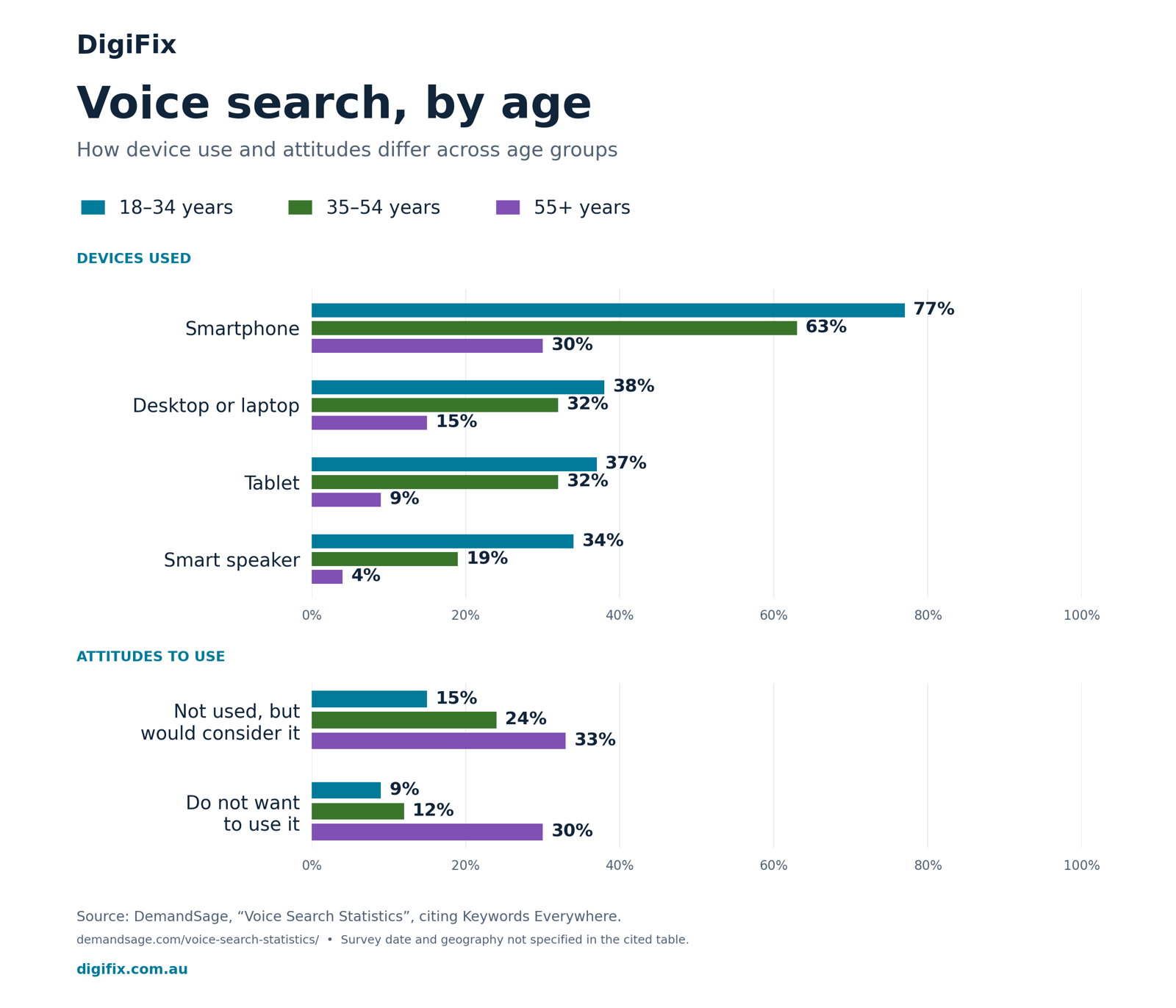
No. Most voice searches happen on a phone rather than a smart speaker, which is why mobile page quality matters most. Age data shows smartphone use for voice at 77 per cent among 18 to 34 year olds, well ahead of any other device. Optimising the mobile page covers the majority of voice traffic.
Can a small business compete with big brands in voice search?
A small business competes best on specific local questions rather than broad ones. A national brand rarely writes a precise answer for one suburb, one service and one situation, so phrases such as “emergency electrician Clayton Sunday” are winnable. That specificity is also the kind of query a phone assistant is most often asked.
How do I check whether I am in voice results?
Check three things: whether the page ranks in the top three for the spoken query, whether it holds the featured snippet, and how many calls and bookings arrive from organic search. Ask the question out loud on a phone and note who is answered, then compare that against Search Console for the same query. Repeat monthly rather than once.
Voice search rewards the same fundamentals as everything else in search: fast pages, clear answers and a trustworthy local presence. More worked examples sit on the DigiFix blog, the wider service range is under digital marketing services, and the SEO frequently asked questions guide covers the ranking fundamentals behind all of it. You can also read about the team behind the work.
Get a straight answer about your own site
Tell DigiFix what you sell and where you sell it. You will get a clear view of what is blocking your visibility and what it would take to fix it.