
As mid-sized business owners in Australia, we know how key it is to make smart choices. These choices help grow local customers and boost our digital footprint. But are you using the best tools to understand your online success?
Understanding and implementing Google Analytics 4 can change your business game. We’ll share our journey with Google Analytics 4 setup and custom reporting. You’ll learn how to improve your online presence.
Key Takeaways
- Understand the benefits of Google Analytics 4 for your business
- Learn how to set up GA4 effectively
- Discover the importance of custom reporting in web analytics
- Gain insights into boosting your local business’s online presence
- Maximise your online performance with data-driven decisions
The Evolution of Google Analytics to GA4
Google Analytics 4 (GA4) is the latest in digital analytics. It helps businesses understand their online presence better. GA4 is a more advanced platform for making data-driven decisions.
The move from Universal Analytics to GA4 is big. It changes how businesses see their customers and measure success online. Now, we can track user actions across different platforms and devices better.
Key Differences Between Universal Analytics and GA4
GA4 and Universal Analytics are very different. GA4 has a flexible data model for more customization and detailed insights. It tracks events, not just page views, for a deeper understanding of user actions.
| Feature | Universal Analytics | GA4 |
|---|---|---|
| Data Model | Session-based | Event-based |
| Cross-platform tracking | Limited | Enhanced |
| Machine Learning capabilities | No | Yes |
Why Australian Businesses Need to Migrate Now
Australian businesses must move to GA4 to keep up. Universal Analytics will soon stop working. Without migrating, businesses will miss out on important customer insights.
By switching to GA4, businesses can use advanced machine learning. They’ll get a deeper understanding of their customers.
Our Australian Client’s Analytics Challenge
We worked with an Australian business. They faced many analytics challenges. These made it hard for them to understand their online presence well.
The client was a mid-sized retail business. They wanted to know more about their customers’ online behaviour. Their main goals were to improve customer engagement and boost online sales.
Business Background and Digital Goals
The business was well-known offline but struggled online. Their website was complex with many products and a big inventory. This made tracking customer interactions hard.
They aimed to make the customer experience better, increase sales, and understand their online journey. They needed a strong analytics system to see how their website was doing.
Previous Analytics Setup Limitations
The client used Universal Analytics before. But it had big limits. It couldn’t track customer journeys well across different devices and platforms.
| Limitation | Impact |
|---|---|
| Lack of cross-device tracking | Inaccurate customer journey mapping |
| Limited data retention | Inability to analyse historical data |
| Insufficient event tracking | Incomplete understanding of customer interactions |
These limits gave them a broken view of their online performance. They couldn’t make good decisions. So, we moved to Google Analytics 4 (GA4) for a better solution.
Comprehensive Google Analytics 4 Setup Process for Local Businesses
We help local businesses set up GA4. We make a plan that fits their needs and goals.
Defining Measurement Strategy
Creating a good measurement strategy is key. It means finding the right KPIs for your business. We work with local businesses to find out what they want to achieve online.
This way, businesses get valuable data insights. These insights help them make better marketing choices and grow.
Setting Clear Business Objectives
Having clear goals is important for GA4. It means setting specific, measurable targets that match your business plan. We help businesses pick what’s most important and set up GA4 to track it.
With clear goals, local businesses can use GA4 to improve their online marketing. They can see real results.
Creating a GA4 Property for Australian Markets
Australian businesses need to create a GA4 property that fits their market. This means understanding what your local audience needs. Then, set up your analytics to match those needs.
Step-by-Step Account Creation
Setting up a GA4 property is easy when you break it down:
- Log in to your Google Analytics account and go to the Admin section.
- Click ‘Create Property’ and fill in your property details.
- Choose the right settings for data retention and user data collection.
- Set up your data streams for web, iOS, and Android app data as needed.
By following these steps, your GA4 property will capture the data you need.
Regional Configuration Best Practices
Setting up your GA4 property with regional best practices is key for market analysis. Here’s what to do:
- Set your timezone and currency to match your business location in Australia.
- Customize your data streams for different regional websites or apps if needed.
- Use Google Tag Manager to manage tracking codes across regions.
By using these regional settings, you’ll get clearer insights into your Australian customers. This will help improve your marketing.
Implementing GA4 Tracking Code
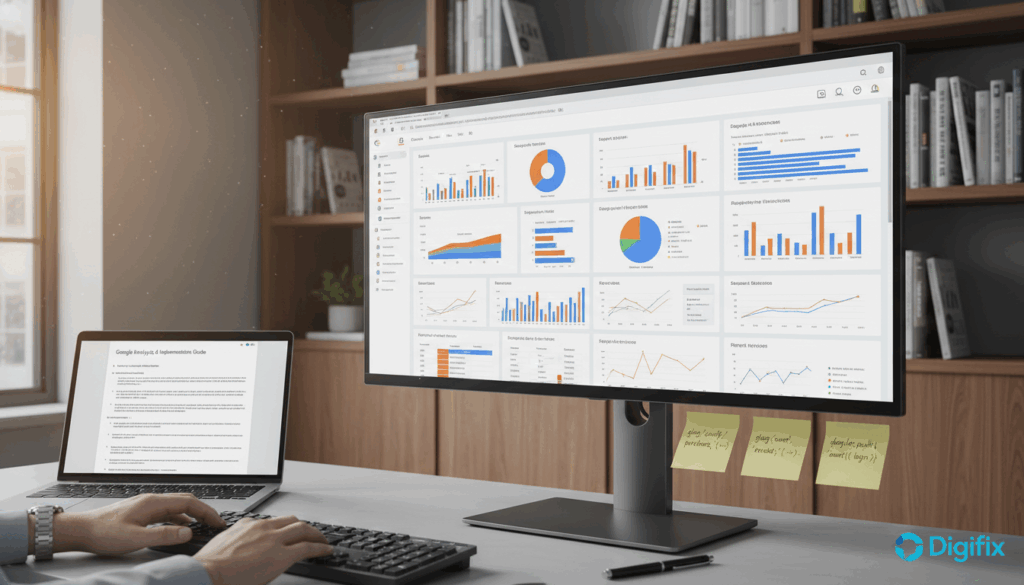
Setting up your Google Analytics 4 property is key. It lets you track your website’s performance and how users interact with it. You can use Google Tag Manager or add the code directly to your site.
Google Tag Manager Integration
Google Tag Manager (GTM) makes managing tags easy. It includes the GA4 tracking code. This way, you can update tags without changing your site’s code.
Container Setup and Organisation
To use GTM, create a container for your site. This means making a GTM account, setting up a new container, and adding the GTM code. Setting up your container right is key for good tag management.
Tag Firing Rules
After setting up your container, you need to set tag firing rules. This controls when your GA4 tracking code works. Getting your tag firing rules right is important for good data.
Direct Website Implementation
You can also add the GA4 tracking code directly to your site. This means putting the code into your site’s HTML. But, it can be harder to keep up with updates.
Choosing between GTM and direct implementation depends on your site and team. GTM is often easier to use for most businesses.
Event Tracking Configuration in GA4
GA4 helps Australian businesses understand how people use their websites. It tracks how users interact with your site or app.
Automatically Collected Events
GA4 tracks some events automatically. This gives businesses quick insights without a lot of setup. It tracks when a user first visits or starts a new session.
Enhanced Measurement Events
Enhanced measurement events give more details on user actions. You need to set this up in your GA4 property. It tracks scrolls, clicks, and site searches.
Custom Event Setup for Australian Market Needs
Custom events let businesses track specific actions. For Australian businesses, this might be local content or regional service conversions.
To set up custom events, use Google Tag Manager or add the GA4 code to your site. For example:
gtag('event', 'view_promotion', {
'promotion_name': 'Australia Summer Sale',
'creative_name': 'Banner Ad'
});
Using these event tracking tools, businesses can make better decisions with detailed data.
E-commerce Tracking Implementation
We set up e-commerce tracking in GA4 to understand customer interactions better. This lets us see how customers use our online store. We learn about product views and when they buy things.
With e-commerce tracking, we can make better choices for our digital marketing. We also improve how customers feel when they shop online.
Product Views and Shopping Behaviour
It’s important to track how customers look at products and shop. GA4 helps us see what products they like most. We also know how they move around our website.
This info helps us make our products better. We can also make shopping easier for everyone.
By looking at how people shop, we find problems. For example, if many people stop at a certain point, we can fix it.
Purchase Conversion Tracking
Tracking when people buy things is key for e-commerce. It shows us if our marketing works. We can see which ads or channels bring in the most sales.
This helps us spend our marketing money wisely. We can see if our efforts pay off. This way, we can make our online sales better and grow our business.
User Properties and Audience Configuration
Understanding user properties and audience configuration is key for Australian businesses. These features help us learn more about what customers like and do. This knowledge is vital for improving our marketing.
Defining Key User Segments in the Australian Market
It’s important to define key user segments for targeted marketing. We look at things like demographics, interests, or behaviours. For example, an e-commerce business might look at who buys what and where they are from.
To learn more about customising dimensions and metrics in GA4, visit our guide on setting custom dimensions and metrics.
- Demographic segmentation: age, gender, income level
- Geographic segmentation: region, city, country
- Behavioural segmentation: purchase history, browsing behaviour
Creating Targeted Audiences
Creating targeted audiences in GA4 helps businesses focus on specific groups. We can make audiences based on what we track in GA4. For example, we might target users who left their shopping carts or made a purchase recently.
To make good audiences, we need to think about what matters most for our business. This way, we can make our marketing better and engage more with our customers.
Data Stream Configuration for Multi-Platform Tracking
Businesses need to track user behaviour across many platforms. Google Analytics 4 (GA4) helps with this. It lets you see how users interact on your website, mobile app, and other digital places. This is key for understanding the customer journey in today’s digital world.
Web Stream Setup
Setting up a web stream is the first step for most businesses. You create a new data stream in your GA4 property. Then, you put the GA4 tracking code on your website. Using Google Tag Manager makes this easier and ensures the code works right.
Key considerations for web stream setup include:
- Make sure the tracking code is on all your website pages.
- Set up your data stream to get the data you need for your goals.
- Use Google Tag Manager to handle your tracking code and other tags.
App Stream Integration
For businesses with mobile apps, you need to integrate an app stream. This means installing the GA4 SDK in your app. Then, set up the app stream in your GA4 property. This way, you can track app launches, in-app purchases, and more. It’s important for understanding how users behave in your app.
The benefits of app stream integration include:
- Track how engaged users are in your app.
- See how well your in-app marketing works.
- Learn about user behaviour on both your website and app.
Challenges Faced During Our GA4 Setup

We faced many challenges while setting up GA4. Our work with Australian businesses showed us some big technical issues. These are important to talk about.
Technical Implementation Issues
One big problem was making sure data was right across all platforms. GA4’s new data model made us change how we track events and user properties. Setting up custom events to match our clients’ goals was hard.
Also, linking GA4 with other marketing tools was harder than we thought.
Solutions and Workarounds
We found ways to solve these problems. We used Google Tag Manager to make setting up custom events easier. This made our tracking setup more flexible and easy to keep up.
We also spent a lot of time testing our GA4 setup. This helped us find and fix any tracking problems.
Our experience shows how important planning and testing are with GA4. We hope our story helps other businesses with their GA4 challenges.
Custom Reporting Strategies in GA4
GA4 gives us lots of data. But, it’s how we use custom reporting that makes this data useful. In Australia, every business is different. So, we can’t just use one way to report.
To get the most from GA4, we must use custom reporting strategies that fit our business. We can use GA4’s advanced tools to make reports that show us important things about our business and customers.
Exploration Reports for Business Insights
Exploration reports in GA4 help us find new things about how people use our sites and apps. We can look at how users move through our site and find out where they stop. This helps us know how to make things better.
For example, we can see where people stop buying things. Then, we can make our site better to keep people buying.
Custom Report Templates for Local Market Analysis
Custom report templates in GA4 let us make reports that are just right for us. We can make templates that focus on things that matter to our Australian customers. This makes it easy to see how we’re doing in the local market.
Let’s say we make a report that looks at how many people buy things, how much they spend, and how long they stay with us. Looking at these numbers helps us understand our business better. This way, we can make smart choices to grow our business.
By using both exploration reports and custom templates, we can really make the most of GA4. We’ll understand our business in Australia much better.
Creating Business-Specific Dashboards for Australian Companies
Australian businesses need dashboards to make smart choices. We make dashboards that show how well a business is doing. This helps them make choices based on facts.
Choosing the right Key Performance Indicators (KPIs) is key. The KPIs should match the business goals and the Australian market.
Key Performance Indicators Selection
Australian businesses should pick KPIs that match their goals. For example, an online shop might look at sales, how much people spend, and keeping customers.
| KPI | Description | Relevance to Australian Businesses |
|---|---|---|
| Website Traffic | Measures the number of visitors to a website | Helps Australian businesses understand their online reach |
| Conversion Rate | Tracks the percentage of visitors who complete a desired action | Essential for measuring the effectiveness of marketing campaigns in the Australian market |
| Customer Acquisition Cost | Calculates the cost of acquiring a new customer | Crucial for Australian businesses to manage their marketing budgets effectively |
Visualisation Techniques for Stakeholder Reporting
After picking KPIs, it’s time to show the data clearly. Using charts, graphs, and heatmaps helps people get the message fast. For example, a bar chart can show sales trends, or a pie chart can show who the customers are.
As Google Analytics experts say, “Data visualisation is key to unlocking the insights hidden within your data.”
By using the right KPIs and visual tools, Australian businesses can make dashboards that help them grow.
Data Analysis and Web Analytics Reporting
GA4 lets businesses dive deep into data analysis and web analytics. This helps them understand their customers better. It makes decision-making and planning smarter.
Identifying Customer Journey Patterns
Knowing how customers move through their journey is key. GA4 tracks user actions across different points. This gives a full view of the customer path.
By looking at these patterns, businesses can spot where to get better. They can then make their marketing better to keep customers interested.
Conversion Path Analysis for Australian Consumers
Conversion path analysis in GA4 is very useful. It shows how Australian shoppers move through websites or apps to buy something.
| Conversion Path Stage | Australian Consumer Behaviour | Business Action |
|---|---|---|
| Awareness | High engagement with social media content | Enhance social media presence |
| Consideration | Frequent visits to product pages | Optimize product page content |
| Conversion | High cart abandonment rates | Implement retargeting campaigns |
By knowing these paths, Australian businesses can make their marketing better. This helps meet customer needs and boosts sales.
Integrating GA4 with Other Marketing Tools
By linking GA4 with our marketing tools, we get deeper insights into how customers behave. This helps us make our marketing better. It makes our marketing strategy stronger.
Google Ads Connection
GA4 and Google Ads work together to track ad performance well. This shows how Google Ads bring in website visitors and sales. For a step-by-step guide, check our resource page.
CRM Integration for Customer Insights
GA4 and CRM systems give a full view of customer interactions. This lets businesses see the whole journey of a customer. It’s from first contact to buying and after.
Email Marketing Platform Synchronisation
GA4 and email marketing platforms work together to analyse email campaigns. This helps businesses see how emails bring in traffic and sales. They can then make their email marketing better.
| Integration | Benefits |
|---|---|
| Google Ads | Precise ad performance tracking, attribution |
| CRM | Comprehensive customer journey tracking |
| Email Marketing | Analysis of email campaign effectiveness |
Conclusion: Data Insights and Lessons from Our GA4 Implementation
Our journey with GA4 has given us deep insights into how customers behave. This knowledge has helped us understand our customers better. We can now make smarter choices for our Australian business.
Setting a clear plan for measuring data from the start is key. This makes sure we get useful data. We also learned that setting up event and e-commerce tracking needs careful thought.
GA4 lets us see how customers interact with us across different platforms. By linking GA4 with Google Ads and CRM systems, we get a smooth flow of data. This boosts our marketing.
For Australian businesses, using GA4 is vital for growth and better customer interaction. Our story shows that with proper use, GA4 can help achieve these goals.