

Choosing the right topic for your blog is the first step towards creating engaging, high-quality content that attracts readers. In this blog, we will explain how to select a topic for your blog, from understanding your audience and tapping into your passion to utilizing SEO tools for better visibility.
Whether you’re a new blogger or looking to refine your content strategy, you’ll learn how to choose topics that drive traffic, engage your audience, and establish your authority. Let’s dive in!
Introduction: Why Topic Selection Matters?
Choosing the right blog topic is the first and most important step in creating a successful blog. It’s not just about picking something you’re interested in. The topic you choose has the power to shape your blog’s entire direction and success.
A great blog topic can significantly impact several key areas:
SEO (Search Engine Optimization):
The right blog topic helps you rank higher on search engines. By focusing on a topic that has strong search interest and integrating relevant keywords, you increase the chances of attracting organic traffic to your blog. A well-chosen topic will also allow you to write more targeted, SEO-optimized content, improving visibility in search results.
Audience Engagement:
When you choose a topic that resonates with your target audience, you’re more likely to keep them engaged. If the topic addresses their pain points, interests, or questions, readers will spend more time on your blog, share your content, and return for more. This engagement fosters a loyal audience base, which is crucial for long-term success.
Brand Authority:
Selecting a topic that aligns with your expertise or passion helps you build authority in your niche. Consistently publishing high-quality, relevant content will position you as an expert, leading to increased trust and credibility with your audience. Over time, this strengthens your brand and can even turn your blog into a go-to resource in your industry.
In conclusion, topic selection is the foundation of your blogging strategy. It influences everything from SEO rankings and audience engagement to how your brand is perceived. Getting it right from the start is essential for the long-term growth and success of your blog.
How to Select a Topic for Your Blog
1. Know Your Audience
Who Are You Writing For?
Understanding your target audience is the first and most crucial step in selecting a blog topic that resonates with readers. If you don’t know who you’re writing for, you risk choosing topics that don’t attract or engage the right people. Defining your audience helps you select a topic that resonates with their needs, interests, and challenges.
Key Characteristics to Define:
(a). Age: Understanding the age group of your audience helps determine the language and tone you should use.
Example: A younger audience (18-24) may prefer casual language, while an older audience (40+) may appreciate a more formal tone.
(b). Gender: While gender may not always be a defining factor, knowing your audience’s gender helps create content that appeals to their experiences or interests.
Example: A blog about skincare may focus on women’s products or concerns if that’s your target demographic.
(c). Interests: Knowing what your audience cares about or is passionate about helps narrow down blog topics.
Example: If your audience is passionate about fitness, a blog about healthy recipes or workout routines would be relevant.
(d). Problems and Challenges: The main reason people read blogs is to solve a problem or get answers to their questions. By understanding your audience’s pain points, you can create content that addresses these directly.
Example: Entrepreneurs may be struggling with how to market their businesses online, so your blog topic might focus on digital marketing tips for startups.
Building Audience Personas
An audience persona is a semi-fictional representation of your ideal reader. Creating personas helps you narrow down content ideas that appeal to your target audience’s needs, challenges, and goals.
Steps to Create an Audience Persona:
Name and Background: Give your persona a name and create a background. This makes them feel like a real person.
Example: “Sarah, the small business owner” or “Tom, the tech enthusiast.”
Demographics: Define the persona’s age, gender, occupation, education, etc.
Example: Sarah is a 35-year-old small business owner with a college degree who runs a bakery in a mid-sized city.
Interests: What are their hobbies, passions, or other areas of interest?
Example: Sarah is interested in cooking, local community events, and sustainable practices.
Pain Points: Identify what keeps them up at night or what challenges they are facing.
Example: Sarah struggles with attracting more customers to her bakery and wishes she knew how to do more effective social media marketing.
Goals: What does your persona want to achieve in the long term?
Example: Sarah wants to grow her bakery’s online presence and increase sales by 20% within the next year.
Example Persona:
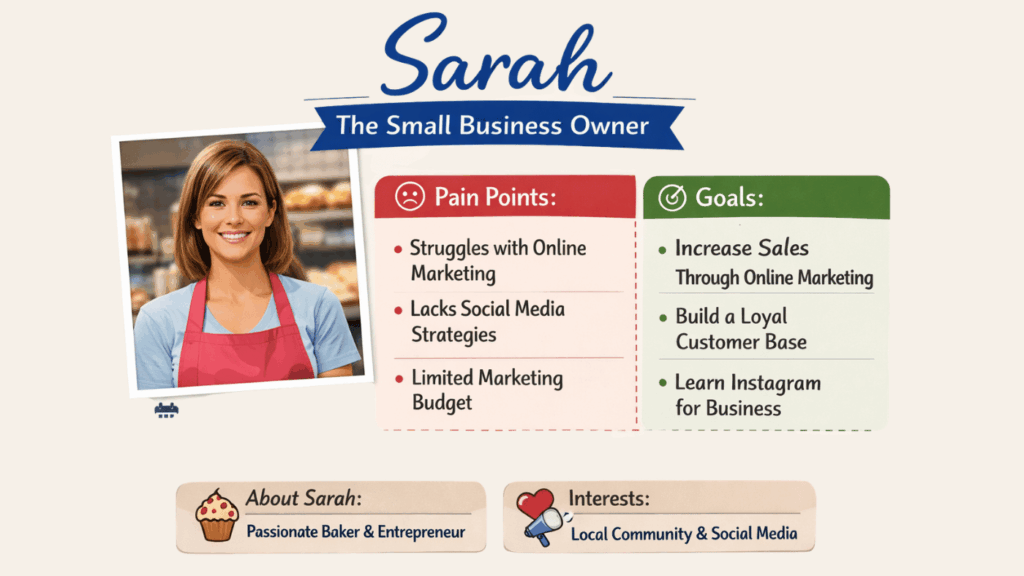
- Name: Sarah, the Small Business Owner
- Age: 35
- Occupation: Bakery owner
- Pain Points: Struggles with online marketing, lacks knowledge of social media strategies, and has a limited marketing budget.
- Goals: Increase sales through online marketing, build a loyal customer base, and learn how to use Instagram effectively for business.
How do These Personas Guide Topic Choice?
Once you have a clear understanding of your audience persona, you can use it to guide your blog topic selection. By focusing on what matters to your persona, whether it’s solving a problem, providing a useful tip, or offering solutions to their pain points, you can create content that resonates deeply with them.
For example:
- Sarah needs help with online marketing, so a blog topic like “5 Low-Cost Social Media Marketing Strategies for Small Businesses” would be a perfect fit.
- If your persona struggles with a particular aspect of their industry, you could create a blog post that addresses that specific challenge, such as “How to Manage Your Time as a Small Business Owner” or “How to Build an Effective Online Presence for Your Small Business.”
By aligning your content with the needs, goals, and challenges of your audience persona, you ensure your blog topics resonate and help build a strong connection with your readers.
2. Find Your Passion and Expertise
Write What You Love:
Passion is one of the most important factors for consistent and sustainable content creation. When you choose a topic you’re passionate about, writing becomes more enjoyable, and your enthusiasm will be evident to your audience. Writing about something you love also helps you maintain motivation, especially when faced with writer’s block or busy periods.
For example, if you love travel, your blog could focus on your experiences, tips, and travel guides. The content will flow more naturally because you’re sharing something that excites you. Your genuine interest in the topic will also resonate with readers, making them more likely to engage with your content and return for more.
Use Your Expertise:
In addition to passion, it’s essential to choose a blog topic that aligns with your expertise. Writing about topics you know well establishes your credibility and authority in that field. Readers are more likely to trust you and value your advice when they see that you have the knowledge to back it up.
For example, if you’re an expert in digital marketing, writing about strategies, tips, and case studies on online marketing will attract an audience looking for guidance. Your expertise not only strengthens your authority but also builds trust with your audience, which is crucial for growing your blog’s influence.
Align Passion with Audience Needs:
While writing about something you love is important, it’s equally crucial to make sure that your passion aligns with what your audience is interested in. You should choose topics that both excite you and meet the needs of your audience.
For example, if you’re passionate about photography, but your audience consists mostly of beginners, writing complex technical content may not be as effective. Instead, you could create blog posts that offer beginner-friendly photography tips, gear recommendations, and simple techniques. By combining your passion for photography with the needs of your audience, you provide content that is both enjoyable to write and valuable to your readers.
Ultimately, finding the balance between what you love and what your audience needs will help you create content that is both fulfilling for you as a creator and beneficial for your audience. This approach ensures that your blog not only reflects your interests but also provides real value to the people you’re trying to reach.
3. Research Popular Trends
Use Tools for Topic Research
To ensure your blog topics are relevant and timely, it’s essential to stay on top of current trends. Using tools designed for topic research can help you identify what’s trending in your niche and what your audience is talking about.
Google Trends: This tool helps you track the popularity of specific search terms over time. By entering keywords related to your niche, you can see which topics are currently gaining traction and whether they are growing or declining in interest. This is especially useful for identifying seasonal trends or topics that are spiking in popularity.
BuzzSumo: BuzzSumo analyzes popular content across social media platforms. You can search for specific topics and see which articles, blog posts, or videos are being shared the most. This gives you a sense of what’s resonating with your audience and helps you identify what content is getting the most attention.
AnswerThePublic: This tool generates a list of questions people are asking around a particular keyword. By using it, you can uncover common questions and problems in your niche, which can inspire blog topics that directly address what your audience is curious about.
By using these tools, you can track seasonal trends (like holidays, events, or specific industry cycles) and ongoing conversations. This helps you stay ahead of the curve and ensure your blog topics are fresh and relevant.
Check Competitors and Industry Leaders
Analyzing what your competitors and industry leaders are writing about can give you valuable insight into what’s working in your niche. Successful blogs often cover similar topics, but bring their unique perspective or provide more in-depth information.
- Identify Successful Blogs in Your Niche: Look for blogs that have a strong following and high engagement rates. Check what topics they’re covering, how often they post, and what their readers are commenting on or sharing. These are indicators of content that resonates with your target audience.
- Study What They’re Discussing: Take note of the themes, issues, and topics they focus on. Are there any common trends across these blogs? Do they focus on tips, tutorials, news, or product reviews? Understanding the types of content that perform well will help you align your blog topics with audience expectations.
- Find Content Gaps: Once you know what your competitors are writing about, you can look for gaps in their content. Is there something they haven’t covered well, or is there a different angle you can bring to the same topic? For example, if everyone is writing about “How to Start a Blog,” you could differentiate yourself by writing about “How to Start a Blog on a Budget.” Finding a unique angle will help you stand out and attract a dedicated audience who values your fresh perspective.
By researching what is already being covered and identifying what’s missing, you can position your blog in a way that offers unique value and captures the interest of readers who may feel like they’re not getting enough from existing content.
4. Utilize SEO and Keyword Research
The Role of SEO in Topic Selection
SEO (Search Engine Optimization) is a crucial aspect of topic selection because it ensures your content gets discovered by the right audience. SEO helps your blog appear in search engine results when users search for specific keywords or topics. The right blog topic optimized for SEO can drive significant traffic to your site, leading to more engagement and visibility. By targeting popular and relevant keywords, you ensure that your content aligns with what users are actively searching for.
When selecting a topic, it’s essential to think about how it will rank on search engines. Topics with high search volume (i.e., many people are searching for them) can lead to increased traffic. By choosing topics that are optimized for SEO, you position your blog to be found by your target audience when they search for relevant information.
Keyword Research Tools
There are several tools available to help you conduct keyword research, making it easier to find high-potential topics that are optimized for search engines. Some popular keyword research tools include:
- SEMrush: SEMrush is a comprehensive SEO tool that helps you search keywords, analyze competitors, track rankings, and discover content opportunities. It provides insights into search volume, keyword difficulty, and trends.
- Ahrefs: Ahrefs is another powerful SEO tool that helps you to find keywords, analyze backlinks, and track the performance of your content. It provides detailed data on keyword search volume and competition, which can guide you toward the best topics to target.
- Ubersuggest: Ubersuggest, created by Neil Patel, is a free tool that gives keyword suggestions, search volume, competition levels, and cost-per-click data. It’s a great tool for beginners to get into SEO.
- Google Keyword Planner: Google Keyword Planner is a free tool that shows search volume and competition for specific keywords. While it’s primarily used for paid search campaigns, it’s also a useful tool for identifying SEO-friendly topics for your blog.
These tools help you find popular and relevant keywords related to your blog niche. By targeting the right keywords, you increase the chances of ranking on search engines, which drives more traffic to your content.
If you have no idea what keywords are, refer to our blog article: What are keywords and how to use keywords
Use Search Volume and Competition Metrics to Identify High-Potential Topics
When performing keyword research, two important metrics to consider are search volume and competition:
Search Volume: This tells the number of people searching for a specific keyword each month. Higher search volume generally means more potential traffic for your blog, but it also means more competition. You’ll want to target keywords that are highly searched but still manageable for you to rank for.
Competition: This measures the number of other websites that are trying to rank for the same keyword. If the competition is high, it might be harder to rank for that keyword, especially if you’re just starting out. Look for keywords with moderate competition, which gives you a better chance to rank while still attracting traffic.
By considering both search volume and competition, you can identify high-potential topics that balance search demand with achievable rankings.
Long-Tail vs Short-Tail Keywords
Keywords come in two main types: long-tail and short-tail. Understanding the difference between these types will help you target the right topics for your blog.
Short-Tail Keywords: These are broad and generic keywords, typically made up of one or two words. They have high search volume but also come with high competition. Examples include:
“Digital marketing”
“Fitness tips”
“Healthy recipes”
While these keywords are widely searched, they are difficult to rank for because so many other websites are targeting them. If you target these keywords, you’ll face significant competition from established sites.
Long-Tail Keywords: These are more specific phrases that usually contain three or more words. They have lower search volume but are much easier to rank for because they are more targeted. Examples include:
- “Best digital marketing strategies for startups”
- “Beginner fitness tips for women over 40”
- “Easy healthy recipes for busy professionals”
Long-tail keywords initially may bring in less traffic, but they attract more qualified and engaged visitors. People who search for long-tail keywords tend to know exactly what they’re looking for, meaning they’re more likely to engage with your content.
By using a combination of long-tail and short-tail keywords, you can create content that targets both broad and specific search queries. For instance, you might write a blog post on “Best digital marketing strategies for startups” (long-tail keyword) to attract a more niche audience, while also writing broader posts like “digital marketing” (short-tail keyword) to reach a larger audience.
Conclusion: Start Your Blog with Confidence
Choosing the right blog topic is essential to the success of your blog. By following these key steps, you can ensure that your content resonates with your target audience and stands out in a crowded space:
- Know Your Audience: Understand who you are writing for by defining their age, gender, interests, and pain points. Creating an audience persona can help guide your content creation.
- Find Your Passion and Expertise: Write about topics that you love and that align with your expertise. This will keep you motivated and help build credibility with your audience.
- Research Keywords and SEO: Use tools like SEMrush, Ahrefs, and Google Keyword Planner to find keywords with high search volume and low competition. This will help your blog rank well on search engines.
- Validate Your Topics: Engage with your audience through surveys or social media to ensure your topic is relevant and in demand. Checking your competitors’ content can also help you identify market gaps.
- Avoid Over-Saturated Content: Find unique angles or niches within popular topics. Offering a fresh perspective will help you stand out from the competition.
Now that you have the roadmap for selecting the right blog topic, it’s time to take action! Start researching your blog topics today, and validate your ideas with your audience to ensure they are interested in what you have to say.
By following these steps, you’ll be on your way to creating engaging, high-quality content that resonates with your readers and helps you grow your blog’s traffic and influence.
Boost Your Online Presence with SEO-Optimized Blog Content
Struggling to come up with blog topics or write SEO-friendly content? At DigiFix, we understand how overwhelming it can be to create engaging and optimized blog posts. That’s why we’re here to help!
Our team of experts specializes in crafting high-quality, SEO-optimized blogs tailored to your business goals and audience. We ensure that every blog post not only resonates with your readers but also ranks high on search engines, driving traffic and boosting your online presence.
Don’t let content creation hold you back; let DigiFix take the stress out of blogging. Contact us today for a free consultation and let us help you create content that works for your business!