

Google August 2026 Spam Update Has Finished Rolling Out: What To Check Now
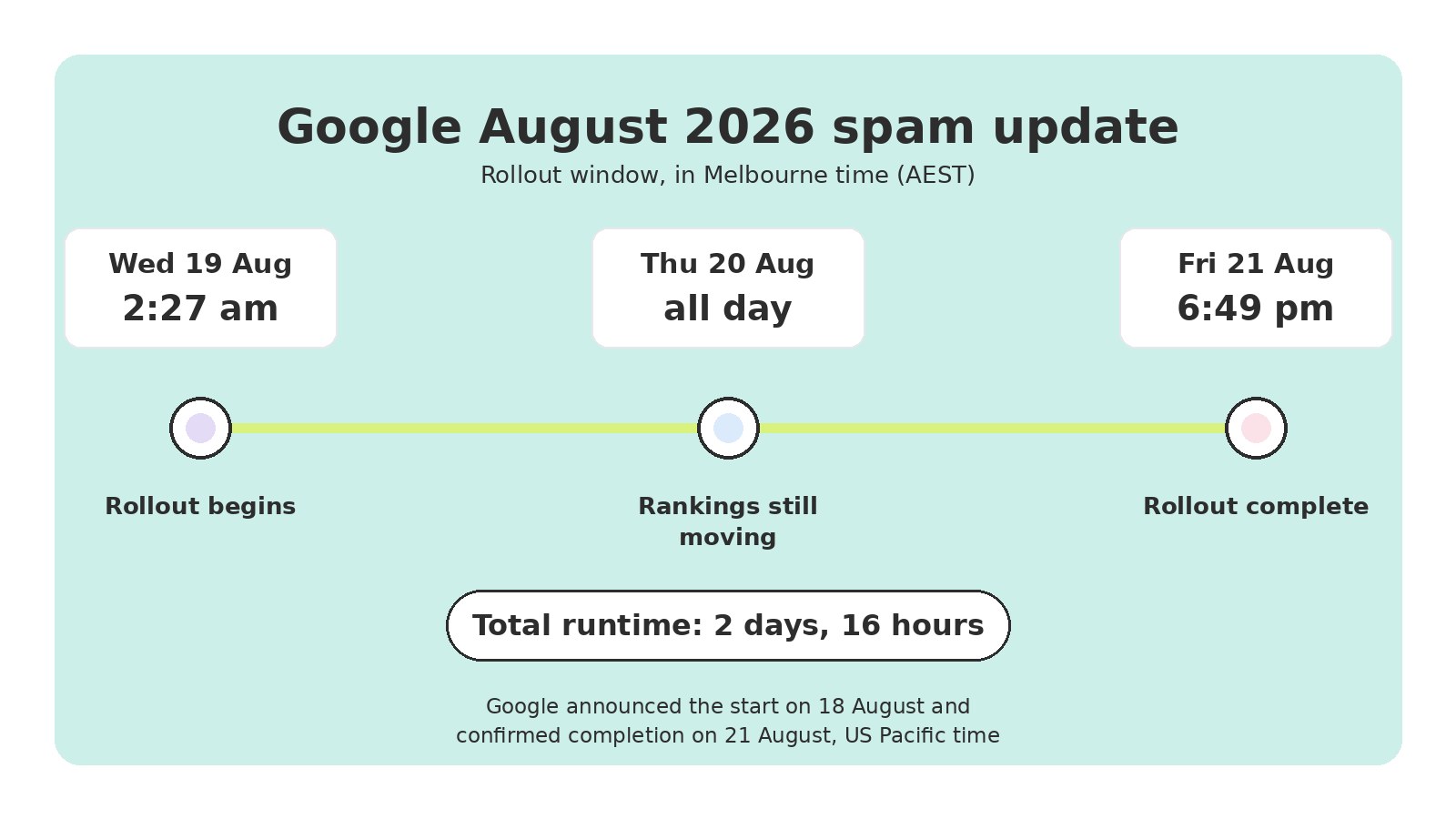
The Google August 2026 spam update finished rolling out on 21 August, which means the ranking changes you are looking at are now the finished picture rather than a work in progress. It ran for two days and 16 hours. In Melbourne time that is 2:27 on Wednesday morning, 19 August, through to about ten to seven on Friday evening, 21 August.
Most businesses reading this were not hit. That is worth saying plainly, because the week of an announced update generates a lot of panic that has nothing to do with the update. Google did not publish a new rule, did not release a blog post alongside it, and would not say what share of searches moved.
What follows is what Google confirmed, what it ruled out, and the specific reason a lot of the “before and after” comparisons being posted this week are measuring the wrong thing.
Key takeaways
- The August 2026 spam update ran from 18 to 21 August US Pacific time, a total of two days and 16 hours. Google confirmed completion on 21 August.
- It is the third spam update of 2026, after March and June. No new spam policy was published with it.
- Google says it does not specifically target link spam or the site reputation abuse policy, which points the diagnosis at content-level tactics instead.
- A separate Search Console logging error under-reported impressions from 13 to 17 August, so that week is a bad baseline. Compare clicks.
- Algorithmic spam demotions do not have a reconsideration request. You fix the problem, then wait for a refresh, which Google says can take many months.
What Google actually said, and what it left out
Google logged the release on its Search Status Dashboard on 18 August at 9:27 am Pacific and posted the note a minute later. The wording was about as plain as Google gets: the August 2026 spam update, global, all languages, a rollout expected to take a few days. On 21 August it marked the incident complete. On LinkedIn the company described it as a normal spam update and pointed people at the existing spam updates help document.
That is the entire official record. No accompanying blog post. No new policy type. No figure for the percentage of queries affected, which Google declined to give when asked.
The duration is more interesting than it looks. This is the third announced spam update of 2026 and the slowest of the three, but only in the way that a three minute mile is slow. March finished in 19 and a half hours, the fastest rollout ever recorded on the dashboard. June took two days and one hour. August took about 15 hours longer than June. Compare that with the August 2025 spam update, which ground on for 26 days. Google has clearly got faster at pushing these through, and the practical consequence for you is that the window where your data is unreadable is now short.
Swipe sideways to see the full table on mobile
What the update targets, and what Google ruled out
A spam update improves how Google’s automated systems catch tactics that already break the published spam policies. Nothing new was added to that rulebook in August. The rules you were measured against on 22 August are the same rules that were sitting on the same page in July.
Two exclusions matter, because they narrow the diagnosis considerably. Google confirmed that this update does not specifically target link spam, and that it does not target the site reputation abuse policy, the one that covers third party content parked on a strong domain. So if your working theory is a dodgy link package someone sold you in 2023, this update is probably not your answer.
That leaves the content-level side of the policies. In practice, the things worth auditing your own site against are scaled content abuse, doorway pages built for suburb after suburb with the name swapped out, cloaking, thin affiliate pages, expired domain abuse and sneaky redirects. Read the list properly rather than skimming it.
The doorway page one catches out a surprising number of otherwise legitimate Australian service businesses who were told years ago to build a page for every suburb they service and did exactly that, forty times, with nothing changed but the heading. There is a right way to do suburb-level coverage, and it is what our local SEO services in Melbourne are structured around.
Worth being blunt here: mass produced content is not automatically spam because a tool helped write it. Google’s position is about whether pages were produced at scale primarily to game rankings rather than to help anyone. A hundred near identical suburb pages fail that test whether a human or a model typed them.
The turbulence before 18 August was not this update
Plenty of people watched their rankings lurch around in the first half of August, then saw the announcement and concluded Google had quietly started early and only told everyone later. Asked about exactly that on LinkedIn, Google’s John Mueller said the opposite: “We don’t roll them out beforehand.” Google aims to announce as close to the moment of release as it can, allowing for time zones.
This is not a small distinction. If you label the first fortnight of August as your “pre-update” baseline and treat every wobble in it as evidence of the spam update, you will end up rewriting pages that were never the problem. Something moved in early August. It was not this.
The measurement trap sitting directly before the rollout
Here is the part almost nobody covering this update has mentioned, and it is the one most likely to cost you a bad decision.
Google’s own Search Console data anomalies page records a logging error that under-reported impressions on the Generative AI performance report in Search, for data from 13 to 17 August 2026. A related error knocked clicks and impressions off the Discover performance report for 13 August. Google’s wording on both entries is that the issue affects data logging only. Mueller described it as a logging problem rather than any change in visibility.
Look at those dates against the rollout. The bug window closes on 17 August. The update starts on 18 August. The exact stretch of data that a sensible person would use as their “before” picture is the stretch that was being logged incorrectly, which means any comparison drawn from the Generative AI report will exaggerate a recovery or invent a drop that never happened.
Three practical consequences. Compare clicks rather than impressions, because clicks were not the metric affected. Baseline on core Search data, not the Generative AI report. And remember that Search Console runs on US Pacific time, so the “21 August” in your date picker is not the same 21 August you lived through in Melbourne.
If reading this is already making you want to check something and you would rather not do it alone, we run this kind of diagnosis for Melbourne businesses as a one off, and the first conversation is a free consultation with no obligation attached.
Before you screenshot a graph for your board pack
Two separate events landed five days apart, and they call for opposite responses.
13 to 17 August: a Search Console logging error. Reporting defect. Do nothing to your site.
18 to 21 August: the spam update. A real ranking event. Worth investigating if clicks moved.
How to tell whether you were actually hit
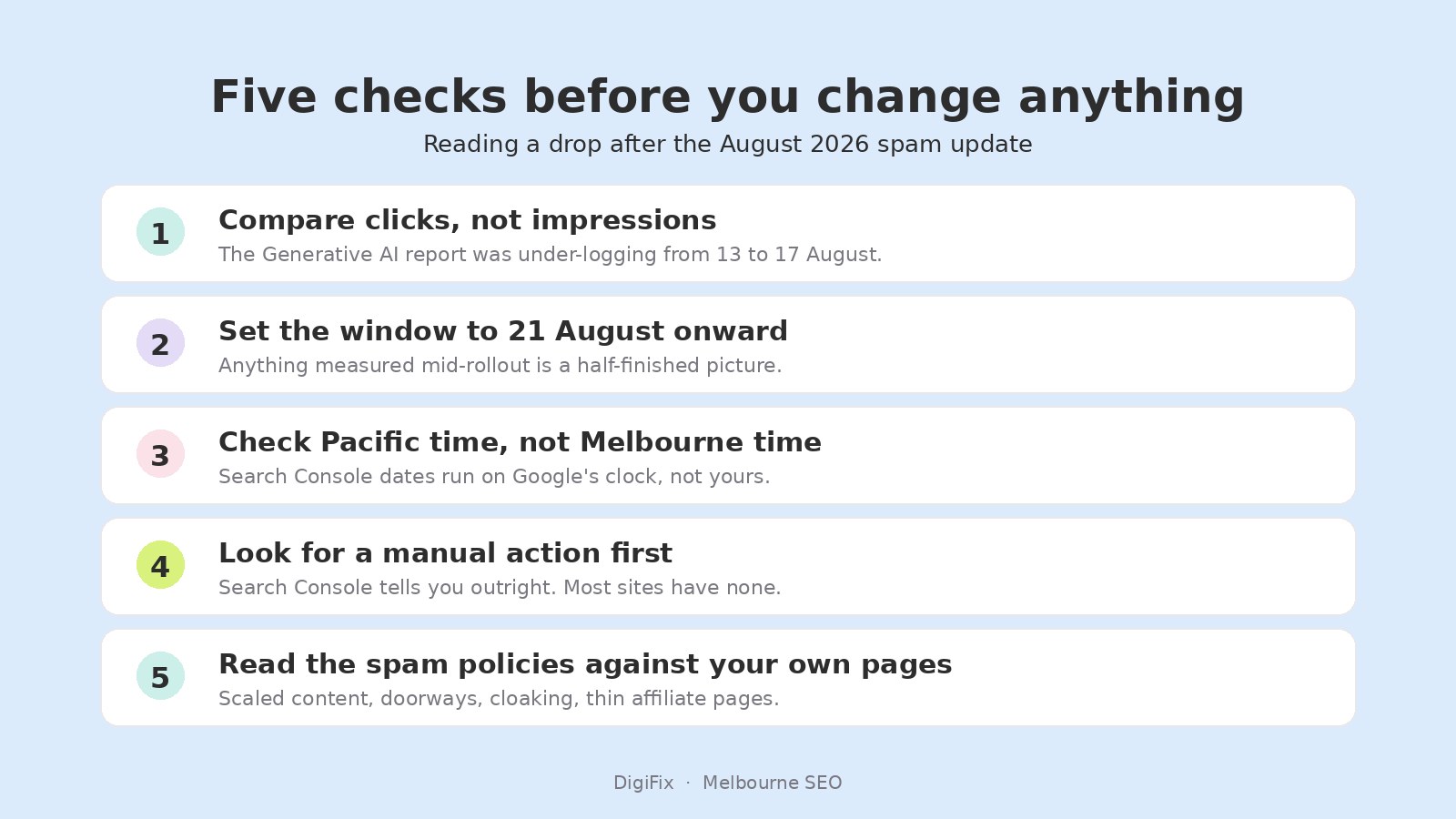
Work through these in order, and resist changing anything on the site until you have finished all five.
Start with the manual actions report in Search Console. If Google has taken manual action against your site, it tells you outright and names the reason. Most sites have nothing there, and if yours is clean you can rule out the loudest possible cause in about thirty seconds.
Then set your comparison window properly. Anything you measured between 18 and 21 August is a half finished rollout, so exclude it. Read from 21 August onward, on the Pacific dates Search Console uses, and baseline on data through 17 August at the latest.
Next, look at clicks by page rather than sitewide traffic. Spam demotions tend to be uneven. A whole site sliding gently is more often a core update pattern or a seasonal one. A specific cluster of pages falling off a cliff while the rest of the site holds steady is the shape worth investigating.
Then check whether your competitors moved too. If the three firms you usually trade places with all dropped on the same day, you are looking at a query level shift, not a site level penalty.
Finally, read the spam policies with your own site open in the next tab. Not as a hypothetical. Page by page, on the pages that lost the clicks. The on-page SEO checklist on our blog is a reasonable reference for what a compliant page looks like while you work through them.
Which of these describes your drop?
Pick the line that matches what you are seeing, then open it for a read on the likely cause.
Not sure whether that dip is real?
Book a free 30 minute consultation with Nel. We will open your Search Console together, separate the logging bug from the ranking change, and tell you straight whether there is anything to fix.
Book your free consultationWhat recovery actually involves
This is the part people find hardest to hear. An algorithmic spam demotion has no appeal process. There is no form, no reconsideration request, no one to email. Google’s guidance is to review the spam policies, comply with them, and wait. The systems reassess when Google runs a refresh, and Google says outright that recovery can take many months.
Which changes the order you should do things in. Fixing the site quickly does not buy back your rankings quickly, so there is no advantage in a panicked weekend of deleting pages. There is a real disadvantage in deleting the wrong ones, because you cannot tell whether a removal helped until the next refresh lands, by which time you will have made forty other changes and lost the ability to attribute anything.
Do it properly instead. Inventory the pages that lost clicks. Decide, page by page, whether each one exists to help somebody or exists to catch a query. Consolidate the near duplicates into one page that is genuinely better than either. Remove what has no reason to exist. Document the date you made each change so that when a refresh does arrive you can read the result.
Then keep publishing. Sites that go quiet after a demotion tend to stay demoted, not because silence is penalised but because the competitors who kept working have moved further ahead by the time the refresh comes around.
Spam update or core update, and why the difference matters
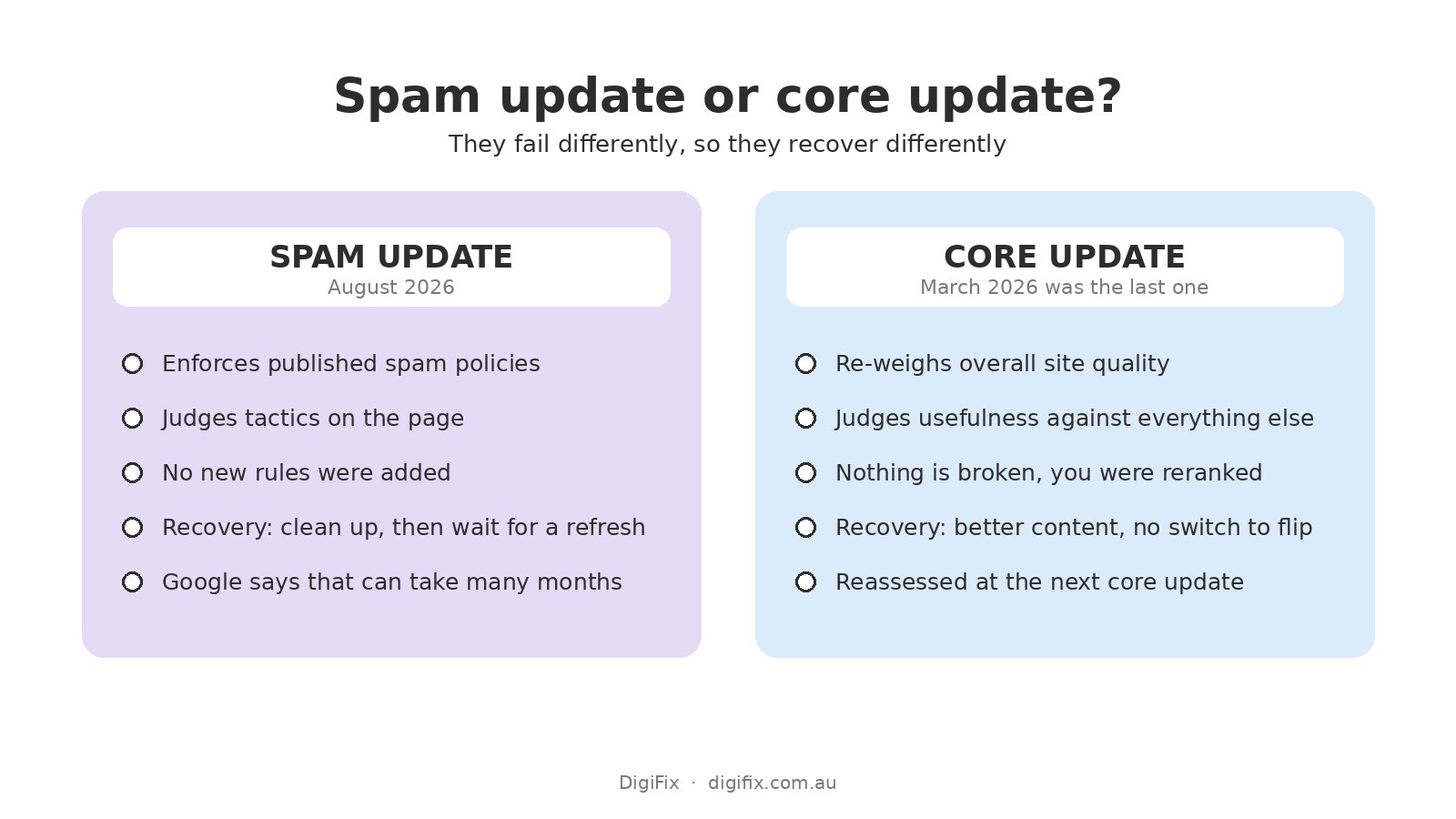
These two get used interchangeably and they are not the same thing. A core update changes how Google weighs overall usefulness and quality across the board. A spam update sharpens the enforcement of rules that were already published. One is a rerank, the other is closer to a rule breach.
The practical difference is what you do next. If a core update moved you, nothing is broken. You were reassessed against everyone else and came out lower, so the work is making the content genuinely better and waiting for the next core update to reassess you. If a spam update moved you, something on the site is tripping a policy, and the work is finding it and removing it.
Getting this wrong costs months. Rewriting perfectly compliant pages because you assumed a spam penalty, or hunting for a policy breach that does not exist after a core update, are both expensive ways to stand still.
What we are doing for clients this week
Every time Google announces something, the inbox fills with the same question in different words: was that us?
The answer for most of our clients this week has been no, and saying so is half the value. The other half is the small number of cases where the answer is yes, or where the honest answer is that the site has been carrying a compliance risk for two years and this update simply happened to be the one that found it.
Our SEO work at DigiFix is built around Melbourne businesses that need to know what actually changed rather than what a dashboard implied. That means reading clicks before impressions, checking Google’s own anomalies log before blaming your site, and auditing pages against the published policies rather than against whatever the industry is speculating about this week. If you want a sense of how we work over a longer engagement, the MRCE rebuild is the clearest example on our portfolio, and our story is on the about page.
Update weeks are also a reasonable prompt for a broader question. If your organic traffic is thin enough that a two day rollout is frightening, the update is not the problem. Concentration is. Businesses with search, paid and referral all pulling their weight do not spend the week of a spam update refreshing a graph.
Get a straight answer on your own data
Book a free 30 minute consultation with Nel. We will go through your Search Console for the 18 to 21 August window, check your pages against Google's spam policies, and tell you whether there is a real problem or just a noisy graph. No obligation and no hard sell, and if the answer is that nothing is wrong, we will say so.
Book your free consultation