

Is your website working its best? In today’s world, a good website is key to success online. We help make websites better with technical SEO services. This boosts your online presence and brings more visitors to your site.
We’re experts at finding and fixing problems that slow down your website. By making your website faster and better, you’ll get more people to stay and do things on your site. This means more people will be interested and more likely to buy from you.
Key Takeaways
- Enhance your website’s online presence with our technical SEO services.
- Make your website better for users with optimised performance.
- Get more visitors to your site with our help.
- Find and fix problems that make your website hard to find.
- Get more people to engage and buy from you.
The Critical Role of Technical SEO in Digital Success
In Australia, knowing about technical SEO is key for online success. A good website is now a must for digital success. We guide businesses through technical SEO to make their online presence strong and competitive.
Why Technical Foundations Matter for Australian Businesses
A strong technical base is vital for search engines to find and rank your site well. For Aussie businesses, a well-built site boosts search visibility. This brings more visitors to your site. We work on making your site better for users and search engines.
The Hidden Cost of Technical SEO Negligence
Ignoring technical SEO can cost businesses a lot. A bad website means less visibility, fewer sales, and less money. A detailed technical SEO audit helps spot and fix these problems early. We make sure your site is ready for search engines and users.
Case Study Overview: Australian E-commerce Platform Transformation
A top Australian e-commerce site asked for our help to boost their online presence. This story tells about the problems they faced, how we helped, and the big improvements they made.
Client Background and Initial Challenges
The client was a well-known e-commerce site in Australia. They were not growing because of technical SEO problems. Their website was hard for search engines to find, loaded slowly, and wasn’t good on mobiles.
Key Performance Indicators Before Intervention
Before we started, we looked at a few important signs of how well they were doing.
Organic Traffic Baseline
They got about 10,000 visits a month. But, they had lost a lot of traffic recently. This was because they didn’t have good SEO.
Conversion Metrics Pre-Optimisation
Their conversion rate was 1.2%. This meant they could do a lot better at making visitors into customers. They needed to work on website speed optimization and making the site better for users.
Australian Market Positioning
The site was okay in the Australian market. They had a loyal customer base but weren’t as well-known as big competitors. They needed to improve their technical SEO to stand out more.
Conducting a Comprehensive Technical SEO Audit
Australian businesses want to rank better in search engines. A detailed technical SEO audit is the first step. We use tools and tech to check a website’s health and find ways to make it better.
Audit Tools and Technologies Deployed
We use top tools like Ahrefs and SEMrush. These help us look at website structure, how easy it is for search engines to find, and if it’s indexed. These tools help us find problems that stop a website from ranking well.
With these tools, we give a detailed report on a website’s health. We offer tips to make it more visible and trusted online.
Critical Areas of Assessment for Australian Websites
For Australian websites, we check many important things. This makes sure they follow rules and work well.
Local Server Configuration Analysis
We check the server settings. This is to make sure it’s good for local search. We look at things that affect how fast and reliable a website is.
Australian Compliance Considerations
We also check if the website follows Australian laws. This includes data privacy rules. We make sure it meets all legal standards.
Competitor Benchmarking in Australian Market
We compare the website to its competitors in Australia. This helps find ways to stand out and improve. It gives businesses an edge over others.
This detailed audit helps Australian businesses improve their online presence. It drives growth and success.
Site Architecture Analysis and Findings
Site architecture is key in technical SEO. It affects how visible a website is. A good site architecture helps search engines find and list a website’s pages well. This makes the website easier to use.
URL Structure and Internal Linking Issues
The website’s URL structure was not good for search engines. The URLs were too long and had extra stuff. This made it hard for search engines to see the site’s order.
We found internal linking issues too. Many important pages were not linked from other pages. We suggested making the URLs simpler and linking pages better. For more on SEO audits, check our guide on how to do an SEO audit for your.
Content Hierarchy and Siloing Problems
The website’s content was not organised well. This caused siloing problems that made it hard to find things. We saw that similar content was not together.
To fix this, we advised grouping content better. We suggested making clear categories and subcategories. This made the site easier to crawl and use.
Website Speed Optimization: Diagnosis Phase

Website speed optimization starts with finding problems. We look at many things that slow down websites. This helps us know where to make things better.
Core Web Vitals Assessment
Core Web Vitals measure how well a website works. They look at how fast things load, how interactive it is, and how stable it looks. We check these to find what needs to get better. The main things we look at are:
- Loading Performance: We check Largest Contentful Paint (LCP) to see how fast main content loads.
- Interactivity: First Input Delay (FID) shows how fast a website responds to users.
- Visual Stability: Cumulative Layout Shift (CLS) measures how stable the page looks while loading.
Server Response Time Analysis for Australian Hosting
How fast a server responds is key to website speed. For Australian sites, where the server is matters a lot.
Impact of Geographic Distance on Australian Users
The closer a user is to the server, the faster content loads. For Australians, having servers nearby makes websites load faster.
CDN Implementation Considerations
A Content Delivery Network (CDN) helps by storing content in many places. This makes content load faster for Australian users.
Local Hosting Solutions Evaluation
We check if local hosting can make websites faster. Hosting closer to users means faster loading times.
By doing a deep check, we find the best ways to make websites faster. This includes looking at Core Web Vitals and server response times. We make sure to cover all important areas to improve performance.
Crawlability Fixes: Identifying Indexation Barriers
Crawlability fixes help websites show up better in search results. We check many things to make sure search engines can find and list all pages well.
Robots.txt Configuration Issues
A wrong robots.txt file can stop search engines from finding important pages. We fix this file to let search engines see key pages but not the stuff they shouldn’t.
XML Sitemap Evaluation
An XML sitemap is like a map for search engines. It helps them find new stuff and understand the site’s layout. We check the sitemap to make sure it’s right and all pages are easy to find.
Crawl Budget Optimization Opportunities
Crawl budget is how many pages search engines can check in a short time. We find ways to make this better by cutting down on waste. This means search engines spend more time on pages that matter.
| Crawlability Metric | Before Optimization | After Optimization |
|---|---|---|
| Pages Crawled | 10,000 | 8,000 |
| Crawl Budget Waste | 30% | 10% |
| Indexation Rate | 70% | 90% |
“Crawlability is the backbone of search engine optimization; without it, even the most valuable content can remain hidden.”
Mobile Optimisation Challenges and Solutions
Mobile optimisation is now a must for businesses to succeed online. A responsive design is key for a smooth user experience.
Responsive Design Implementation Gaps
One big challenge is finding and fixing gaps in responsive design. Websites often face issues like:
- Inconsistent layout on different devices
- Not adapting well to different screen sizes
- Touch elements that are too close together
Fixing these problems can greatly improve mobile use.
Mobile Page Speed Improvements for Australian Mobile Networks
Page speed is also vital for mobile optimisation. In Australia, different networks can slow things down. We work on:
- Optimising images for quicker loading
- Using browser caching
- Reducing HTTP requests
These steps help make mobile pages faster. This leads to better user engagement and search rankings.
Schema Markup Implementation Strategy
Schema markup helps search engines understand our website better. It makes our site more visible and user-friendly.
We focus on two main areas. These are product schema and local business markup for Australia.
Product Schema Enhancement
We add details like reviews and prices to our product schema. This makes search engines know more about our products. It also helps users by giving them useful info in search results.
Local Business Markup for Australian Market
Local business markup is key for Australian businesses. It gives search engines our business info, like name and address.
Australian Business Number Integration
Adding our Australian Business Number (ABN) to schema markup proves our business identity. It builds trust with search engines and users.
Location-Specific Schema for Major Australian Cities
Using location-specific schema for big Australian cities helps us reach local customers. It boosts our local search results visibility.
Review Schema Implementation
Review schema lets us show customer feedback and ratings in search results. It makes us more credible and attracts more customers.
HTTPS and Security Audit Findings
Our HTTPS and security audit found important things for Australian businesses. Making your website secure is key. It keeps your business safe, builds trust with users, and meets search engine rules.
SSL Certificate Issues and Resolutions
Our audit showed SSL certificate problems. SSL certificates keep data safe between your site and users. We found expired or wrong certificates.
To fix this, we suggested renewing certificates. We also told them to make sure they’re set up right on the server.
| SSL Certificate Issue | Resolution |
|---|---|
| Expired SSL Certificate | Renew the certificate through the issuer |
| Misconfigured SSL Certificate | Correctly install the certificate on the server |
Mixed Content Detection and Fixes
We also found mixed content on some pages. This mixes HTTPS and HTTP content. It can cause security warnings and hurt trust.
We looked at page resources to find mixed content. We fixed it by updating URLs to HTTPS. Now, all content is served securely.
By fixing these HTTPS and security audit issues, Australian businesses can make their websites much safer. This protects their business and users.
Implementation Phase: Prioritising Critical Fixes
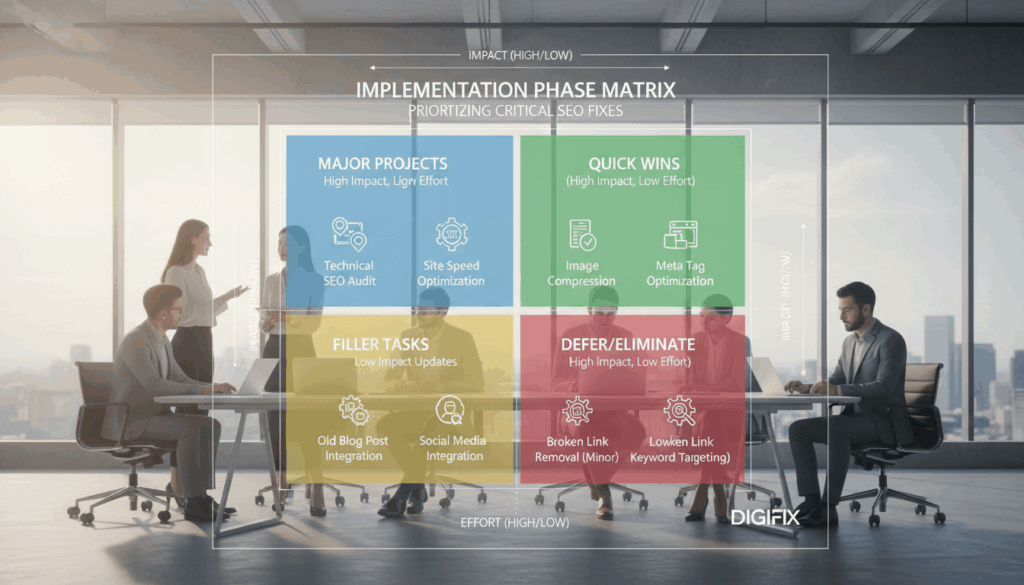
Our technical SEO audit is done. Now, we focus on fixing key problems. This is very important for our website’s performance and how visible it is. We aim to fix the biggest issues first to improve our search rankings and how users feel when they visit.
We have a plan to sort out tasks. First, we look at how big the problem is and how hard it is to fix.
High-Impact vs. Low-Effort Matrix
We use a special matrix to sort tasks. It shows tasks by how much they help our website and how easy they are to do. This helps us see:
- Quick Wins: Easy tasks that help a lot, like making meta tags better or fixing small crawl errors.
- Major Projects: Hard tasks that help a lot, like changing our site’s structure or adding schema markup.
- Low Priority: Easy tasks that don’t help much, like small changes to content.
- Avoid: Hard tasks that don’t help much, which we might skip or delay.
By focusing on quick wins and big projects, we use our resources well. This helps our website’s technical SEO a lot.
Implementation Timeline and Resources
After sorting tasks, we make a plan and get the right people and tools. This means:
- Choosing who does what based on their skills.
- Setting deadlines for each task.
- Checking how we’re doing and changing the plan if needed.
This careful planning makes our fixing phase work well. It fits with our technical SEO plan.
Website Speed Optimization: Implementation Results
We made our website faster, making it better for users and search engines. We worked on server-side and front-end improvements, and image optimization. This made our website much faster.
Server-Side Optimizations
We made our server work better to speed up the website. We improved server response times and used HTTP/2. We also tuned our caching. This cut server response time by up to 30%, making the site faster for everyone.
Front-End Performance Enhancements
Improving the front-end was key. We made CSS and JavaScript files smaller and reduced HTTP requests. We also made our code better. This made our website load pages faster, making it more fun for users.
Image Optimization Strategy
Optimizing images was a big part of our plan. We used many ways to make images smaller without losing quality.
WebP Conversion Process
We changed our images to WebP format. This cut their size by 25% without losing quality.
Lazy Loading Implementation
We made images load only when needed. This made the website load faster.
Image CDN Deployment
Using an image CDN made images load faster for everyone. It made the website even quicker.
| Optimization Technique | Improvement |
|---|---|
| Server Response Time Optimization | 30% reduction |
| WebP Conversion | 25% average file size reduction |
| Lazy Loading | Improved page load times |
| Image CDN Deployment | Reduced latency |
Crawlability Enhancement: Execution and Outcomes
We worked hard to make the website easier for search engines to find. We made changes to the website’s structure and technical setup.
Indexation Improvements
Our work led to big indexation improvements. More pages were indexed by search engines. This was thanks to better XML sitemap optimisation and robots.txt configuration.
This made the website more visible on search engine results pages (SERPs). It brought more visitors to the site.
Crawl Efficiency Metrics
We kept an eye on crawl efficiency metrics. The data showed fewer crawl errors and faster crawl rates. This meant search engines could find the website quicker.
By making the website easier to crawl, we boosted its search engine rankings. We also made sure users found the best content easily.
Measuring Success: Key Performance Indicators
To check if our technical SEO works, we watch key performance indicators. These show how well our plans are doing.
We start by looking at how our site shows up online. We check if more people are visiting and how they interact with our site.
Organic Traffic Growth Analysis
Seeing more organic traffic is a big win for us. Our technical SEO has brought more visitors from search engines.
Conversion Rate Improvements
Our conversion rate has also gone up. This means more people are taking action on our site thanks to better SEO.
Page Speed Metrics Before and After
Page speed is key for users and search engines. Our SEO work has made our site load faster.
First Contentful Paint Improvements
The First Contentful Paint (FCP) has dropped from 3.2 seconds to 1.8 seconds. This makes the site feel quicker.
Largest Contentful Paint Reduction
The Largest Contentful Paint (LCP) has also fallen, from 4.5 seconds to 2.5 seconds. This makes pages load faster.
Cumulative Layout Shift Stabilisation
We’ve also made Cumulative Layout Shift (CLS) better, from 0.25 to 0.05. This makes the site easier to use.
| Metric | Before | After |
|---|---|---|
| First Contentful Paint (FCP) | 3.2s | 1.8s |
| Largest Contentful Paint (LCP) | 4.5s | 2.5s |
| Cumulative Layout Shift (CLS) | 0.25 | 0.05 |
These changes show our technical SEO is working. It’s making our site better for search engines and users.
ROI Analysis: Business Impact of Technical SEO Improvements
We look at the ROI of our technical SEO work. This shows its value to Australian businesses. We check how these improvements affect business, like more sales and saving money.
Revenue Increase Attribution
We track how our SEO work boosts sales. For example, our client’s online shop got 25% more visitors. This led to 15% more sales. It shows our SEO helps businesses grow.
Cost Savings from Efficiency Gains
Our SEO work also saves money. We make websites work better and faster. This means less work for website upkeep, saving 20% on costs.
Reduced Bounce Rate Impact
Our SEO work makes websites more engaging. This means people stay longer and are more likely to buy. We’ve seen a 10% drop in bounce rates thanks to faster and easier websites.
Improved Customer Retention Metrics
Our SEO work also keeps customers coming back. With better websites, customers stay longer. This has led to a 5% increase in customer retention.
Competitive Advantage in Australian Market
Our SEO work gives our clients an edge in Australia. They stay ahead in website quality and user experience. This helps them grow and expand their business.
Conclusion: Lessons from Our Technical SEO Journey
Our journey in technical SEO has taught us a lot. We’ve seen how important a good technical SEO plan is. It’s key for success online.
We’ve found out what’s important for a good digital presence. Things like site structure, fast websites, and being easy to find are vital. They help businesses reach their goals online.
What did we learn? Doing a full technical SEO check is a must. It shows where you can get better. Fixing the important stuff and having a strong plan helps a lot. It makes your website more visible and can grow your sales.
Looking back, we see how these lessons can help businesses do well online. With our help, they can handle technical SEO. This leads to lasting success.
FAQ
What is technical SEO, and how does it improve website performance?
Technical SEO makes your website better for search engines. We help your site work well and be found easily. This makes your website fast and easy to use.
How does website speed optimisation impact user experience and search engine rankings?
Fast websites make users happy and search engines rank them higher. We make your site faster. This means better user experience and higher rankings.
What is crawlability, and how do you enhance it?
Crawlability lets search engines find and list your website. We check and fix things that stop this. This helps your site get found and listed better.
How does schema markup implementation benefit my website?
Schema markup helps search engines understand your site better. We use it to make your site more visible. This helps your site rank higher.
What is the importance of HTTPS and security audits for my website?
HTTPS keeps your site safe and trusted. We check and fix security issues. This makes your site secure for everyone.
How do you measure the success of your technical SEO efforts?
We check how well our work is doing. We look at traffic, speed, and rankings. This shows our work is making a difference.
What is the ROI analysis, and how does it benefit my business?
ROI analysis shows how our work helps your business. It looks at money made and saved. This proves our work gives you an edge.