

The digital landscape is changing faster. Businesses that adapt early to new SEO trends for 2026 will capture more attention, rank higher, and grow faster than competitors who wait.
We have been in the SEO industry for nearly 10 years and witnessed the landscape evolve in ways that were hard to imagine a decade ago. From algorithm updates to shifts in user behavior, SEO has always required adaptation. But today, it’s changing faster than ever.
People search differently, refer to content in new ways, and increasingly rely on AI-powered tools to get answers instantly. Traditional SEO strategies alone are no longer enough to keep up.
Using our experience and observations, We decided to write this article on the upcoming SEO trends for 2026, with our experiences and observations. Our goal is to provide actionable insights. That way, your website, content, and overall SEO strategy can stay ahead in an ever-evolving digital world.
This blog will break down the most important upcoming SEO trends for 2026. For every SEO trend covered in this guide, you will learn:
- What the trend is and why it matters
- How search engines are using it
- Real examples of how it works in practice
- What steps should you take now to stay ahead
If your goal is to maintain rankings, increase organic traffic, and future-proof your digital presence, understanding these SEO trends is not optional. It is a strategic priority.
Now, let’s move to discover new things in SEO for 2026.
Is SEO still relevant in 2026?
I’ve been in the SEO industry for nearly a decade, and one thing is clear: search engine optimisation isn’t what it used to be. It’s no longer just about stuffing keywords into a page or collecting backlinks wherever you can. SEO is evolving fast.
Over the past year, I’ve noticed search engines getting smarter. They don’t just scan text anymore.
They try to understand intent, context, user behavior, voice, visuals, and even the emotions behind a search. It’s like they’re learning to think more like humans. And honestly, watching this shift has been fascinating.
Why is this happening? It’s all because of the rapid advancements in AI, machine learning, and generative search technologies.
Google, Bing, and other engines are now trying to imitate how people think, speak, and make decisions. That means the old “SEO hacks” that once worked are losing their punch, and the real winners will be those who focus on experience-driven, strategic SEO.
From a business perspective, this is both exciting and a little scary. The risk is obvious: if you stick to outdated tactics, your website could start dropping in rankings, lose traffic, and get left behind by competitors who are faster to adapt. But here’s the flip side.
The opportunity is huge. Brands that pay attention to these upcoming SEO trends for 2026 and start implementing them now will see better visibility, more meaningful traffic, and stronger long-term results.
Upcoming SEO Trends for 2026
SEO Trend #1: AEO – Answer Engine Optimization
The first trend I want to highlight for 2026 is AEO, or Answer Engine Optimization. From my experience, this is going to be a game-changer for anyone in the SEO industry.
So, what exactly is AEO? Simply put, it’s optimizing your content for AI-powered “answer engines” like Google’s AI Overview, ChatGPT, Perplexity, and even voice assistants like Siri or Alexa.
For years, traditional SEO had a clear goal:
- Rank your website as a blue link on Google
- Get users to click through
- Drive traffic to your site
I’ve seen this model work for almost a decade. But now, it’s breaking down.
Users aren’t searching the way they used to. They’re no longer typing one or two keywords. They’re asking full, complete questions. And more importantly, they often don’t click through to websites at all. Instead, AI tools and voice assistants are delivering instant answers.
This means if your content isn’t structured in a way that AI can easily read, understand, and pull into answers, you risk being invisible in these new search results, even if your site still ranks well in traditional Google searches.
Often, users get what they need without ever visiting a website. This is where AEO comes in. For example, let’s say you asked “how to make a YouTube channel,” Google AI overview will give an instant answer like below,
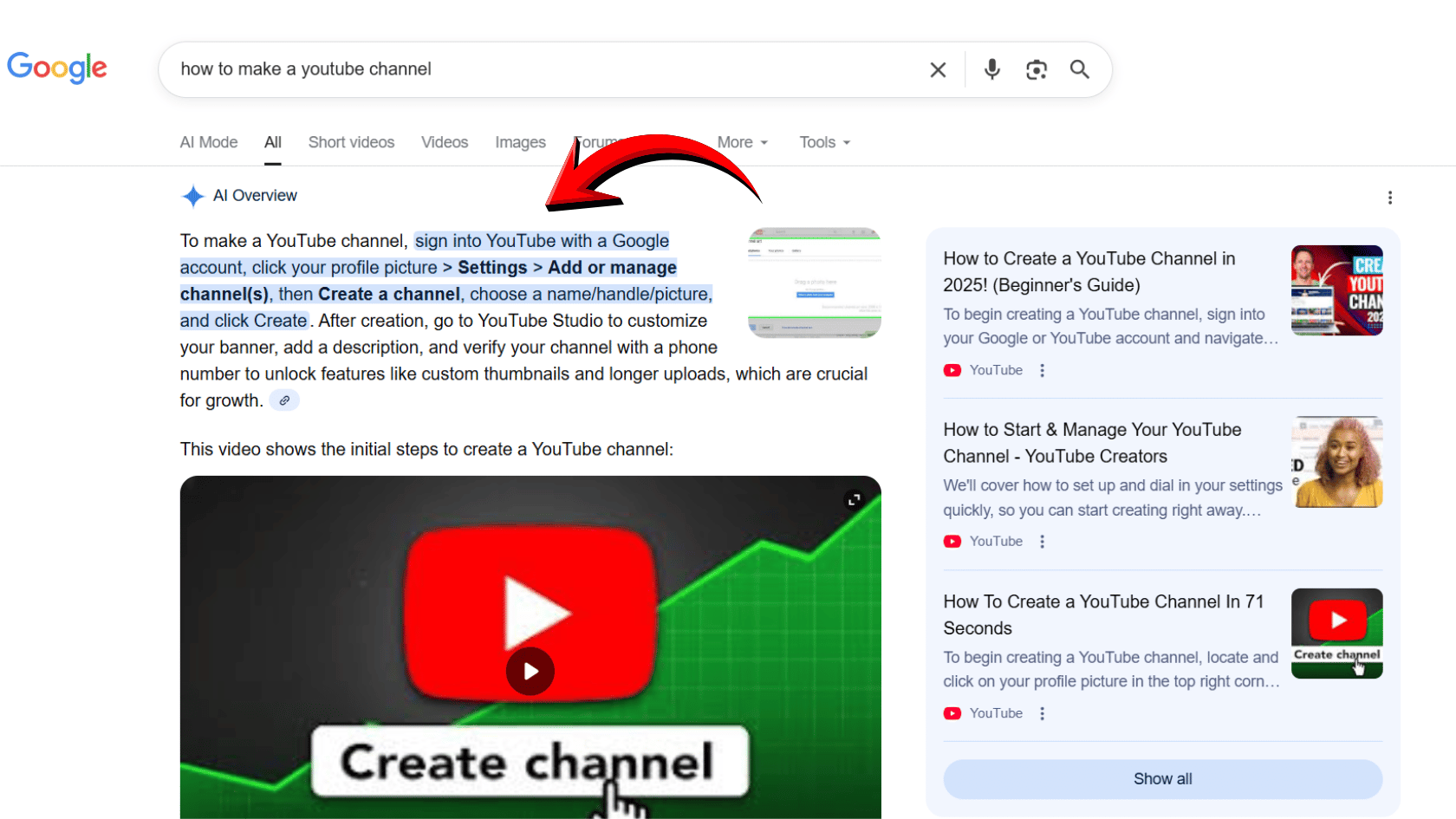
If your content is not structured as an answer, it will be ignored. So, your new objective is simple but demanding: content must be easy for AI to read, understand, and quote.
Why AEO Matters More in 2026?
By 2026, answer-based search will dominate because:
- AI search tools are becoming the default interfaces
- Voice search usage continues to rise
- Users want fast, direct responses
- Search engines aim to reduce friction
This means fewer clicks, fewer page views, and more zero-click searches.
Brands that fail to adapt will:
- Lose visibility
- Lose authority
- Lose relevance
Brands that optimise for AEO will:
- Appear inside AI-generated answers
- Be cited as trusted sources
- Gain brand exposure even without clicks
That exposure still drives trust, brand recall, and buying decisions.
Real-World Examples of AEO in Action
Let’s look at how AEO works in practice.
Example 1: Cost-Based Search
User asks:
“How much does SEO cost?”
Instead of showing ten links, AI responds with:
- A price range
- A short explanation
- A cited source
If your content clearly answers:
- What SEO costs
- What affects pricing
- Average ranges
…AI may pull your explanation directly.
Your brand becomes the authority.
Example 2: How-To Queries
User asks:
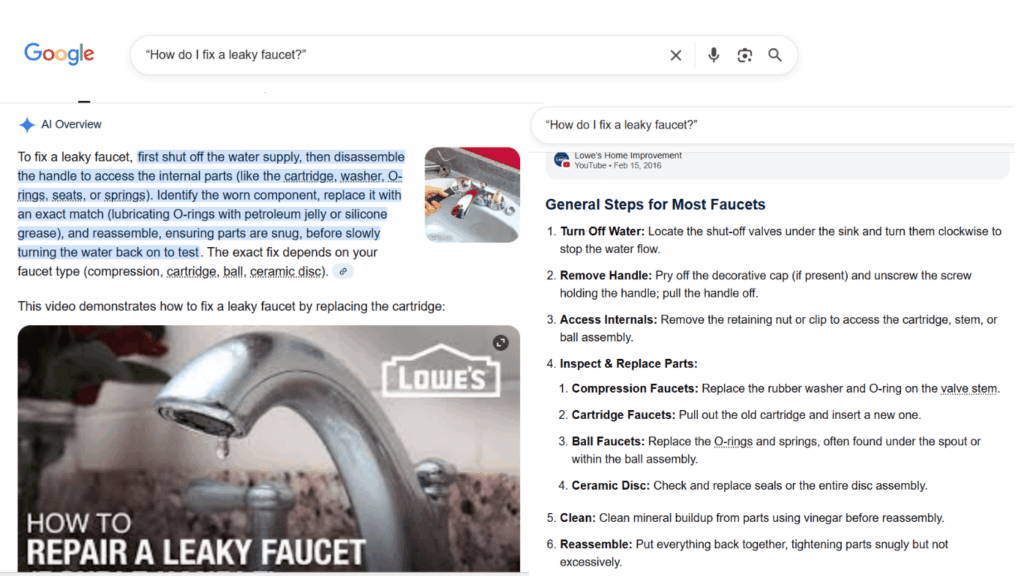
“How do I fix a leaky faucet?”
AI does not want a blog story.
It wants:
- Clear steps
- Simple instructions
- Safety tips
If your content provides structured steps, AI will use it.
Example 3: Definition-Based Search
User asks:
“What is Answer Engine Optimization?”
AI will look for:
- Short, clear definitions
- Easy explanations
- Supporting points
Long, vague paragraphs will be skipped.
Clear answers win.
How AEO Actually Works Behind the Scenes
AI systems prioritise content that is:
- Structured
- Direct
- Easy to break into parts
- Clearly written
- Focused on one idea at a time
This is why modular content is critical.
Modular content breaks your content into small, reusable blocks, where each block answers one specific question.
Think of your content like LEGO pieces:
- One piece = one question
- One piece = one clear answer
AI prefers this because it can:
- Identify the question
- Extract the answer
- Reuse it safely in responses
How to Structure Content for AEO?
To optimise for AEO, your content must follow a clear structure.
- Use Clear Questions as Headings
Each heading should be a real question users ask.
Examples:
- What is AEO?
- How does Answer Engine Optimization work?
- Why is AEO important for SEO in 2026?
This helps AI understand context immediately.
- Answer Directly Below the Heading
Do not delay the answer.
Bad approach:
- Long introductions
- Storytelling
- Background explanations first
Correct approach:
- Answer the question in the first 2–3 sentences
- Expand only after that
AI reads top-down.
- Keep Paragraphs Short and Focused
Each paragraph should:
- Address one idea only
- Stay under 3–4 lines
- Avoid filler language
Clarity beats creativity here.
- Use Bullet Points and Lists
AI loves structured formats.
Use:
- Bullet points for features or benefits
- Numbered lists for steps or processes
- Checklists for action items
These formats are easy to extract and reuse.
- Add Tables Where Relevant
Tables help AI compare data.
Examples:
- Pricing ranges
- Feature comparisons
- Pros and cons
Tables increase your chances of being cited.
Action Plan: How to Optimise for AEO Today
Here is a clear action plan businesses should follow.
Step 1: Audit Existing Content
- Identify pages answering common questions
- Break large paragraphs into sections
- Add question-based headings
Step 2: Rewrite for Clarity
- Put the answer first
- Remove unnecessary filler
- Simplify language
Step 3: Add Structured Elements
- Bullet points
- Numbered steps
- Tables
- FAQs
Step 4: Create Dedicated Answer Sections
- Add FAQ blocks
- Include “Quick Answers” sections
- Summarise key points clearly
Step 5: Think Like an AI
Before publishing, ask:
- Can this answer stand alone?
- Can AI quote this without editing?
- Is the question obvious?
If the answer is yes, you are doing AEO correctly.
SEO Trend #2: Search Everywhere Optimization
The second major SEO trend for 2026 is Search Everywhere Optimization.
This trend is direct, unavoidable, and already happening.
What Is Search Everywhere Optimization?
Search Everywhere Optimization means optimising your content across all platforms where people search, not just Google.
In the past, SEO meant one thing:
- Optimise your website
- Rank on Google
- Get traffic
That model is outdated. Today, search happens inside platforms, not just search engines. Especially for younger audiences.
Gen Z is changing how search works. Instead of opening Google, they are searching directly on:
- TikTok
- YouTube
These platforms are no longer just social networks. They are full-scale search engines. If your brand is not visible there, you are invisible to a large audience.
Why Is This Trend Exploding in 2026?
For the first time, platforms like TikTok and Instagram are being treated as primary search engines.
This is not a small shift.
Research shows:
- Up to 40% of modern search behaviour now happens on social platforms
- 64% of Gen Z use TikTok as a search engine (Source: Adobe)
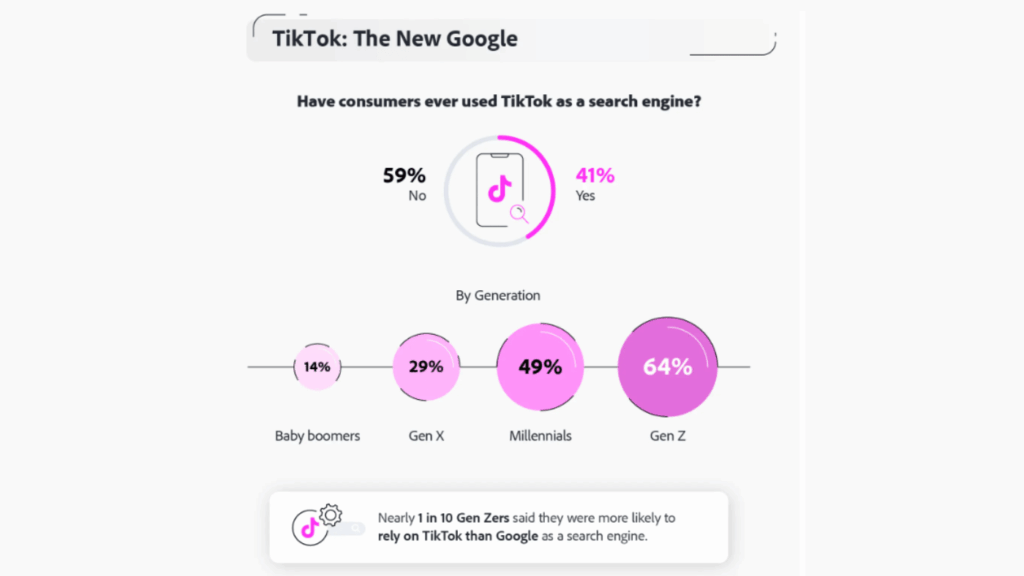
- 40% of consumers overall start their research journey on TikTok
(Source: Adobe/ Google Internal Data)
This means nearly half of search intent never reaches Google.
Why Do People Prefer Social Search?
There are clear reasons for this behaviour.
- Visual Answers Are Faster
People prefer:
- Short videos
- Real examples
- Visual demonstrations
A 30-second video often answers a question better than a long article.
- Trust in Real Humans
Gen Z does not trust “corporate” content.
Studies show:
- 60% of Gen Z prefer learning from YouTube or TikTok
- Reason: content feels like real conversations, not textbook explanations
(Source: Virlo)
They trust creators, not brands.
- Community-Based Search Is Growing
Platforms like Reddit are booming as search tools.
Reddit growth data:
- 450% increase in AI citations since 2024
- 21% of Google AI Overview citations now come from Reddit
- 47% of Perplexity citations come from Reddit
(Source: The Digital Bloom / Profound)
This shows that Search engines trust community-driven platforms.
Simple Example: TikTok SEO in Action
Let’s say you post a TikTok about travel.
Weak Caption (Bad SEO): “Amazing trip 😍✈️”
This tells the algorithm nothing.
Optimised Caption (Search Everywhere SEO):
“Paris travel tips for first-time visitors – food, transport, and must-see places”
Now the platform understands:
- Topic: Paris travel
- Intent: Travel tips
- Audience: First-time visitors
That content becomes searchable.
Additional Optimisation Layers
To fully optimise:
- Add keywords in on-screen text
- Say keywords out loud in the video
- Use clear language
- Avoid slang-only captions
Platforms now transcribe audio and index it.
If you say it clearly, it can rank.
How Marketers Are Adapting?
Modern marketers now treat platforms like search engines.
Examples:
- TikTok captions = Meta titles
- Instagram descriptions = Blog headings
- YouTube transcripts = SEO articles
- Reddit comments = Authority signals
This is not optional anymore.
Action Plan: How to Apply Search Everywhere Optimization
Here is a clear execution plan.
Step 1: Identify Where Your Audience Searches
Ask:
- Are they on TikTok?
- Are they on YouTube?
- Are they on Reddit?
- Are they on Instagram?
Do not guess. Observe their behaviour.
Step 2: Create Search-Friendly Content
For every post:
- Use clear topic-based captions
- Avoid vague emojis-only descriptions
- Use keywords naturally
Step 3: Optimise Video Content
- Add keywords as on-screen text
- Speak keywords clearly
- Keep language simple and direct
Step 4: Repurpose Content Across Platforms
One idea should become:
- A TikTok
- A YouTube Short
- An Instagram Reel
- A Reddit discussion
Optimise each version for how that platform searches.
Step 5: Track Platform-Specific Performance
Measure:
- Search impressions
- Saves
- Watch time
- Comments
These are ranking signals on social platforms.
SEO Trend #3: First-Hand Experience (EEAT Is Non-Negotiable)
One of the strongest SEO signals moving into 2026 is first-hand experience. This is no longer a “nice to have.” It is a core ranking requirement.
Google has made this direction very clear through its EEAT framework, which stands for:
- Experience
- Expertise
- Authoritativeness
- Trustworthiness
While all four matter, experience now carries the most weight. Google wants proof that content is written by someone who has actually done the thing they are writing about.
What Does This Trend Really Mean?
Search engines are actively filtering out content that lacks real-world depth. This includes:
- Generic AI-written articles
- Rewritten content with no original insight
- Pages created without using the product or service
Google is rewarding content that clearly shows:
- You tested it
- You used it
- You learned from it
- You formed an opinion based on real use
This shift directly targets low-effort content.
Why Is Google Pushing First-Hand Experience?
AI has changed content creation. Anyone can now generate articles in minutes.
The result:
- The internet is flooded with similar content
- Many pages repeat the same points
- Original thinking is rare
- Trust is declining
Google’s response is direct and logical: You must prioritise real experience over polished writing.
Search engines are trying to protect users from shallow content and surface-level advice.
Clear Example: Weak vs Strong Content
Weak content:
“This product is great and works well.”
This tells Google nothing. Anyone could write it without ever touching the product.
Strong content:
“I tested this product for 30 days. In the first week, the battery drained faster than expected. By week three, performance stabilised, but charging time remained slow.”
This works because it shows:
- Time spent
- Real observations
- Balanced, honest feedback
Search engines trust this because it cannot be faked easily.
Action Plan: How to Show First-Hand Experience
To align with this trend, follow these steps.
Step 1: Write Only From Direct Use
Create content only about:
- Products you personally tested
- Services you actually delivered
- Tools you used in real projects
- Strategies you applied and measured
Avoid surface-level explanations. Depth comes from experience.
Step 2: Add Personal Proof
Strengthen credibility by including:
- Timeframes (for example, “after 14 days”)
- Measurable results (for example, “traffic increased by 22%”)
- Failures and adjustments (for example, “this did not work at first”)
Honesty increases trust.
Step 3: Use Original Media
Whenever possible:
- Add your own images
- Include short videos
- Share screenshots
Original media is one of the strongest EEAT signals because it proves real involvement.
Step 4: Add Clear Author Context
Always show:
- Who wrote the content?
- Why are they qualified
- What experience do they bring
Anonymous or faceless content performs poorly in 2026.
SEO Trend #4: Social Proof as an SEO Signal
One of the major SEO trends in 2026 is the growing importance of social proof.
Search engines are no longer judging brands only by what they publish on their own websites. They are now paying close attention to what real people say across the internet.
What Is Social Proof in SEO?
In SEO, social proof refers to public signals of trust and usage created by real users.
This includes:
- Google reviews
- Reddit discussions
- Forum comments
- Testimonials
- Community feedback
These signals help AI systems answer key trust questions:
- Is this business trusted?
- Do real people use it?
- Are opinions consistent over time?
When the answers are positive, rankings improve.
Why Social Proof Matters More Than Ever?
Modern AI-driven search systems are trained to detect credibility at scale.
They no longer rely only on traditional SEO signals like:
- Keywords
- Meta tags
- Backlinks
Instead, they analyse public opinion across platforms.
This allows search engines to:
- Validate brand claims
- Cross-check reputation
- Identify genuine businesses
As a result, social proof has become a ranking factor, not just a conversion tool.
Simple Example: How Social Proof Affects Rankings
Consider two restaurants:
Restaurant A
- Perfect on-page SEO
- Only 5 reviews
Restaurant B
- Average SEO
- 500 real reviews
Among these two, Restaurant B will rank higher. Why? Because real users confirm quality, consistency, and trust.
Search engines prioritise what people validate, not what brands claim.
Where AI Looks for Social Proof?
AI systems gather trust signals from multiple sources, including:
- Google Business Profiles
- Review platforms
- Reddit threads
- Online forums
- Q&A websites
This data directly influences:
- Local search rankings
- AI-generated answers
- Brand mentions and citations
A strong public reputation improves visibility across all search surfaces.
Action Plan: How to Strengthen Social Proof?
Step 1: Actively Collect Reviews
- Ask customers after the service
- Automate review requests
- Focus on genuine feedback, not fake reviews
Volume and authenticity matter.
Step 2: Respond to Reviews
- Reply to positive reviews
- Address negative reviews professionally
- Show consistent engagement
Active responses signal trustworthiness and accountability.
Step 3: Be Present in Communities
- Participate in relevant Reddit discussions
- Answer questions honestly
- Avoid promotional language
Helpful brands earn organic trust.
Step 4: Showcase Testimonials on Your Website
- Use real names where possible
- Add context and measurable results
- Avoid vague or generic praise
Specific testimonials strengthen credibility.
SEO Trend #5: Micro-Content SEO
The final SEO trend shaping 2026 is Micro-Content SEO. This trend challenges a long-held belief in digital marketing: Longer content always performs better. That belief is no longer valid.
What Is Micro-Content SEO?
Micro-Content SEO focuses on small, highly focused pieces of content that clearly answer a specific question. This includes:
- Short answers
- Small explainers
- One-question posts
- Short videos
- Single-topic content
The objective is to deliver the answer as fast and as clearly as possible.
Why Micro-Content Is Winning?
Search behaviour has changed, and search engines have adapted.
How AI Systems Evaluate Content
AI-driven search systems prioritise:
- Direct answers
- Easy-to-extract information
- Focused explanations
Content that gets straight to the point is easier for AI to understand and reuse.
How Users Consume Content
Users now prefer:
- Quick solutions
- Fast learning
- Minimal effort
Not every question needs a long article. Many searches are simple and require short answers.
Where Micro-Content Works Best?
Micro-content performs exceptionally well across modern search surfaces, including:
- AI-powered search results
- TikTok
- YouTube Shorts
- Instagram Reels
- Featured snippets
Search engines favour concise content that removes friction.
Action Plan: How to Use Micro-Content SEO
To apply this trend effectively, follow these steps.
Step 1: Break Big Topics Into Small Pieces
Instead of publishing one long guide:
- Create multiple short pieces
- Each answering a single question
This increases your chances of ranking for more queries.
Step 2: Create Short Videos
For video content:
- One question per video
- Clear, spoken answers
- Simple, direct language
Avoid unnecessary storytelling.
Step 3: Optimise for One Intent
Each piece of micro-content should:
- Target one clear question
- Solve one problem
- Avoid mixing topics
Focus improves visibility.
Step 4: Repurpose Micro-Content
One short answer can be reused as:
- A section inside a longer blog
- A video clip
- A social media post
- An AI-citable answer
This multiplies reach without extra effort.
SEO Trend #6: Personalization Signals
Search results are no longer the same for everyone. Google and AI-powered search engines now tailor results based on each user’s context.
What Are Personalization Signals?
Personalization signals are factors that search engines use to customise search results for individual users. These include:
Location – Users in different cities or countries see different results
Behavior – Past interactions with websites and apps influence rankings
Preferences – Topics a user frequently searches for or engages with
Device type – Mobile vs. desktop can affect which content is shown
The result?
There is no single “ranking” anymore. Everyone sees a slightly different search result page.
Why Personalization Matters?
Personalized search improves user experience by delivering the most relevant content to each user. But for businesses and marketers, it changes the SEO landscape:
- You can’t rely solely on generic rankings
- Optimization must consider multiple user scenarios
- Content needs to satisfy intent for different segments
How Search Engines Personalize Results?
User Intent Analysis
Google and AI systems interpret what the user wants, not just the keywords typed.
Behavior Tracking
Previous clicks, dwell time, and interactions influence which results appear next.
Location Signals
Local searches like “coffee near me” or “best gyms in Melbourne” prioritize nearby businesses.
Device Adaptation
Mobile users may see faster-loading, mobile-optimized content first.
Action Plan: How to Optimize for Personalization?
Step 1: Understand User Segments
- Identify key audience groups
- Track location, device, and browsing behavior
Step 2: Map Content to Intent
- Create content for different search intents (informational, transactional, navigational)
- Address specific needs for local, mobile, or repeat users
Step 3: Leverage Local SEO
- Include accurate location data
- Claim Google Business Profiles
- Use local keywords in content
Step 4: Optimize Across Devices
- Ensure fast-loading, mobile-friendly pages
- Consider voice search optimization
Step 5: Test and Monitor
- Track personalized ranking variations
- Analyze engagement metrics for different segments
Let’s take a closer look at some of the other SEO trends for 2026 with more explanation:
- Human-AI Hybrid Content
This trend is based on the 80/20 rule. You can use AI for about 80% of the content creation and add 20% human input to make it authentic. AI can generate guides, research, and drafts quickly, but Google values content that shows a real human perspective. Adding personal experiences, opinions, or anecdotes makes your content more trustworthy and engaging.
Why it matters:
AI-generated content alone can feel generic and may struggle to rank highly. Human input signals originality, credibility, and EEAT.
For example:
- AI writes a step-by-step guide on “How to Hike.”
- You add a personal story: “Last summer, I almost got lost in the rain while hiking Mount Kosciuszko, and here’s what I learned…”
Action Plan:
- Use AI to handle research, outlines, or repetitive explanations
- Add human insights, personal experiences, and opinions
- Ensure the final content reads naturally and authentically
- Video Semantic Search
This is known as “AI with ears.” Search engines can now “listen” to videos and understand content from the spoken words, not just titles or captions. This means your keywords and main points should be spoken clearly in the video.
Why it matters:
AI is increasingly generating answers from video content. If you don’t say your keywords out loud, your video may be overlooked even if the title is optimised.
Example:
- Bad: You make a cake video without clearly saying the topic.
- Good: You say at the start, “In this video, I’ll show you how to bake a chocolate cake step by step.”
Action Plan:
- Script your videos with clear keyword phrases
- Speak keywords naturally during recording
- Include captions and transcripts for reinforcement
- Structure content with questions and answers inside the video
- Visual Discovery (Google Lens)
Also called “Searching with your Camera.” People now use images to search. Google Lens and similar tools identify objects, products, and places directly from photos. SEO now requires high-quality, clear images that AI can recognise and link to your website.
Why it matters:
Even if your website ranks well, poor-quality or unclear images can prevent AI and visual search tools from identifying your products.
Example:
- Uploading a blurry photo of a handmade vase won’t help.
- A clean, well-lit photo allows Google Lens to identify the item and link it to your online store.
Action Plan:
- Use high-resolution images with clear focus
- Add descriptive alt text and captions
- Showcase products from multiple angles
- Use structured data for images wherever possible
- Hyper-Localised Proximity
This is known as “Neighbourhood SEO.” In 2026, it’s not enough to just rank for a city. Search engines now favour businesses that dominate a very specific local area or landmark.
Why it matters:
AI and search engines prioritise businesses based on precise proximity, so being “near a landmark or street” increases visibility for location-based searches.
Example:
- Instead of “coffee shop in London,” say “coffee shop right next to the Big Ben clock tower.”
Action Plan:
- Include exact addresses and landmarks in your content
- Optimise Google Business Profile with local info
- Add geo-specific keywords in blogs, posts, and metadata
- Encourage local reviews mentioning your street or area
- Conversational Long-Tails
Also called “Natural Questions.” Users now type or speak full sentences instead of short keywords. SEO needs to focus on answering real, human-like questions directly.
Why it matters:
AI systems prefer content that matches natural search queries, not just generic keywords. Long-tail conversational content improves chances of being cited in AI answers and featured snippets.
Example:
- Instead of “dog wedding rules,” write a blog titled:
“Can I bring my dog to a wedding? Here’s what you need to know.”
Action Plan:
- Research questions your audience asks in full sentences
- Structure content to directly answer these questions
- Use FAQs, step-by-step guides, and short paragraphs
- Include examples and scenarios to make it practical
Conclusion
As someone who has spent nearly a decade in the SEO industry, I can honestly say that 2026 will be one of the most transformative years for search. SEO is no longer just about keywords, backlinks, or ranking first on Google. It’s about understanding how people search, how AI interprets content, and how your brand can stand out as trustworthy and authoritative.
From Answer Engine Optimization (AEO) to micro-content, personalization, and social proof, the trends we’ve covered show that SEO is becoming smarter, more human, and more experience-driven. Businesses that adapt now, by creating structured, clear, and authentic content, will not only survive but thrive in this new landscape.
The key takeaway is simple: focus on real experience, clarity, and value. Make it easy for AI and search engines to understand your content, but also make it genuinely helpful for people. That’s how your brand will build visibility, trust, and long-term growth in 2026 and beyond.
Start implementing these trends today. Test, adapt, and iterate. The sooner you embrace this new SEO reality, the faster you’ll see results.
Take Your Business to the Top with DigiFix SEO Services
Having been in the SEO industry for nearly a decade, we’ve seen firsthand how businesses struggle when they rely on outdated SEO tactics. I’ve also seen the ones that get it right, those that focus on strategy, experience, and real results, dominate their niche online. That’s exactly what we do at DigiFix.
We don’t just “do SEO.” We help your business rank higher, attract the right audience, and grow sustainably. Our approach is built on years of experience, tested strategies, and a deep understanding of how search engines and humans actually behave.
What Makes DigiFix Different?
- Experience-Driven SEO: Every recommendation we make is based on real-world results. We’ve tested countless strategies and know what truly works.
- Full-Coverage Approach: From on-page SEO, content strategy, and technical fixes to local SEO and authority building, we cover it all.
- Future-Ready Strategies: SEO is evolving fast. We optimize your site for AI search, voice search, video, and answer engines, so you stay ahead of 2026 trends.
- Results That Matter: Traffic is good, but conversions and leads are better. Our focus is on driving meaningful growth for your business.
- Transparency & Trust: We show you exactly what’s working with detailed reports and clear analytics. No guesswork. No jargon.
How We Help
- Audit your website and fix what’s holding you back
- Optimize content for humans and AI alike
- Boost local visibility with Google Business and neighborhood SEO
- Build authority with high-quality backlinks and references
- Continuously monitor performance and refine strategies
Why Now
The digital landscape is changing faster than ever. Businesses that adapt early to new SEO trends will capture more attention, rank higher, and grow faster than competitors who wait.
At DigiFix, we combine experience, strategy, and hands-on execution to make sure your business not only keeps up but thrives.
If you’re ready to get real results from SEO, it’s time to take the next step.
Discover More About Our SEO Services
Book your free consultation with DigiFix today, and let’s start building your online success story.