

SEO for attorneys lawyers and Australian firms. Why the word you use matters, how to beat legal directories, and what changes by practice area.
SEO for Attorneys Lawyers: A Practical Guide for Firms
Search for SEO for attorneys lawyers and you will find a hundred articles telling you to claim your Google listing and write more blog posts. Useful advice in 2015. Not much use now, and none of it addresses the thing that makes legal search genuinely strange, which is that four people with the identical problem will type four different words to solve it.
One types “attorney”. One types “solicitor”. One types “lawyer”. One types it in Mandarin. They all want the same person. Most law firm websites are built to be found by only one of them.
That is the first of four problems this article covers. The others are the shape of page one, which now has six things sitting above your website, the legal directories that occupy two of those slots, and the enquiry that arrives and goes cold because nobody answered the phone. Rankings are the easy half.
Key takeaways
- Australians search "lawyer" and "solicitor". Newer arrivals and expats search "attorney". Your site can serve both without sounding confused.
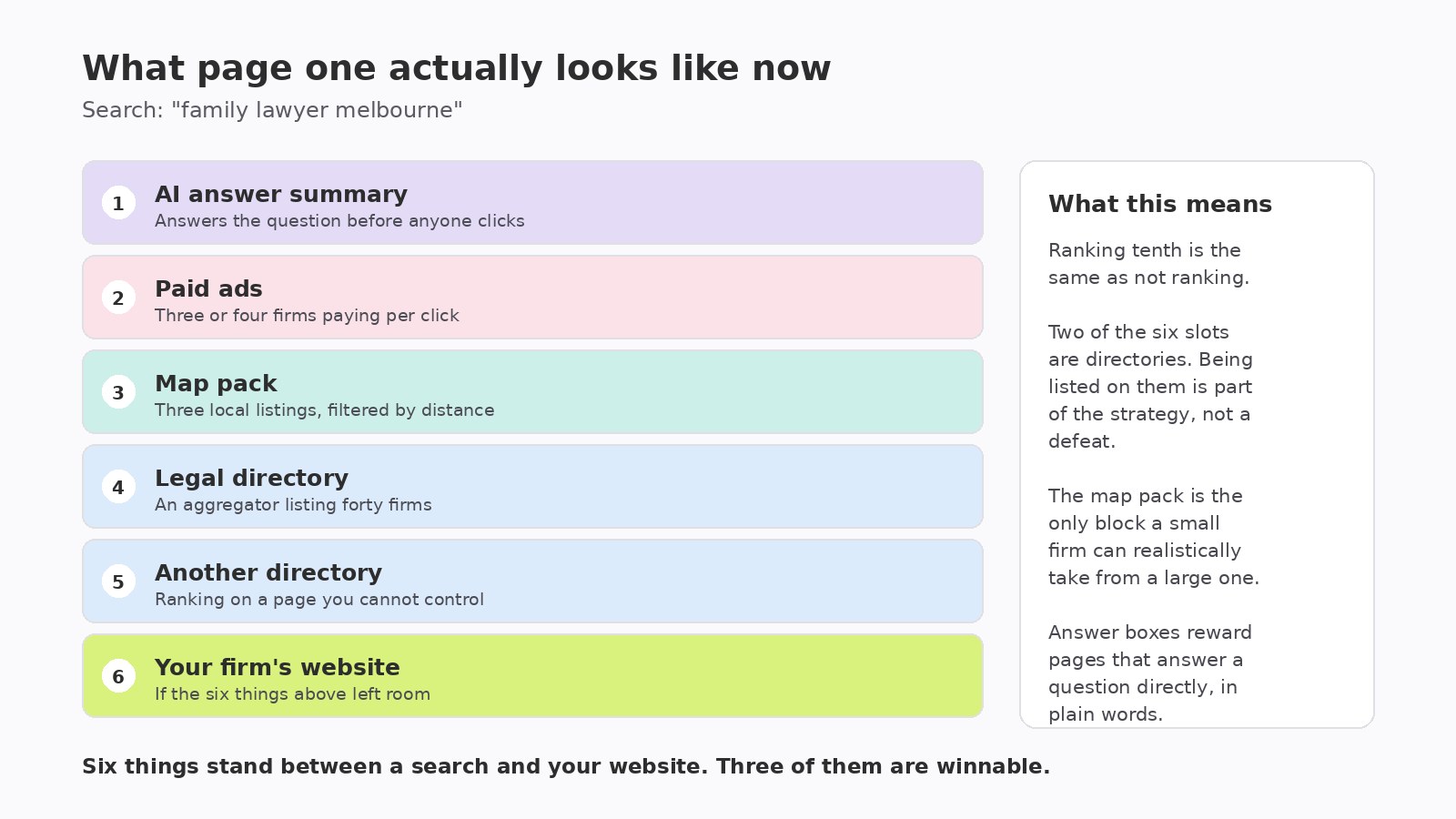
- Six blocks now sit above the ordinary results on a legal search. Three of them are winnable for a small firm.
- Legal directories are not just competitors. Being listed on the ones that rank is part of the strategy.
- Family, criminal, commercial and immigration work behave completely differently in search and should not share one plan.
- Answer boxes reward pages that answer the question directly, in plain words, with a named author.
- The firm that answers the phone first usually gets the file, regardless of who ranked first.
Attorney, lawyer, solicitor, barrister
In Australia, a lawyer is anyone admitted to practise. A solicitor is the one clients deal with directly. A barrister is briefed for court. “Attorney” is not a term Australian practice uses at all, except in the phrase power of attorney, which means something entirely different.
None of which stops people searching for it. Melbourne has a very large population born overseas, and plenty of them have learned the word for this job from American television or from having lived in the United States. Google itself uses the American terms in its own business categories, which is why a Dandenong family practice ends up choosing “family law attorney” from a dropdown menu.
So there is a gap between the correct term and the searched term, and the firms that handle it well pick up work that never reaches anyone else. The firms that handle it badly either ignore it, or scatter “attorney” through their homepage and end up reading like an offshore content mill wrote it.
How to handle the vocabulary without sounding foreign
The rule is simple. Australian terms carry the structure. Everything else lives in the body copy, where it reads as a natural aside rather than a keyword.
Your page titles, headings and menu labels use lawyer, solicitor, barrister and the practice area names. That is what the majority of your market types, and it is what tells a Victorian reader that you are a Victorian firm.
The American term belongs in a sentence that acknowledges it honestly. A line on your family law page along the lines of “you may see firms described as family law attorneys, which is the American term for the same work” does the job in one sentence, sounds like a person wrote it, and covers the query. One mention, done properly, beats twenty scattered ones.
Language is the bigger opportunity and almost nobody works it. If a solicitor at your firm speaks Mandarin, Cantonese, Vietnamese, Greek, Arabic, Punjabi or Hindi, that deserves its own page, a mention on your Google Business Profile, and a line in the relevant practice area page. Someone dealing with a legal problem in a second language will choose the firm that can talk to them in the first one, almost regardless of anything else on this page.
One warning. Do not put “attorney” in your business name field on Google, and do not build a separate near-duplicate page for each synonym. Google’s search essentials are clear that the goal is words people use placed naturally, not the same page produced four times with the noun swapped.
| Term | Who searches it | Where it belongs on your site |
|---|---|---|
| Lawyer | The majority of Australians | Page titles, H1s, menu labels, meta descriptions |
| Solicitor | Older and more legally literate searchers | Headings, team profiles, body copy |
| Attorney | Expats, newer arrivals, anyone raised on American media | One explanatory sentence in body copy, plus your Google category |
| Barrister | Other lawyers, and clients who have been told to brief one | Only where accurate. Do not use it for marketing reach |
| Other languages | A very large slice of the Melbourne market | A dedicated page per language your team genuinely speaks |
Swipe to scroll the table on mobile
What page one actually looks like now
Ranking first stopped meaning what it used to mean. Run a legal search on a phone and count what appears before an ordinary website link. An AI generated summary answering the question. Three or four paid ads. A map with three local listings. Then usually a directory or two. Your firm’s website, if it gets a look at all, is a long way down a screen most people never reach.
This is not a reason to give up, it is a reason to be specific about what you are chasing. Of those blocks, three are realistically winnable by a small or mid-size practice.
Stop fighting the directories and start using them
Every firm that looks at a legal search asks the same question. Why is a directory outranking me on my own practice area?
Because directories have thousands of pages on one subject, links accumulated over a decade, and a full-time team working on nothing else. You are not going to beat them on their own ground with four practice area pages, and trying is the fastest way to waste a year.
The productive response is to treat them as three separate things. Some are worth being listed on, because if the directory owns the ranking, you want to be the firm inside it that gets the click. Some are worth ignoring, because nobody who matters uses them. And a few queries are worth taking from them directly, which is where the map pack comes in, since directories cannot appear there. A verified profile with real reviews sits above every aggregator on the page, and it is the one block a two-partner firm can take off a national brand. That is covered properly in our guide to local SEO for lawyers in Melbourne.
The test for whether a directory is worth your time is simple. Search your own practice area and suburb. If it appears on page one, get listed and make your entry the best one there, with a full profile, photographs and reviews. If it does not appear, skip it, no matter what their sales email says about domain authority.
Want to see what your page one really looks like?
We will run your practice areas and show you exactly which blocks are taken, by whom, and which ones are actually available to you.
Book your free consultationPractice Area Changes the whole plan
A single firm-wide SEO plan is how most budgets get wasted, because these practice areas have almost nothing in common once you look at how people search.
Family law is emotional, urgent and searched at night from a phone, often in secret. The searcher does not know the legal terminology and is describing a situation, not a service. Content that uses plain language wins, and speed of response matters more than anything on the website.
Criminal work is even more urgent and even more phone-driven. Nobody is reading your blog after an arrest. Your listing, your reviews and whether someone picks up after hours are effectively the whole strategy.
Conveyancing is a price comparison. People search fees, they compare three firms, and they choose quickly. If you will not publish a fee range, someone else will and they will get the call.
Wills and estates splits in two. Will drafting is planned and unhurried, which suits patient content. Estate disputes are urgent and adversarial and behave more like litigation.
Commercial and employment work is researched over weeks, often by someone who is not the decision maker, and reputation signals do the heavy lifting. Named partner authorship, industry writing and case experience matter more than volume of pages.
Immigration is language-driven above everything else, and the language pages mentioned earlier are the single highest return work you can do.
| Practice area | How they search | What to build first |
|---|---|---|
| Family | Late at night, on a phone, describing a situation | Plain language articles plus after hours contact |
| Criminal | Immediately, often by a family member | Google Business Profile, reviews, someone answering |
| Conveyancing | Comparing fees across three firms | A published fee range and suburb pages |
| Wills and estates | Planned for drafting, urgent for disputes | Two separate content tracks, not one |
| Commercial | Researched over weeks, often by a staffer | Named partner authorship and industry writing |
| Immigration | Frequently in a language other than English | Language pages for every language your team speaks |
Swipe to scroll the table on mobile
Different practice areas, different plans
DigiFix builds search programmes around the work you actually want more of, rather than one plan bolted across every service you offer.
Book a free 30 minute consultationGetting Cited when the Answer Box does the answering
A growing share of legal questions now get answered above the results, and the reader never clicks anything. That sounds like bad news for a law firm, and for thin content it is. For firms with real expertise it is an opening, because those summaries pull from pages that answer a specific question clearly and cite the source.
What appears to help is unglamorous and matches what Google already asks for in its guidance on helpful, people-first content.
- Answer the question in the first two sentences under the heading, then explain. Do not warm up for four paragraphs.
- Use the question itself as the heading, worded the way a person would say it.
- Keep each answer self-contained, so a passage makes sense lifted out of the page.
- Put a named solicitor on it, with admission details and a link to their profile.
- Give a specific number, range or timeframe wherever you honestly can. Vague pages do not get quoted.
- Add FAQ structured data so the questions and answers are machine readable.
There is a strategic point underneath this. If a summary answers the general question and then a reader still wants a solicitor, the next search is a firm name or a local one. Being the cited source in the first search is how you become the name in the second.
The Part Nobody Optimises
Here is the uncomfortable finding from most firms we audit. The SEO is not the bottleneck. The phone is.
Enquiries arrive at eight at night and get answered at eleven the next morning. Web forms land in an inbox nobody owns. A prospective client who rang three firms has already engaged the one that called back within the hour. You can rank first and still lose that file, and you will never see it in an analytics report.
Fix the plumbing before you spend more on traffic. Someone owns the enquiry inbox by name. Every enquiry gets a response the same business day, and after-hours enquiries get one first thing. Reception asks how each caller found you and writes it down. Your phone number is tappable on mobile and visible without scrolling.
None of that is search engine optimisation. All of it decides what your search engine optimisation is worth.
Where to start, depending on the firm you are
The right first move depends less on your practice area than on the shape of your firm. Find yourself below.
What should your firm do first?
Tap the description that fits you best.
Whichever one you are, the order rarely changes: profile and reviews, then structure, then content, then links. Skipping to content is the most common and most expensive mistake.
How to tell whether an agency understands law firms
Most agencies pitching you have never worked with a practice and will not say so. Six questions sort them quickly, and you can ask all of them in one call.
Ask what they would put in a reply to a one star review. If they suggest anything that references the matter or confirms the person was a client, they do not understand your confidentiality obligations and they will eventually create a problem for you.
Ask how they would handle the word specialist in your copy. The right answer involves checking your accreditation before writing anything.
Ask which practice area they would start with and why. If the answer is “all of them”, they are selling volume rather than a plan.
Ask what they would do about the directories on page one. If the answer is only “outrank them”, they have not looked at the results.
Ask who writes the content and whose name goes on it. If the answer is a content team and nobody’s name, that is a ranking problem as well as a credibility one.
Ask what happens if you leave. Whether you own the website, the Google profile, the analytics and the content is worth knowing before you sign, not after.
For the fuller picture on the mechanics behind all of this, our guide to search engine optimisation for lawyers covers the keyword mapping, site structure and link building side in detail, and our SEO services for lawyers in Melbourne page sets out how we run it.
We answer all six of those questions the same way whether or not you engage us, because a firm that understands what it is buying is easier to work with than one that does not. You can read more about how our team works on our About page, or see the wider digital marketing services we offer if search is only part of what you need.
If you are in the gap between launching and ranking, Google Ads management fills it while the organic work matures, then tapers as the rankings arrive.
Let us show you your own page one
Book a free 30 minute consultation with Nel. We will look at what sits above you for your practice areas, which of those blocks you can realistically take, and what it would take to get there. No obligation and no hard sell.
Book your free consultation