

Do you feel like you’re stuck on a content treadmill? You keep making more without getting the traffic you want. What if you could make thousands of landing pages quickly with a smart system?
Creating lots of quality content fast can seem hard. But, a smart, programmatic approach can change everything. It’s not just about making more content. It’s about building a system that works for you.
We helped a big design platform rank for over 800,000 keywords using programmatic SEO. It wasn’t about making lots of low-quality pages. It was about a smart system for bulk content generation that really answers what people search for. This shows the power of a systematic approach.
Our programmatic SEO services focus on strategy and research. We don’t just make pages. We build a scalable, sustainable content framework that brings in consistent, high-quality traffic. It’s about working smarter, not harder.
Key Takeaways
- Move beyond one-off content creation to a scalable, systemised approach.
- Programmatic SEO uses data and automation to generate high-quality, targeted pages at scale.
- A strategic framework is essential, focusing on strategy and research, not just automation.
- Real-world results, like scaling to rank for 800,000+ keywords, prove the model’s effectiveness.
- The right strategy transforms content creation from a manual chore into a scalable growth engine.
Understanding Programmatic SEO
The digital world is always changing. Programmatic SEO is a big change in how we do search engine optimisation. It’s not just about making more content. It’s about making the right content, lots of it, in a way we never could before.
What is Programmatic SEO?
Programmatic SEO uses tech and data to make lots of good pages fast. It’s different from old ways of SEO, where each page was made by hand. Now, it uses templates and data to make thousands of pages at once.
This makes SEO faster and bigger. It’s like building a whole neighbourhood with a blueprint, not one house at a time.
How Does Programmatic SEO Work?
Programmatic SEO is based on a system. It starts with looking at data to find where content is needed. Then, it uses templates to make new pages when new data comes in.
This makes lots of pages, each one just for a certain search. It’s like a machine that makes SEO pages for you. Learn more about it here.
It’s like a factory for SEO pages. You put in data, and it makes pages that are ready for search engines. This is how big sites rank for so many keywords.
Benefits of Programmatic SEO
Why should your business use programmatic SEO? The benefits are big:
- Unmatched Scalability: Make lots of good pages fast, not slow like before.
- Unlocks Long-Tail Traffic: Get lots of traffic from specific, easy-to-rank keywords.
- Consistent SEO Architecture: Every page follows the best SEO rules, every time.
- Data-Driven Agility: Change fast with new trends or data. Make new pages quick.
- Competitive Dominance: Build a big lead over competitors with lots of content.
Programmatic SEO is more than a tactic. It’s a way to win in your field. It makes a strong content engine that works all the time.
Why Choose a Programmatic SEO Agency?
Choosing a programmatic SEO agency is key for businesses wanting to lead in search results and grow. They offer more than just tasks; they are a fractional growth team. They bring senior-level skills and advanced tech to your digital plan.
This partnership reduces risks and speeds up results. It turns making lots of content into a predictable, data-driven growth engine.
Expertise and Experience
Creating a successful SEO strategy needs more than just keywords. It requires deep knowledge in data analysis and search engine algorithms. An in-house team might not have the wide experience needed.
A specialised agency offers a fractional growth team with proven skills. We’ve seen the dangers of going alone: wrong KPIs, wasted money, and strategies that don’t grow. Our role is to be your strategic partner, using proven methods and senior insight for your goals.

A dedicated agency stands out because of its deep experience. We’ve dealt with many algorithm changes and trends. We don’t just do things; we plan ahead.
We build content systems that rank, engage, and convert. This strategic thinking, from our experience, makes your content plan powerful and self-sustaining.
Let’s look at the main differences in approach:
| Aspect | In-House SEO Team | Programmatic SEO Agency |
|---|---|---|
| Expertise & Experience | Limited to internal team’s knowledge; high turnover risk. | Deep, multi-client experience across industries; senior-level strategists. |
| Tools & Technology | Often reliant on a few core tools; budget constraints may limit access. | Access to enterprise-grade SEO, analytics, and automation platforms. |
| Cost & Scalability | High fixed cost (salaries, benefits, training). Slower to scale. | Scalable, outcome-focused model. Pay for results, not just headcount. |
| Strategic Alignment | May focus on tactical outputs (e.g., “publish 10 articles”). | Strategy is intrinsically tied to business goals and measurable ROI. |
Advanced Tools and Technology:
Scaling programmatic SEO needs a top-notch tech stack. It’s like the difference between a manual line and an AI-powered factory. Our agency uses advanced tools that are too expensive for most businesses.
We use tools for site audits, content automation, and AI for ideas and optimisation. We don’t just track ranks. We use predictive analytics and automate SEO at a scale humans can’t match.
This combo of human skill and machine power gives you a lasting edge. It’s not about replacing creativity, but boosting it. Our tools do the hard work, letting our experts focus on strategy and creativity.
Choosing a programmatic SEO agency is more than just outsourcing. It’s getting a fractional growth team and tech that turns your content strategy into a high-performing asset. It’s the strategic difference between playing the SEO game and changing the rules in your favour.
Key Components of Programmatic SEO
To make a good programmatic SEO plan, you need more than just a plan. You need a system with strong parts. These parts are: smart data gathering, making lots of content, and checking how it does.
Data Analysis and Research
Every good programmatic campaign starts with looking at data. We check more than just keywords. We look at what people are searching for and what your content does well.
We find out what your audience wants to know. Then, we make a plan for your content. This makes sure every piece of content has a purpose and fits well in the search world.
Content Automation
This is where the “programmatic” in programmatic SEO really shows. We make templates for your content that can be used over and over. This way, we don’t have to write thousands of pages by hand.
We use these templates to make unique, good content for every page. This isn’t about making lots of bad pages. It’s about making lots of good pages that search engines and people like.
Performance Tracking
Launching content is just the start. We keep a close eye on how well it does. We look at things like how many people visit your site and how well your pages rank.
We use this info to make things better. This keeps your programmatic SEO services up to date and working well. It helps your site stay visible and grow over time.
Targeting the Right Audience
You’ve set up your programmatic SEO. Now, who are you talking to? The real power of programmatic SEO is in precision targeting. It’s about moving from a wide net to a sharp spear.
The goal is to make content that feels personal. It’s like it’s talking directly to one person’s problem at the exact moment they search for a solution. This is the heart of modern SEO.

The Critical Role of Audience Segmentation:
Why is segmenting your audience so important? Because not all users are the same. A small business owner in Sydney has different needs than a marketing manager in Melbourne.
Programmatic SEO uses data to create detailed Ideal Customer Profiles (ICPs). We look at search intent, pain points, and the language your audience uses. This lets us create targeted pages.
For example, instead of one “accounting software” page, we can make specific ones. Like “accounting software for Melbourne cafes” or “project management tools for Sydney architects.” This is the power of segmenting your audience before creating content.
Effective Targeting Techniques for Programmatic Content:
Effective targeting isn’t a guess. It’s based on data. We start with deep research to build detailed ICPs and map the user journey.
Here are key techniques for our bulk content generation:
- Intent-Based Keyword Clustering: We group keywords by user intent to match the user’s exact stage in the buying journey.
- Geo-Targeting at Scale: We create location-specific pages for users in Clayton, VIC, with local context.
- Personalisation at Scale: We tailor content modules within pages to address different segments, making content personal and relevant.
This approach goes beyond basic keyword matching. It’s about understanding the ‘why’ behind a search query. Our process ensures your content framework is built on deep audience insight, not just keyword lists.
By focusing on the ‘who’ before the ‘how many’, you transform your content. It becomes a strategic asset that builds genuine connections and drives meaningful engagement.
Scaling Your Content Strategy
To reach more people and top search results, you need more than great content. You need a system that grows with your dreams. Many businesses have lots of ideas but struggle to make high-quality content fast. A smart, programmatic approach makes your content strategy grow and work well.
Developing a Scalable Framework
Start by moving away from making content one piece at a time. A scalable framework uses templates, structured data, and clear rules. It’s like building a content factory.
We pick main topics and make templates for each content type. This could be a page for a service area or a blog post. This way, every piece of content is built the same way. It’s like a blueprint for your content.
Experts like Duda say using a product-led, topic cluster approach is key. It builds authority in specific areas, not just chasing keywords. This method makes sure every piece of content fits your brand and message perfectly.
This method makes creating content predictable and easy to repeat. It helps manage big content projects without taking too much time or money.
Automating Content Creation
With a solid framework, automation can really help. Bulk content generation becomes a real process. We use advanced tools to make lots of high-quality, specific content.
This isn’t about making bad content. It’s about using smart systems to keep quality high even when making lots of content. Epic Slope says it’s about making sure every piece is good and consistent.
Automation takes care of things like meta tags and local info. But the important stuff is made by experts. This way, every piece of content is perfect for search engines and your brand.
Scaling your content isn’t about making lots of bad stuff. It’s about making a smarter system. With a scalable framework and smart automation, bulk content generation becomes easy and powerful for your business.
Optimising for Search Engines
Creating lots of content is a good start. But to really stand out, that content needs to be seen. Good search engine optimisation helps your content reach the right people at the right time.
This means knowing how search engines work and making your content easy for them to find. It’s about being found by the right people when they need what you offer.
Understanding Search Engine Algorithms:
Modern SEO is simple: search engines want to show the best answer to a user’s question. They use complex algorithms to do this. These algorithms look at billions of web pages to find the most useful results.
For businesses, the goal is to match what these algorithms value: being relevant, authoritative, and easy to use.
We make sure every page is built for technical SEO. This means fast load times and easy-to-read site structures. We also use schema markup to help search engines understand your content quickly.
This technical foundation is key for all SEO efforts.
On-Page and Off-Page Optimisation:
Optimisation has two parts: on-page and off-page. On-page is what you control on your website. This includes using the right keywords and making your site easy to crawl.
Technical things like page speed and mobile-friendliness are also important. They affect your rankings and how easy it is for users to use your site.
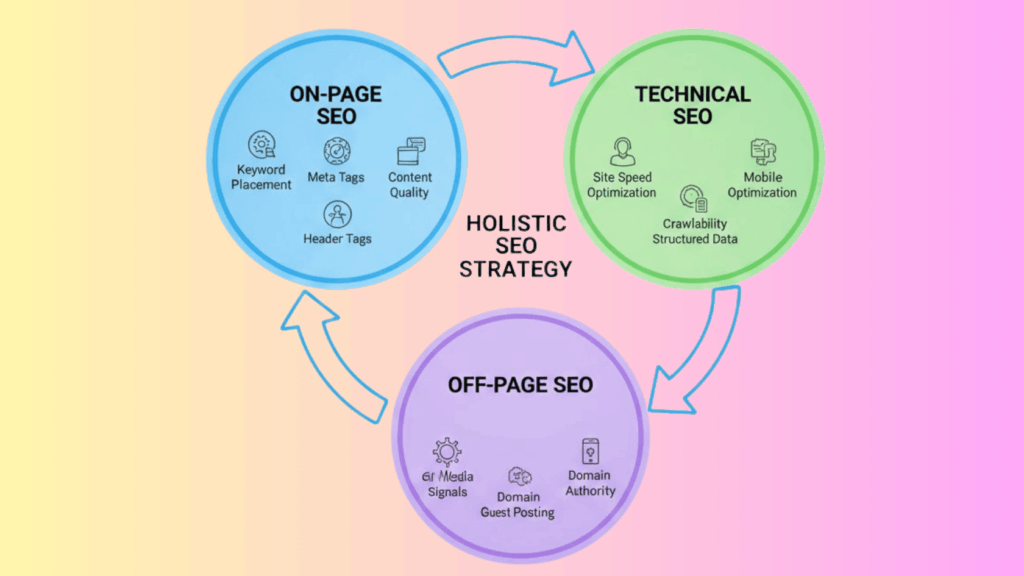
We do more than the basics. Our system creates pages that are optimised for keywords and easy for search engines to read. This includes using header tags and proper internal linking.
Off-page optimisation is about your website’s authority and reputation. This includes getting backlinks from other good sites. Our system helps build a strong content hub, but a good SEO strategy also involves creating content that attracts links.
By focusing on technical excellence, valuable content, and a good user experience, you build a site that search engines and people love.
Measuring Success in SEO
Measuring SEO success is more than just watching your website traffic grow. True success is about the real business results your SEO efforts bring. We look at the important KPIs that show real return on investment and help your business grow.
Key Performance Indicators (KPIs)
Don’t just track rankings. We focus on KPIs that link SEO performance to your bottom line. We look at more than just website traffic. Our reports focus on business results like lead generation and sales.
We track the whole journey, from search to sale. This way, your SEO investment is measured by the revenue it creates, not just rankings.
Tools for Tracking Performance
We use advanced tools to track important KPIs. We combine data from Google Analytics, Search Console, and your CRM. This gives us a full picture.
Our reporting shows you exactly which content and keywords work. We provide clear, actionable insights. We’re your partner, using tools to measure your business growth. For more on this, see our guide on measuring success in programmatic SEO.
We want you to see things clearly. You’ll have a dashboard showing how SEO helps your business goals. It moves from abstract metrics to a clear picture of growth and return on investment.
Integrating Programmatic SEO with Marketing
Programmatic SEO is powerful when it works with other marketing. It’s the heart of a strong digital plan. It helps every part of your online world.
Your SEO pages are like a big library. They attract people looking for specific things. But they can do more. They can help your whole marketing plan grow.
Synergy with Other Marketing Strategies
Programmatic SEO is better when it works with other marketing. It’s part of a holistic marketing approach. This way, your content can reach more people.
For example, a special landing page can be used in a local ad. The data from SEO helps make your ads better. This makes your money go further.
Programmatic SEO works best with other channels:
- Paid Social & Search: Use SEO pages for ads. This makes your ads more effective.
- Email Marketing: Use SEO data to make emails better. This makes your emails more personal.
- Content Amplification: Share your best SEO pages on social media. This builds your authority.
This teamwork creates a strong cycle. SEO gets you traffic. Other channels help that content grow. And all the data makes your strategy better.
Creating a Holistic Marketing Approach
It’s important to have a single plan. A unified strategy means all your marketing works together. They share goals and data.
Your SEO gives you lots of useful data. This data helps your ads, emails, and PR. It makes your customer’s journey smooth.
Working with a full-service digital marketing agency can help. They make sure your SEO helps your whole marketing plan. This helps leads from start to finish.
As one marketing leader said:
“The brands that win are those that break down the walls between SEO, content, and paid media. Programmatic SEO is the perfect data source to unify these efforts.”
Don’t keep your SEO to yourself. By working with your marketing, you create a strong system. It’s more powerful than any one part.
Local SEO Considerations
Programmatic SEO is great for scaling content. But it’s even better when it’s targeted right. For Aussie businesses, focusing on local search is key. It brings in the right customers, looking for your services in your area.
Using programmatic SEO services helps create pages for each location. This makes sure your business shows up where it matters most.

Importance of Local Search in Australia
In Australia, people often search for things nearby. They might look for a “plumber near me” or the “best cafe in [Suburb Name]”. This local search is very important for businesses.
A programmatic SEO approach helps create pages for every suburb or town. This is based on how often people search for things there. It makes sure you rank for the terms your local customers use.
Optimising for Local Searches
Optimising for local search is more than just adding a suburb name. It needs a data-driven approach. Programmatic services are great for this.
They use data to create and optimise pages for each location. This ensures your business’s details are the same everywhere. It also lets you create unique content for each place, at a big scale.
For example, our agency in Unit A11/2A Westall Rd, Clayton VIC 3168 uses this method. We know the local scene because we’re part of it.
| Local SEO Factor | Manual Approach | Programmatic SEO Approach | Impact on Local Ranking |
|---|---|---|---|
| Google Business Profile (GBP) Optimisation | Manual setup, often inconsistent across locations. | Bulk management and optimisation via API, ensuring uniform, complete profiles. | High. GBP is the #1 factor for local “3-pack” rankings. |
| NAP Consistency | Prone to human error across directories. | Automated, error-free NAP distribution across hundreds of local pages. | High. A core local ranking and trust signal for Google. |
| Localised Content | Time-intensive to write unique content for each suburb. | Automated generation of unique, location-specific content for each service area. | High. Drives relevance for hyper-local keywords. |
| Local Citation Building | Manual, slow, and difficult to scale. | Systematic, scalable submission to relevant local directories and data aggregators. | Medium-High. Builds local authority and citation signals. |
This table shows how programmatic SEO saves time. It lets you manage local SEO for many places from one place. It makes local SEO easy and data-driven.
For more info, check our guide on what a local SEO agency should do. It explains the basics.
In short, combining local SEO with programmatic processes makes your business more visible. It turns local search into a reliable way to grow your business.
Case Studies: Success Stories
Seeing is believing. The power of programmatic SEO is shown in real results. We share two case studies that show how data-driven content automation can change businesses. These examples show how we helped clients grow from local to national.
Featured Case Study 1: Local Service Business Expansion
A plumbing and electrical services company had ten locations across three Australian states. They wanted to rank well in local searches without making thousands of pages manually. Their website was just one page, not visible in local searches.
The Challenge: They needed to rank for “plumber in [suburb]” and “electrician near me” in ten areas. Their website was one page, not set up for local SEO.
Our Programmatic Solution: We made a plan for location-based SEO. We created pages for each location, not just by swapping city names. Each page had unique content, FAQs, contact forms, and Google Maps.
The Result: In six months, they saw a 200% increase in local traffic and 150% more service inquiries. They went from 23 local keywords to over 200, with 8 pages on page one for “electrician in [suburb]”.
Featured Case Study 2: E-commerce Content Scaling
An Australian e-commerce retailer sold outdoor gear but struggled with long-tail keywords. They had only 15 blog articles, updated rarely.
The Challenge: They needed to make more content for thousands of product variations and seasonal activities.
Our Programmatic Solution: We used product data and activity templates to create content. We made guides, checklists, destination guides, and comparison tables.
The Result: In 9 months, traffic grew from 30,000 to over 3 million visits. They saw a 300% increase in organic revenue and a 400% increase in traffic. Their content library grew to over 2,000 pages, each targeting specific searches.
“The programmatic approach allowed us to create a content moat around our niche. We’re now the go-to resource for adventure gear advice, and our organic traffic has become our most valuable marketing channel.”
To see how these approaches differ, we’ve put key metrics from both case studies in a table below.
| Metric | Local Service Business | E-commerce Adventure Gear |
|---|---|---|
| Initial Monthly Traffic | ~5,000 visits/month | ~30,000 visits/month |
| Post-Campaign Traffic | 15,000 visits/month | 3,000,000 visits/month |
| Time to Results | 6 months | 9 months |
| Content Scale | 50 location pages | 2,000+ programmatic pages |
| Primary Traffic Source | Local “near me” searches | Long-tail informational queries |
| Key Success Metric | 200% increase in location-specific organic traffic | 400% increase in organic traffic |
These examples show how programmatic SEO works for different businesses. For more programmatic SEO case studies and examples, check our detailed analysis for 2025.
Programmatic SEO isn’t about replacing creativity with automation. It’s about scaling what works. The plumbing company’s pages and the adventure gear retailer’s guides were built on templates. But they delivered exactly what each searcher needed.
Our method combines SEO expertise with content strategy for growth. The table shows that programmatic SEO works for local searches or building a site. Automation, scalability, and data-driven content lead to results.
Common Pitfalls in Programmatic SEO
Using programmatic SEO to grow your content is smart. But, it has dangers you might not see. What are the common traps that can hurt your search ranking? Knowing these traps helps you build a strong strategy.
A good strategy is about quality, not just size. It’s what makes automation work well, not badly.
Issues to Avoid in Programmatic SEO
Automation is great, but it can make mistakes bigger. The main problem is relying too much on it without checking. We aim to solve problems, not create new ones. Here are the main issues to watch out for:
| Pitfall | Impact on SEO | Common Example |
|---|---|---|
| Thin or Duplicate Content | Low-quality, spun, or duplicated content is a primary target for search engine penalties. It devalues your entire site’s authority. | Generating thousands of near-identical location pages with only the city name changed. |
| Keyword Cannibalisation | Multiple pages targeting the same keyword can cause them to compete, splitting their ranking power and confusing search engines. | Having 50 service pages all optimised for “best plumber in [Suburb]” with minimal unique content. |
| Poor Template Design | Rigid, unnatural templates produce robotic, unhelpful content that fails to engage users or answer their queries. | Pages where only the business name and location change, but the core text is a repetitive, keyword-stuffed block. |
| Ignoring User Intent | If content doesn’t match the searcher’s intent, it leads to high bounce rates and signals to Google that the page is irrelevant. | A page targeting “how to fix a leaky tap” that only contains a list of plumbers without a clear, helpful guide. |
These problems often come from focusing too much on making lots of content. This approach can lead to poor content that search engines don’t like.
Strategies for Overcoming Challenges
Success in programmatic SEO is not about avoiding automation. It’s about making it smart and checking quality. Here are our main strategies to avoid common problems:
- Robust Data Validation: We check the data carefully. This ensures the information is right before we create content.
- Human-in-the-Loop Review: We have a human check the content. This adds a touch that machines can’t match.
- Canonical Tags and Silo Structure: We use clear site structure and canonical tags. This stops pages from competing with each other.
- User Intent as the North Star: We make sure content meets the user’s needs. This makes our content useful and relevant.
We don’t replace humans with machines. Instead, we use machines to help us make lots of good content. This way, your content is both wide and useful.
Choosing the Right Programmatic SEO Partner
Finding a good programmatic SEO partner is key. It’s not just about the tools they use. The right partner will help your content grow. The wrong one can waste a lot of money.
Choosing the right partner means looking beyond what they say. You need someone with the right skills, tools, and a proven plan. Let’s look at what makes a partner stand out.
Factors to Consider
Programmatic SEO services vary. Your choice should be based on strategy, not just cost. Focus on these important points:
- Technical & Strategic Expertise: They should know the technical side and how it helps your business.
- Proven Track Record: Look for a strong portfolio and case studies in your field. Ask for real results, not just promises.
- Technology & Transparency: Check the tools they use and if they’re open about their methods. You should always know what’s happening.
- Industry-Specific Experience: A partner who knows your field will make better content. They’ll avoid making low-value pages.

Questions to Ask
Doing your homework is important. Ask tough questions to find the right agency. They should answer clearly and confidently. Here are some key questions:
On Process & Quality:
- “Can you explain how you keep content quality high and avoid bad content?”
- “How do you make sure your content is unique and valuable?”
- “How do you keep improving based on what you learn?”
On Technology & Reporting:
- “What technology do you use for automation, and how do you handle data?”
- “Can you show me a report that shows how your work helps my business?”
We’re so sure about this that we’ve written a guide on choosing the right SEO.
“The right partner doesn’t just do the work; they help your business grow. They think ahead and grow with you.”
Here are the main things to check when comparing:
| Evaluation Criteria | What to Look For | Red Flags |
|---|---|---|
| Expertise & Track Record | Case studies, client testimonials, and examples in your field. | Vague promises, no examples in your field. |
| Technology & Tools | Leading tools for automation and analytics. | Too much manual work or generic tools. |
| Process & Reporting | Clear reports that show how your business is doing. | Reports that don’t show real business results. |
| Cultural & Strategic Fit | A team that talks clearly and gets your business goals. | Generic solutions and poor communication. |
Choosing a programmatic SEO partner is a big deal. The right one will feel like part of your team. They’ll help your business grow, not just do work for you.
If you want a partner who cares about your success, call them. They should have the skills to help your business grow with programmatic SEO services.
Contact Us
Scaling your content and dominating search results is powerful. We’ve looked at how to do it. Now, we’re ready to help you.
Get in Touch for a Consultation
Want to grow your online presence? Our SEO plans are here to help. We make it easy for you to focus on your business.
Location and Contact Details
Ready for a chat? Let’s make a plan to boost your online presence.
Phone: 03 8669 1773
Address: Unit A11/2A Westall Rd, Clayton VIC 3168
Email: info@digifix.com.au
We’re here to boost your Google rank. Contact us to start your SEO journey.
FAQ
What is programmatic SEO and how is it different from traditional SEO?
A: Programmatic SEO uses data to make lots of web pages at once. It’s different from traditional SEO, which does one page at a time. It uses templates and automation to make many pages quickly.
This method turns your data into lots of useful content. Companies like Canva use it to make millions of pages. It’s a key part of modern pSEO strategy.
Why can’t I just do programmatic SEO myself?
A: Doing programmatic SEO yourself is hard. It needs special skills in data, technical SEO, and content systems. A specialist agency has these skills.
They make a system that avoids Google penalties. They handle the hard parts, making your data useful. This saves you from the trouble of doing it yourself.
How does your agency ensure quality with bulk content generation?
A: We make sure the quality is good from the start. We don’t just make pages quickly. We use your data to make pages that are useful and unique.
Our system checks the pages before they go live. This makes sure they are good and not thin content. This is how we make a pSEO strategy work well.
How do you target specific audiences with programmatic SEO?
A: Programmatic SEO is great at targeting people. We use your data to make pages just for certain areas. For example, we can make pages for “emergency plumber in Clayton” and “blocked drain plumber in Glen Waverley”.
We make detailed plans for who we’re making pages for. This makes the pages we make very effective and targeted.
How does this integrate with my other marketing efforts?
A: Programmatic SEO works best with other marketing. The pages we make are great for ads, emails, and PR. For example, a page for a local service can be the perfect ad landing page.
We help you use these pages together. This makes a strong digital plan that helps customers find and buy from you.
We’re an Australian business with multiple locations. How can this help?
A: Programmatic SEO is very helpful for Australian businesses with many places. We can make pages for each place. This helps catch local searches and “near me” searches.
This is key for any local SEO strategy. It helps your business be found by people in your area.
What are the risks, and how do you mitigate them?
A: The main risks are making bad content, using too many keywords, and technical mistakes. We avoid these by checking data, using special tags, and making pages for people, not just keywords.
We also check pages before they go live. This makes sure they are good and not bad. We focus on making quality, not just lots of pages.
What results can we expect and how is success measured?
A: Success is about how well your business does, not just rankings. We look at how many people visit your site, how many keywords rank well, and how many people buy from you.
We show you how your pSEO strategy is helping your business grow. This is how we measure success.
What should I ask a programmatic SEO agency?
A: Ask for examples of their work and results. Ask how they make sure content is good and avoid penalties. Ask how they work with your marketing and how they measure success.
We’re happy to answer these questions. We’re confident in our answers.