
Key Takeaways
- Small businesses benefit from PPC specifically because it allows a local focus: targeting the suburb, postcode, or radius that represents your actual service area
- The cost per lead from a well-managed Google Ads campaign is predictable and scalable in a way that referrals, word of mouth, and organic traffic are not
- Quality Score, not budget, determines Google Ads success: a small business with QS 8 outranks a larger competitor with QS 4 even at half the bid
- The minimum viable budget for a small Melbourne service business to generate meaningful results is typically $800 to $1,500 per month in ad spend
- PPC data (which keywords convert, which messages resonate) feeds back into every other channel including website copy, SEO, and social media strategy
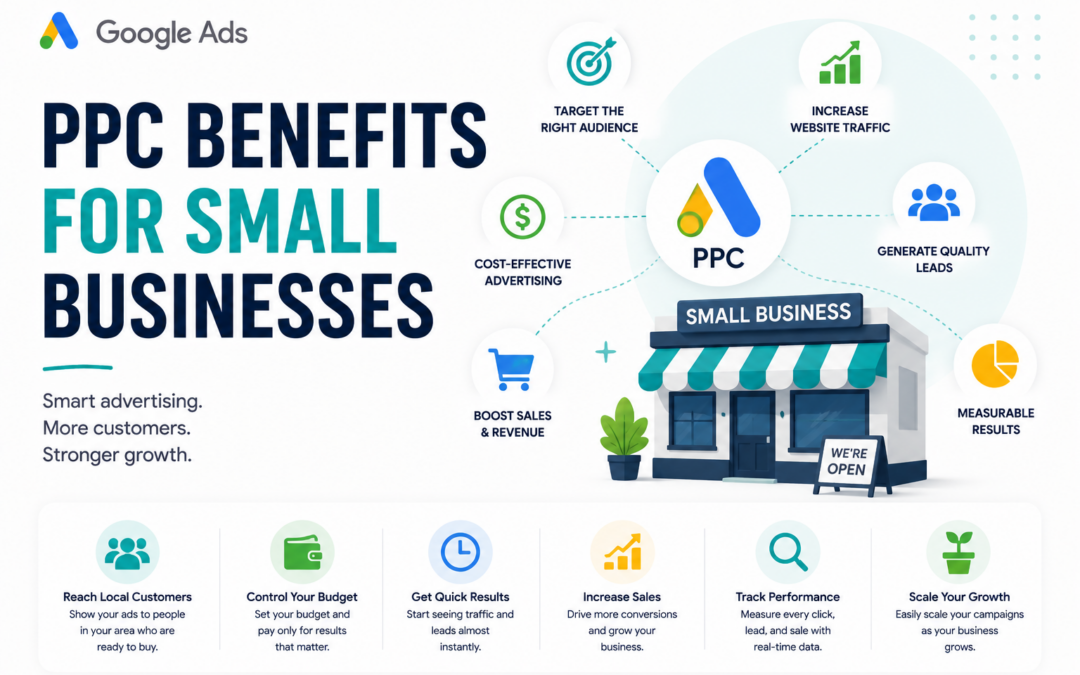
Small businesses face a specific challenge in digital advertising: limited budgets, limited time for management, and the need for every dollar to deliver a measurable commercial return. PPC, when structured correctly for a small business context, addresses all three constraints. It is immediately measurable, can start at modest budgets, and is precisely targetable to the local area where the business actually operates.
This guide addresses PPC specifically from the perspective of small and medium businesses in Australia, covering the strategic case, the realistic cost expectations, the mistakes that cause small business PPC campaigns to fail, and the specific configuration choices that make limited budgets work harder. 
Start at the tier that matches your current budget and objective. Each tier has a specific strategic focus that maximises efficiency at that investment level.
Why PPC Works Particularly Well for Small Businesses
The conventional wisdom that Google Ads favours large budgets is not accurate. The auction mechanism rewards relevance, not spend. A small electrical business in Fitzroy bidding $3.50 on 'licenced electrician Fitzroy' with a Quality Score of 8 and a dedicated landing page will typically outrank a large national trades platform bidding $7 on the same keyword with a Quality Score of 4 and a generic directory page.
This quality-over-quantity dynamic creates a genuine opportunity for small businesses that invest in the structural quality of their campaigns. Three factors that small businesses can control entirely give them a consistent advantage: ad relevance (writing ad copy that includes the exact keyword and a specific local value proposition), landing page quality (a fast-loading page with a clear single CTA matched to the ad), and negative keyword precision (blocking irrelevant queries that a large platform's campaign cannot efficiently filter at the ad group level).
The local specificity argument is equally important. A small trades business in South Melbourne with a campaign targeting a 10-kilometre radius around its base generates highly relevant local traffic at CPCs below what national competitors with geographic inefficiency pay. Local targeting precision is a competitive advantage that small businesses inherently possess and should exploit systematically.
The 4 Most Common PPC Mistakes Small Businesses Make
Mistake 1: Too broad, too cheap, too fast. The most frequent small business PPC mistake is using Broad Match keywords with a minimal budget and no negative keyword list. Broad Match tells Google to show your ad for any search related to your keyword. 'Plumber' on Broad Match will show for 'plumber salary', 'plumber cost estimate', 'free plumber advice', and 'plumber training'. A $1,000 monthly budget disappears in days without generating a single commercial lead. The fix is simple: use Phrase Match and Exact Match for all keywords and load 50+ negatives before spending a dollar.
Mistake 2: No conversion tracking. Launching a campaign without tracking which clicks become enquiries is the equivalent of running a retail store without a till. You know money is going in but you have no idea what is coming out or what caused it. Conversion tracking installation is a one-time technical setup that takes approximately 2 hours and should be the absolute first action before any campaign is created.
Mistake 3: Sending all traffic to the homepage. The homepage of most small business websites is designed to introduce the business broadly. It has navigation to five or six sections, multiple CTAs, and a message appropriate for everyone. A user who clicked on 'commercial kitchen cleaning Melbourne' and lands on a homepage that also promotes residential cleaning, one-off cleans, and end-of-lease services is not being efficiently served. A dedicated page specific to the service they searched for converts at 3 to 5 times the rate of a homepage.
Mistake 4: Setting and forgetting. Many small business owners launch a Google Ads campaign, check the results once a week at best, and assume if nothing is obviously broken then things are working. Without a weekly 30-minute review, Search Term Reports accumulate irrelevant queries that slowly bleed budget, Quality Scores erode as ads age without refresh, and optimisation opportunities are missed. The compound effect of these small degradations is significant over 3 to 6 months.
Small Business PPC Budget Planner
Enter your monthly ad budget to see a recommended allocation and realistic performance expectations.
Want a small business Google Ads campaign built to perform from day one?
Book a free 30-minute consultation with Nel. We work specifically with Melbourne small and medium businesses and understand the budget constraints and ROI requirements that matter to you. Walk away with a clear plan, no obligation.
Book your free consultation
Tick every item before spending a dollar. The cost of skipping any one of these is typically much higher than the time saved.
The Right Budget for a Small Business PPC Campaign
One of the most common questions from small business owners is what the minimum viable budget for Google Ads is. The answer depends on your industry (which determines CPC) and your target leads per month, but a useful starting point for most Melbourne service businesses is $800 to $1,500 per month in ad spend.
Below $800 per month, most service businesses in Melbourne cannot generate enough clicks per day (typically fewer than 8 to 10) to give the campaign enough data to optimise meaningful decisions within a reasonable timeframe. With fewer than 50 to 60 clicks per week, conversion data accumulates too slowly for keyword-level performance to be statistically meaningful, which means optimisation decisions are based on insufficient data.
Above $1,500 per month, the additional budget buys more clicks from a larger keyword set, which generates more leads but also more data for optimisation. The efficiency per click typically improves as the campaign accumulates data, meaning cost per lead often falls as budget increases, up to the point where search volume constraints are reached in a given local market.
The Budget Planner above gives you a specific estimate for your industry and business type. As a rule of thumb: budget = target leads per month multiplied by your target cost per lead. If you want 15 leads per month at $75 each, you need $1,125 in ad spend as a baseline, not accounting for the optimisation journey to reach that target CPL. Our keyword strategy guide covers how to stretch a limited budget further through keyword selection discipline.

These results came from a Melbourne home services business. Same suburb, same service, same budget. Expert management transformed every metric.
How Small Businesses Can Compete Against Larger Competitors
Small businesses competing in Google Ads against national brands or larger local competitors often assume the fight is unfair. In practice, the structural advantages available to a small, locally focused business are significant.
Local specificity: a small business can restrict its ads to the exact service area it covers. A plumber who works in inner Melbourne only needs to target inner Melbourne postcodes. Every click from outer suburbs is wasted spend for them but not for a national directory. That geographic precision is an inherent advantage.
Service specificity: a small business typically offers a narrower service range than a large competitor. This means its ad groups can be extremely tightly themed (one service per ad group, one landing page per service), which drives Quality Scores above 7 consistently. A national platform showing ads for dozens of services in a single ad group has lower relevance scores by definition.
Relationship and trust signals: small businesses can use local trust signals that national brands cannot match. 'Family-owned since 2008. 847 five-star reviews. Carlton-based.' is a more compelling message to a local buyer than a generic national brand. These messages fit naturally into Google Ads callout extensions and headlines.
At DigiFix, we manage Google Ads specifically for Melbourne small and medium businesses. Our approach builds every campaign on the three local advantages above, and our results show that properly structured local campaigns consistently achieve lower CPLs than industry benchmarks. See our Google Ads management service for the specifics of how we work.
Ready to launch a small business Google Ads campaign that actually delivers?
Book a free 30-minute consultation with Nel. We will build you a realistic budget plan, show you the keyword opportunities in your specific local market, and give you an honest estimate of what results to expect. No obligation, no hard sell.
Book your free consultation