
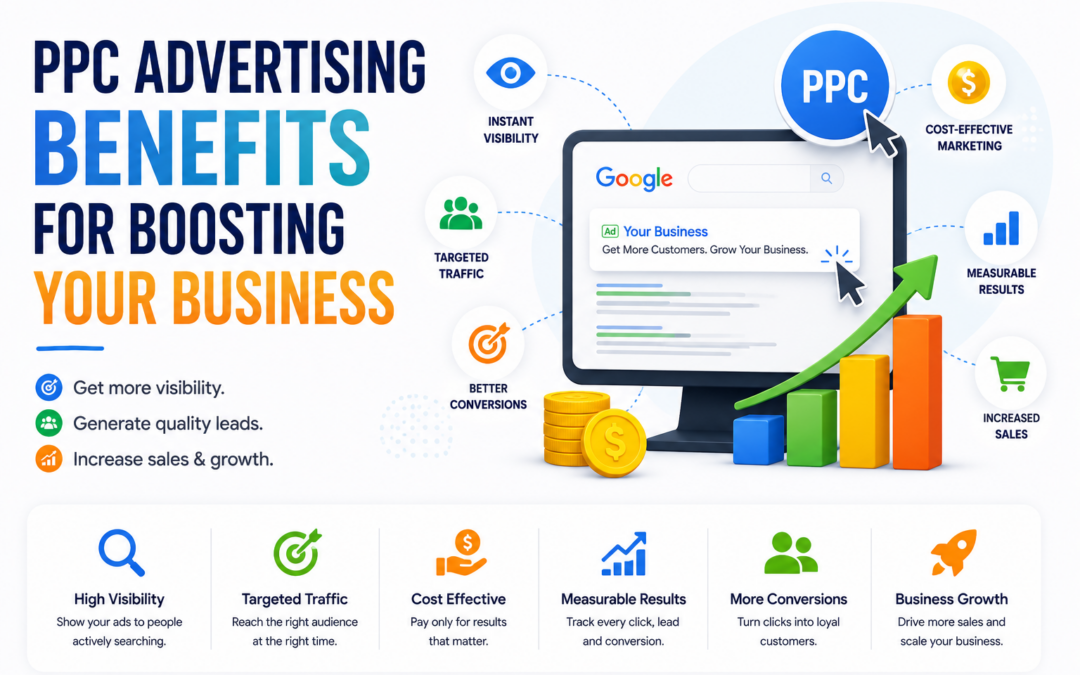
Key Takeaways
- PPC (pay per click) advertising delivers six core benefits: instant visibility, precise targeting, measurable ROI, budget flexibility, competitive advantage, and brand authority
- Unlike traditional advertising, you pay only when someone clicks your ad, meaning every dollar spent is a response from someone who saw your message
- PPC reaches customers at the highest point of purchase intent, when they are actively searching for a solution to the problem your business solves
- The measurability of PPC transforms advertising from a cost centre into a revenue lever where data drives every budget decision
- Small and medium Australian businesses can compete at the top of Google search results against larger competitors through quality and relevance, not budget alone
PPC advertising, in the context of Google Ads, means paying a fee each time a user clicks on one of your ads. That click represents a user who has actively searched for something related to your product or service, which makes it fundamentally different from impression-based advertising where you pay for visibility regardless of engagement. Understanding PPC's specific benefits helps you evaluate whether it is the right channel for your business goals and at what point in your growth strategy it makes the most sense to deploy.
This guide covers each of the six core benefits of PPC advertising in practical terms, explains what each means for Melbourne businesses, and addresses the common misconceptions that lead businesses to underinvest in or misuse the channel. For the foundational knowledge needed before launching your first campaign, see our guide on what every Australian company must know about PPC.

PPC delivers on all six dimensions simultaneously. No other single advertising channel achieves this combination.
Benefit 1: Instant Visibility at the Moment of Purchase Intent
The most immediate benefit of PPC advertising is the ability to place your business at the top of Google search results within 24 to 48 hours of launching a campaign. This speed has no equivalent in digital marketing. Search engine optimisation, content marketing, and brand building all require months of investment before generating meaningful visibility. Google Ads delivers top-three placement almost immediately.
Critically, this visibility is not random. It occurs precisely when a user searches for a keyword you are bidding on, meaning the user is actively looking for a solution. When a business owner in Carlton types 'commercial cleaning service Melbourne', they are in market. When your ad appears in that moment, you are reaching a buyer, not an audience member.
This is why businesses in competitive industries where organic rankings take years to establish use Google Ads as their primary lead generation engine. The alternative, waiting for SEO results while competitors own search visibility, represents a direct cost in leads and revenue. See the data comparison in the Ahrefs blog on organic vs paid traffic acquisition timelines for more context on this speed differential.
Benefit 2: Precision Targeting Across 8 Dimensions
Google Ads allows you to layer eight distinct targeting dimensions on top of your keyword selection. You can restrict ads to users within 5 kilometres of your Melbourne office, showing only on mobile devices, between 8am and 6pm on weekdays, to users who have previously visited your website and are in the in-market audience for your service category. No other advertising channel provides this combination.
The commercial significance of this precision is that your budget concentrates on your most likely buyers. A Melbourne plumber who restricts their ads to the inner suburbs, mobile users, and business hours will spend significantly less per lead than one who lets their campaign run nationally 24 hours a day with broad match keywords. The precision is not just a targeting feature. It is a budget efficiency mechanism that directly impacts cost per acquisition.
PPC Benefits Deep-Dive Explorer
Click each benefit to explore what it means in practice for your Melbourne business.
Google Ads puts your business at the top of search results within 24 to 48 hours.
This speed advantage is particularly valuable for new businesses that cannot wait for organic authority to build, for seasonal businesses that need to capitalise on short windows of demand, and for any business in a competitive market where organic page one is dominated by established players.
Want to understand which PPC benefits apply most to your specific business?
Book a free 30-minute strategy consultation with Nel. We will review your business model, target customer, and current lead sources, then show you specifically how PPC's benefits map to your growth goals.
Book your free consultation
PPC wins on every dimension that drives commercial efficiency. The gap between PPC and traditional advertising is widening every year.
Benefit 3: Complete ROI Measurability
One of the most significant competitive advantages of PPC over traditional advertising is the ability to measure every outcome with precision. When a user clicks your ad and fills in your contact form, you can see which keyword triggered the ad, which device they were using, what time of day it was, where they were located, how long they spent on your page, and whether they converted. This level of attribution is simply not available from television, radio, print, or even most social media advertising.
The practical business impact is that you can make budget decisions with data rather than intuition. If keyword A generates leads at $45 each and keyword B generates leads at $280 each, you shift budget from B to A. If mobile traffic converts at half the rate of desktop traffic, you reduce your mobile bid. These are not sophisticated insights. They are obvious decisions made possible only by the measurability that PPC provides. HubSpot research consistently shows that businesses using data-driven marketing attribution generate 20% higher revenue than those relying on last-touch or no attribution.
Benefit 4: Budget Flexibility and No Minimum Commitment
Unlike traditional advertising formats, Google Ads has no minimum campaign spend, no contract period, and no penalty for pausing or stopping a campaign. You can start with $20 per day, pause over Christmas, double your budget in September when your seasonal demand peaks, and reduce back in the quiet season. This flexibility is genuinely valuable for the way Australian small and medium businesses actually operate.
The pay-per-click model itself is also a form of budget efficiency. In impression-based advertising (television, display, outdoor), you pay for everyone who sees the ad, whether they are interested or not. In PPC, you pay only when someone clicks, meaning every dollar you spend has produced an active response from a user. A campaign that receives 1,000 impressions but 40 clicks means 40 people chose to engage with your ad. You pay for the 40, not the 1,000.

Your industry benchmark determines what a successful ROAS looks like for your business. Compare your current return against these figures.
Benefit 5: Competitive Advantage Through Quality, Not Budget
Google Ads uses a quality-adjusted auction mechanism called Ad Rank, which determines advertising position based on the product of your maximum bid and your Quality Score (a 1 to 10 relevance rating). This mechanism means a well-optimised campaign with a Quality Score of 8 can outrank a competitor with a Quality Score of 4 who is bidding twice as much. Budget alone does not determine success.
For small and medium Melbourne businesses competing against national chains or well-funded competitors, this is strategically significant. A local business with a precisely relevant, well-structured campaign targeting highly specific local keywords can consistently appear above a large national competitor with a generic, poorly-optimised campaign. The level playing field created by quality-based ranking is one of the most underappreciated aspects of the Google Ads system.
At DigiFix, we build every client campaign around maximising Quality Score as the primary cost-reduction mechanism. A business that achieves QS 8 to 9 on its primary keywords pays 28 to 43% less per click than a competitor with QS 5, creating a sustained competitive cost advantage that compounds as the campaign matures. Our full approach is outlined on our Google Ads management page.
Want to access all 6 PPC benefits for your Melbourne business?
Book a free 30-minute consultation with Nel. We will show you exactly how each of these benefits applies to your specific market, industry, and business goals, and give you a clear picture of what a professionally managed campaign would deliver. No obligation.
Book your free consultation