

Effective on-page SEO techniques are the foundation of any website that ranks and converts. Without getting the on-page fundamentals right, even the best link building campaign will struggle to move the needle.
Key Takeaways
- On-page SEO techniques cover everything that lives on your page: content, HTML tags, internal links, and page structure.
- Text relevance is confirmed by Semrush as the single most important Google ranking factor.
- Title tags and meta descriptions are still critical, and 7.4% of top-ranking pages are missing a title tag entirely, according to Ahrefs.
- Core Web Vitals are now a confirmed Google ranking signal and directly influence your page experience scores.
- Internal linking distributes page authority and helps Google understand your site structure.
- DigiFix provides free, no-obligation SEO audits for Melbourne businesses to identify on-page gaps fast.
Mastering on-page SEO techniques gives you direct control over how search engines interpret and rank your content. This guide covers every major on-page element, from title tags and meta descriptions through to content structure, internal linking, and Core Web Vitals. Whether you are optimising an existing page or building something new, applying these techniques consistently will set you up for stronger rankings and better user experiences.
Want an expert to review your on-page SEO?
DigiFix offers free SEO audits for Melbourne businesses. We will identify exactly which on-page issues are holding your rankings back and show you how to fix them.
What Are On-Page SEO Techniques?
On-page SEO refers to all the optimisations you make directly on a webpage to improve its visibility in search results. This includes the content itself, the HTML markup, the URL structure, internal links, images, and the technical performance of the page. Every element you can control on the page falls under this umbrella.
Off-page SEO covers factors outside your direct control, such as backlinks from other websites. While both matter, on-page SEO is where you start. You cannot control what other sites say about you, but you have full ownership over the quality and structure of every page you publish.
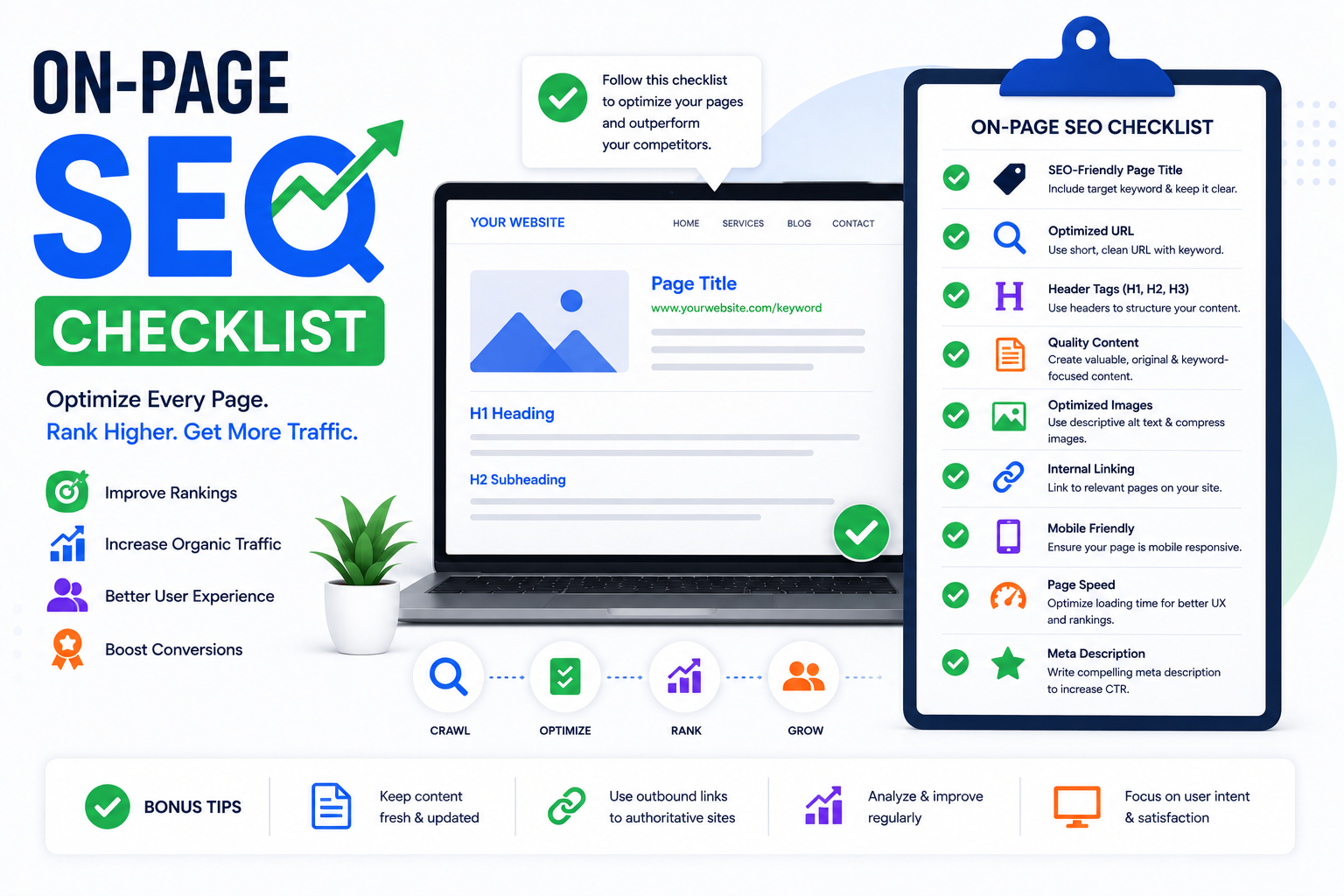
Title Tags: Your Most Visible On-Page SEO Signal
The title tag is the clickable headline displayed in search results and browser tabs. It is one of the strongest on-page SEO signals you can control. According to Ahrefs, 7.4% of top-ranking pages do not have a title tag at all, which means even basic optimisation here can give you a competitive edge.
How to Write Effective Title Tags
Keep title tags between 50 and 60 characters so they display fully in search results. Place your primary keyword toward the front of the tag. Write for the user first and search engines second. A title that earns the click is more valuable than one that simply contains a keyword. Avoid repeating keywords and never use the same title tag across multiple pages.
Meta Descriptions: Earning the Click
Meta descriptions do not directly influence rankings, but they have a significant effect on click-through rate. A well-written meta description tells the searcher exactly what they will get when they click your link. According to Semrush research, Google rewrites meta descriptions 62.78% of the time. But when Google uses yours, it needs to be compelling.
Keep meta descriptions under 160 characters, include your primary keyword naturally, and end with a clear reason to click. If you are working through an on-page audit, book a free consultation with the DigiFix SEO team to get your meta tags reviewed professionally.
Content Quality and On-Page SEO Techniques That Work
According to Semrush’s ranking factors research, text relevance is the most important Google ranking factor. This means your content needs to genuinely answer the searcher’s query better than any competing page. Keyword stuffing is counterproductive. What Google rewards is depth, clarity, and genuine usefulness.
Writing Content That Ranks
Start by understanding search intent. What does the person searching your target keyword actually want? Are they looking for information, a product, a comparison, or a local service? Your content format and depth should match that intent precisely.
Use your primary keyword in the first 100 words, in at least one H2 heading, and naturally throughout the body text. Add related terms and synonyms to build semantic depth. The SEO services at DigiFix include content optimisation as a core component of every campaign.
| On-Page Element | Priority | Key Rule |
|---|---|---|
| Title Tag | Very High | Keyword near the front, 50 to 60 characters |
| Meta Description | High | Under 160 characters, include a clear value proposition |
| H1 Heading | Very High | One per page, includes primary keyword |
| Body Content | Very High | Match search intent, use semantic keywords |
| URL Slug | Medium | Short, keyword-rich, hyphens only |
| Internal Links | High | Descriptive anchor text, link to relevant pages |
| Image Alt Text | Medium | Describe the image accurately, include keyword naturally |
Swipe to scroll the table on mobile
Not sure which on-page elements need fixing first?
Get a prioritised on-page SEO audit from the DigiFix team. We will show you exactly which changes will have the biggest impact on your rankings and traffic.
Heading Structure and Content Organisation
A clear heading hierarchy helps both search engines and readers navigate your content. Use one H1 per page for your primary keyword. Use H2s to introduce major sections, and H3s for subsections within those. Avoid skipping heading levels, and never use headings purely for visual formatting.
Including your primary keyword in at least one H2 is good practice, but do not force it. Readers scan headings before deciding to read the body text, so each heading needs to communicate clear value and move the reader forward through your content.
Internal Linking: A Powerful On-Page SEO Technique
Internal linking is one of the most underused on-page SEO techniques in Australian digital marketing. Every time you link from one page on your site to another, you pass authority and context between them. This helps Google understand which pages are most important and how they relate to one another.
Use descriptive anchor text that tells readers and search engines what the destination page is about. Avoid generic phrases like “click here” or “read more”. Instead, use contextual phrases such as “our Melbourne SEO services” or “on-page optimisation guide”. For more on building an effective SEO strategy, visit the DigiFix SEO blog.
7 Core On-Page SEO Techniques to Apply Today
Optimise Title Tags
Place the primary keyword near the front and keep tags between 50 and 60 characters.
Write Compelling Meta Descriptions
Under 160 characters, include a clear benefit and natural keyword usage.
Match Search Intent
Align your content format and depth with what the searcher actually wants to find.
Structure Headings Clearly
Use one H1, then H2s and H3s to organise your content into a logical hierarchy.
Build Internal Links
Link between related pages with descriptive anchor text to pass authority and context.
Optimise Images
Use descriptive alt text, compress file sizes, and use modern formats like WebP.
Improve Core Web Vitals
Optimise LCP, CLS, and INP to meet Google’s page experience standards.
Apply all seven on-page SEO techniques together for the strongest cumulative impact.
URL Structure and Page Architecture
A clean URL structure makes your pages easier to understand for both Google and your visitors. Keep URLs short, use hyphens to separate words, and include the primary keyword where it fits naturally. Avoid using stop words, dynamic parameters, or unnecessary subdirectories in your URLs.
Your page architecture should reflect the logical hierarchy of your content. Important category pages and service pages should sit close to the root domain, while supporting content sits one or two levels deeper. This structure ensures link equity flows efficiently through your site.
Core Web Vitals and Page Experience
Google has confirmed that Core Web Vitals are a ranking signal. These metrics measure real-world user experience across three dimensions: Largest Contentful Paint for load speed, Cumulative Layout Shift for visual stability, and Interaction to Next Paint for responsiveness. Pages that score well tend to rank higher in competitive search results.
To improve your scores, compress and properly size images, remove render-blocking scripts, use efficient caching, and minimise layout shifts caused by dynamically loaded content. The team at DigiFix handles Core Web Vitals improvements as part of comprehensive technical SEO engagements.
How Strong Is Your On-Page SEO Right Now?
Tick every statement that accurately describes your current website. Be honest for the most useful score.
E-E-A-T and On-Page Trust Signals
Google evaluates content through the lens of Experience, Expertise, Authoritativeness, and Trustworthiness, known as E-E-A-T. Strong on-page signals include named authors with credentials, citing reputable sources, accurate and up-to-date information, and a clear connection between the content topic and the expertise of the organisation publishing it.
For Australian service businesses, demonstrating local expertise and genuine industry knowledge in your content is one of the most powerful ways to build E-E-A-T. Include specific examples, client outcomes, and relevant credentials where appropriate. This signals to Google that your content is trustworthy and written from firsthand experience.
Image Optimisation as an On-Page SEO Priority
Images contribute to both page experience and search visibility. Every image on your page should have descriptive alt text that includes your keyword naturally where it fits. File sizes should be compressed without visible quality loss, and modern formats such as WebP should be used where your platform supports them.
Unoptimised images are one of the most common causes of poor Core Web Vitals scores, particularly for Largest Contentful Paint. Fixing image optimisation often has an immediate and noticeable impact on page speed scores. For a complete technical review of your on-page elements, explore the full range of SEO services available from DigiFix.
Get Expert On-Page SEO Support for Your Business
Book a free, no-obligation consultation with the DigiFix team. We will audit your on-page SEO, identify the highest-impact opportunities, and give you a clear action plan. Free, honest, and no strings attached.