

Local SEO services Melbourne businesses trust are built for one goal, getting your shopfront or trade van found before the competitor down the road. When someone nearby searches for what you sell, you want your business in front of them, not on page two. This guide explains how it works and what it costs.
Key Takeaways
- Full disclosure, this guide is published by DigiFix, a Melbourne digital marketing agency. The framework below applies whichever agency or in-house team you choose.
- Local SEO services Melbourne businesses use focus on three pillars, Google Business Profile, on-page signals, and local citations.
- Ranking in the local map pack brings substantially more calls and direction requests than sitting further down the results.
- Reviews, response speed, and consistent business details across the web all influence local rankings.
- Most Melbourne small businesses see meaningful movement within three to six months of consistent work.
- Pricing varies by suburb competitiveness and the number of locations you manage.
Nearly half of all Google searches are now looking for local information, according to HubSpot research. That is a huge pool of nearby customers actively looking for a business exactly like yours. Good local SEO services Melbourne wide are what turn that search volume into phone calls, bookings, and foot traffic.
For a suburb-based business, this matters more than broad national rankings ever could. A plumber in Brunswick does not need to rank in Perth. They need to own the three to five kilometre radius where their actual customers live and search.
This is true across almost every trade and profession in Melbourne, from cafes and hairdressers to accountants and mechanics. Whoever shows up first in that nearby search usually gets the enquiry.
Not sure where your business currently stands in local search results. Book a free local SEO check and we will show you exactly where the gaps are.
What Local SEO Services Include
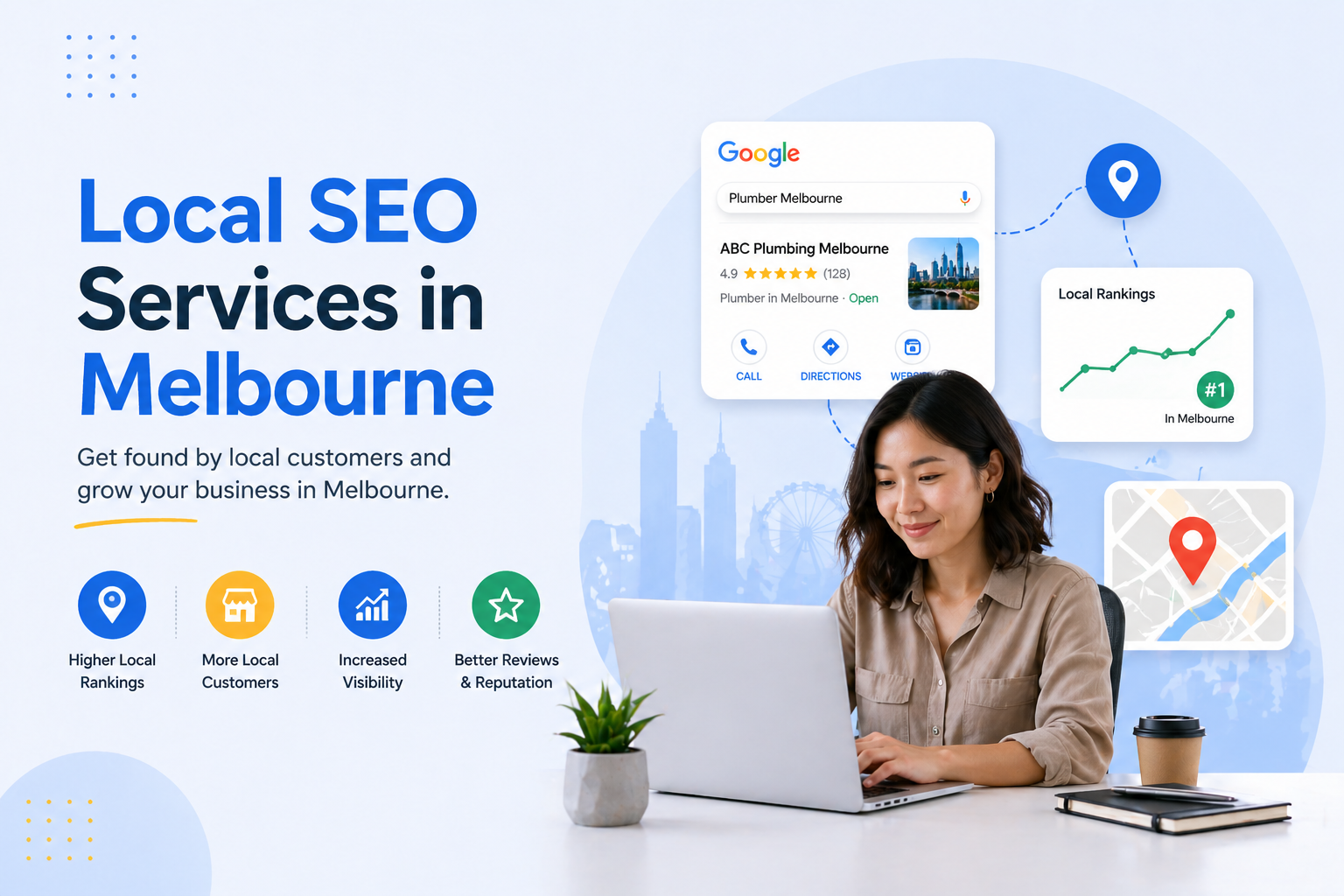
A proper local campaign starts with your Google Business Profile. This is the listing that shows up with your map pin, opening hours, and reviews when someone searches nearby.
Beyond the profile, on-page signals matter too. Your website needs suburb-specific pages, clear service descriptions, and schema markup that tells Google exactly where you operate and what you do.
Regular Google Business Profile posts and fresh photos keep a listing looking active. Google tends to favour profiles that show ongoing engagement over ones left untouched for months at a time.
The Q&A section on a profile is worth watching too. Answering common questions publicly, before a customer even has to ask, builds trust and can reduce repetitive phone enquiries.
Content That Supports Rankings in Your Area
Blog posts about local events, seasonal tips, or community involvement help a website feel genuinely rooted in its area. This kind of content also earns natural local backlinks over time.
A cafe writing about a nearby festival, or a plumber explaining how Melbourne’s older homes affect pipework, both signal real local expertise rather than a generic template dropped into a suburb.
Citations and Consistency
A citation is any online mention of your business name, address, and phone number. Directories, industry associations, and local news sites all count.
Inconsistent details across these listings confuse search engines and quietly damage rankings. Cleaning this up is unglamorous work, but it makes a real difference.
A common example is a business that moved premises two years ago but still has the old address listed on ten different directories. Fixing that alone can noticeably lift local visibility.
How Google Maps Rankings Work
The map pack is the block of three businesses shown with a map above the standard organic results. Businesses that appear there capture the vast majority of local clicks.
Businesses in the map pack get 126% more traffic and 93% more calls and direction requests than those ranked lower, according to HubSpot data. That gap explains why so many Melbourne owners chase this specific placement.
Around 92% of searchers choose a business shown on the first page of local results. If you are not visible there, you are effectively invisible to most nearby customers.
The Mobile Connection
Local searches happen mostly on phones, often while someone is already out and about. Around 76% of people who search for something nearby on a smartphone visit a business within a day, per HubSpot’s local search research.
This is why a slow, clunky mobile site quietly costs Melbourne businesses real customers every week. If your website is not mobile friendly, local SEO work alone will not fix the leak.
A visitor who taps through from a map listing expects your phone number, address, and opening hours within a second or two of the page loading. Burying that information forces people to give up and call a competitor instead.
Click-to-call buttons, a visible map embed, and large readable text all make a genuine difference on a small screen. These small details often get overlooked in favour of flashier design choices.
| Local SEO Factor | Why It Matters | Typical Effort |
|---|---|---|
| Google Business Profile | Powers the map pack listing | Ongoing, weekly posts and photos |
| Reviews | Trust signal for Google and customers | Ongoing, request after every job |
| Citations | Confirms your details are consistent | One-off cleanup, then quarterly checks |
| Suburb pages | Targets each service area directly | One-off build, occasional updates |
| Local backlinks | Builds authority within your area | Ongoing, a few per month |
Swipe to scroll the table on mobile
Suburb Pages, Reviews and Citations
Start by auditing your Google Business Profile. Check that categories, hours, and photos are current, and reply to every recent review.
Next, fix citation inconsistencies across major directories. Even small mismatches, like a missing suite number, can hold back rankings.
Then build or refresh suburb-specific landing pages with genuine, useful content rather than duplicated text with the suburb name swapped in.
Finally, set up simple monthly tracking. Watch map pack position for your core terms, phone call volume, and direction requests, since these three numbers tell you whether the work is paying off.
Want a Plan Built Around Your Business
Every suburb and industry is different. Get a free consultation and we will map out a plan specific to your service area.

Local Search Versus Broader SEO
Broad organic SEO chases national or industry-wide rankings, which usually takes longer and costs more. It suits businesses that ship products anywhere or serve clients Australia wide.
A suburb-based trade or clinic does not need that scale. Narrowing the target to a handful of Melbourne suburbs means less competition and a faster path to page one.
That said, the two approaches share a foundation. Fast page speed, clear content, and solid technical structure help both local and national rankings, so nothing here is wasted effort.
Common Mistakes That Slow Down Local Rankings
The most common mistake is leaving a Google Business Profile half finished, with missing hours, no photos, and an outdated category. This tells Google, and customers, that nobody is minding the shop.
Another frequent issue is keyword stuffing suburb names into thin pages with little real content. This approach used to work years ago, but it now does more harm than good.
Ignoring negative reviews is a third mistake. A calm, professional reply to a bad review often reassures future customers more than a wall of five-star ratings alone.
Reviews Are a Ranking Factor, Not Just Social Proof
Search results consider the number of reviews, average rating, and how recently they were left. A steady flow of fresh reviews signals an active, trustworthy business.
Ask happy customers directly after a job is done. A simple text with a review link performs far better than a generic email months later.
It also helps to reply to every review, good or bad, within a day or two. Prompt, genuine responses show future customers that someone is actively paying attention to the business.
Profile and citation audit, cleaning up every listing
Suburb pages and on-page fixes across the website
Reviews, local links, and ongoing monthly reporting
A simple three-stage view of how local SEO work typically rolls out.
Local SEO Timeline and Reporting
Local rankings tend to move faster than broad national SEO because competition is limited to a smaller geographic pool. Many Melbourne businesses see initial movement within eight to twelve weeks.
A team like DigiFix tracks ranking position, calls, and direction requests monthly so you can see the trend, not just a single snapshot. Whoever you work with, insist on that level of transparency.
Highly competitive suburbs, like inner Melbourne cafe strips or busy legal precincts, can take longer simply because more businesses are fighting for the same handful of map pack spots. A realistic timeline should account for your specific industry, not a generic average.
Seasonal businesses should also expect some natural fluctuation. A landscaper’s rankings might climb through spring and settle over winter, which is normal and not a sign that the work has stopped.
Patience matters here. Chasing quick fixes or shortcuts can trigger penalties that take far longer to undo than the time saved, so steady, consistent effort remains the safer path.
Is Your Business Ready for Local SEO
Tick everything that already applies to your business.
Choosing a Melbourne Local SEO Partner
Ask any agency for examples of suburb-level results, not just broad national case studies. Local SEO is a different skill set to enterprise SEO.
We covered a related project on our Melbourne case study page, which shows what a focused local campaign can look like in practice. You can also browse more guides on our SEO blog.
Whichever team you choose, DigiFix included, look for clear monthly reporting and a plan tailored to your actual service area rather than a generic template.
It also helps to ask how a provider handles multi-location businesses, since managing five suburb listings takes a different process to managing one. Get a straight answer before signing anything.
Contracts worth checking closely include how long you are locked in, who owns the Google Business Profile access, and what reporting you receive each month. Clarity here avoids awkward surprises later.
Ready to Get Found Locally
The consultation is completely free, with no obligation to sign up. Claim your free local SEO consultation and see exactly where your business stands.