

Metehan CC Rank Checker: Understanding Your Website’s Authority in the AI Era
Search engine optimization is evolving rapidly. Traditional ranking signals such as backlinks, domain authority, and content quality still matter, but a new layer has entered the conversation: AI visibility. As large language models (LLMs) increasingly rely on massive web datasets for training, SEO professionals are asking an important question: How often does my website appear in the data used to train AI models?
This is where the Metehan CC Rank Checker becomes valuable. Developed by international SEO consultant Metehan Yesilyurt, the tool enables marketers and SEO professionals to examine how their domains are represented within the datasets generated by Common Crawl, one of the largest open datasets of the web.
The Metehan CC Rank Checker helps practitioners analyze domain authority inside the Common Crawl Web Graph, offering insights into how websites are interconnected and how frequently they may appear in data that feeds AI models.
The Question That Sparked the Tool
Metehan Yesilyurt spent several months analyzing Common Crawl datasets. During this work, a question kept resurfacing in the SEO community:
“What about the training data?”
Modern AI systems rely heavily on large datasets from the web. Since Common Crawl provides a massive open archive of the internet, it naturally became a key source used in AI training pipelines. If your website appears frequently in these datasets, there is a greater chance that AI systems will reference or learn from it.
To help SEOs understand this visibility, Metehan built a free tool called the CC Rank Checker, available at: CC Rank Checker.
This tool makes complex web graph data accessible in a simple interface for marketers, analysts, and website owners.
What Are Web Graphs?
Every month, Common Crawl releases a massive dataset that maps how websites link to one another across the internet. This dataset is called the Web Graph.
Think of the internet as a giant network:
- Every website is a node.
- Every link between sites is a connection.
- The structure formed by billions of links becomes the web graph.
The Web Graph dataset includes billions of connections between domains, helping researchers and SEO professionals to learn how authority flows through the web.
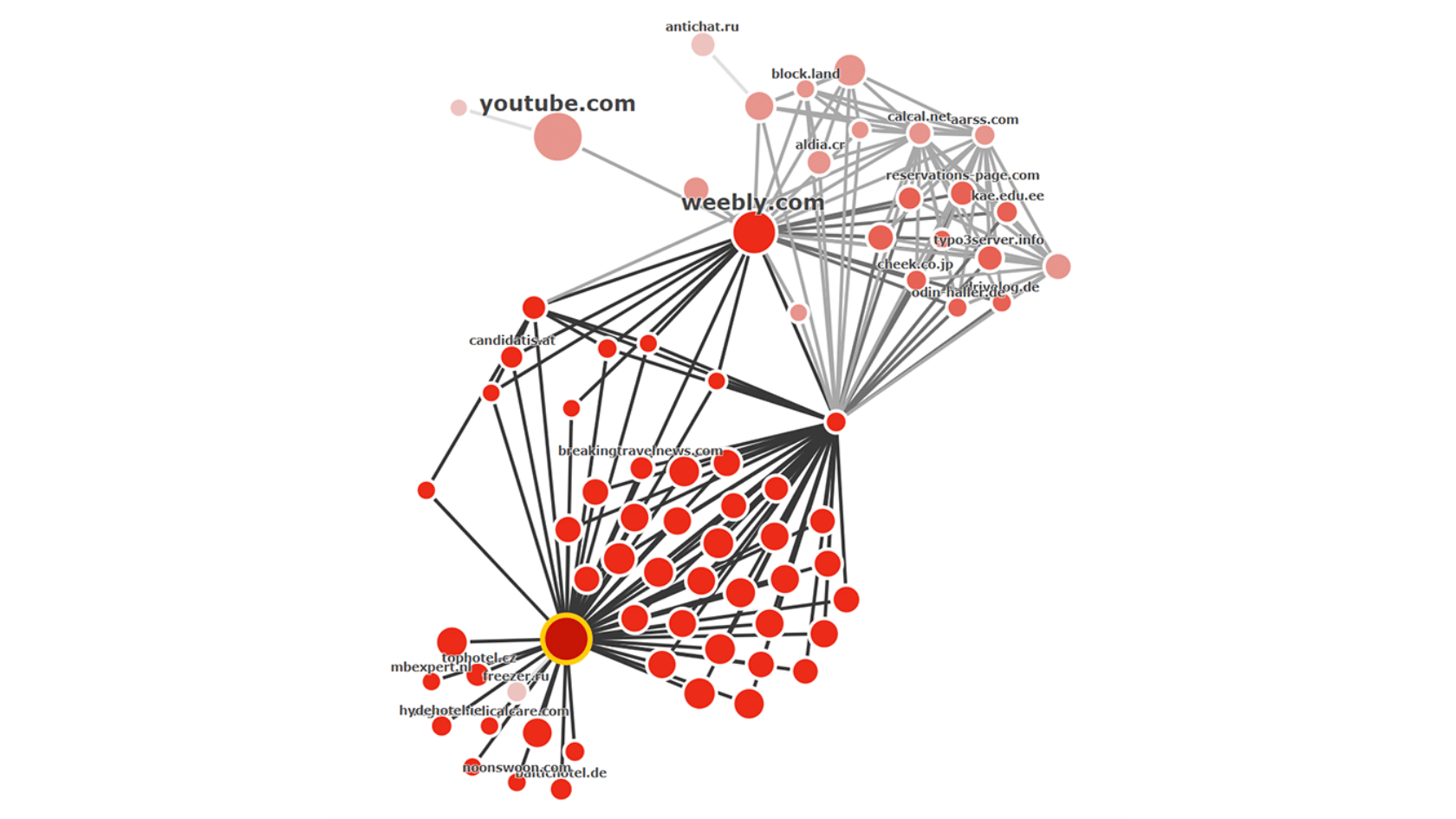
Common Crawl publishes these Web Graph datasets alongside their main crawl archives, which can be explored through the official Web Graph index.
These datasets include statistics about:
- Link relationships between domains
- Authority signals across the web
- Structural importance of websites within the internet ecosystem
The Two Key Metrics in the Web Graph
Within the Web Graph dataset, two primary metrics help measure a website’s influence.
- Harmonic Centrality (HC)
Harmonic Centrality measures how close a domain is to all other domains on the Internet.
In simple terms:
- A domain with high HC can reach many other sites with fewer link steps.
- These sites often act as central hubs of the web.
For example, major platforms such as social networks or large information sites tend to have very high harmonic centrality because millions of sites link to them.
The higher your HC score, the more central your site appears in the internet’s link structure.
- PageRank
PageRank is a widely popular algorithm originally used by search engines to determine website authority.
It measures:
- The number of links pointing to a domain
- The authority of the sites providing those links
If authoritative websites link to you, your PageRank increases. This metric reflects both link quantity and quality.
Both Harmonic Centrality and PageRank have been included in Common Crawl releases for years and are used internally by CCBot, the crawler responsible for collecting web data.
The CC Rank Checker Tool
The CC Rank Checker was created to simplify access to Web Graph metrics.
Instead of downloading massive datasets and running complex analysis, SEOs can simply enter a domain and instantly see its authority ranking.
The tool currently indexes:
- Around 18 million domains
- Across five time periods from 2023 to 2025
This allows users to perform several valuable analyses.
What the Tool Can Do?
1.Check domain authority
Users can instantly view:
- HC Rank
- PageRank score
2.View historical rankings
The tool helps users to see how a domain’s authority has changed across multiple time periods.
3.Track authority growth
By comparing data across releases, SEOs can measure whether link building or brand growth is improving their authority.
4.Compare competitors
The platform supports comparing up to 10 domains simultaneously, making it useful for competitive benchmarking.
Why This Matters for AI Visibility
In 2024, the Mozilla Foundation published a report titled “Training Data for the Price of a Sandwich.”
The findings revealed a major insight: 64% of the 47 LLMs studied used filtered versions of Common Crawl data.
For example:
- Over 80% of the training tokens for GPT-3 came from filtered Common Crawl datasets.
This means the websites appearing frequently in Common Crawl archives have a higher likelihood of influencing AI training.
The Connection Between Web Graph Metrics and AI Training
Here is the logic many SEO professionals are now exploring:
- Common Crawl uses Harmonic Centrality to determine crawl priorities.
- Websites with higher HC scores are crawled more frequently.
- More frequent crawling means more appearances in datasets.
- These datasets are often used for AI model training.
The result is a potential chain reaction:
Higher web authority → more crawl frequency → greater dataset presence → stronger AI visibility
While this is not the only factor affecting AI responses, it provides a valuable signal for understanding the evolving search ecosystem.
The Correlation Debate
Many of the highest-ranked domains in the Web Graph are globally dominant platforms such as:
- Meta Platforms (Facebook)
- YouTube
- Wikipedia
These same domains are also frequently cited by AI systems.
The question remains whether this relationship is caused by:
- Genuine authority and popularity
- Heavy representation in training datasets
- Strong performance in real-time search systems
- Or a combination of all these factors
Most researchers believe it is a mix of all these influences.
How SEO Professionals Are Using Web Graph Data
The CC Rank Checker has opened new opportunities for strategic analysis.
Benchmarking: SEOs can compare their domain authority against competitors to identify structural gaps in their link profile.
Trend Analysis: Tracking HC and PageRank over time helps teams understand whether their SEO campaigns are strengthening their position in the web ecosystem.
Link Strategy: Instead of focusing only on backlink quantity, SEOs can evaluate how close potential linking domains are to the core of the web graph.
Links from highly central domains may carry a stronger influence.
Behind the Scenes: How the Data Is Built
The Web Graph dataset is constructed using host-level connections across the internet.
Key characteristics include:
- Hostnames are recorded in reverse domain notation.
- The graph includes all link types, including technical links to images, scripts, and fonts.
- Only domains with a valid IANA top-level domain are included.
- IP-based URLs are excluded.
The graph is aggregated at the pay-level domain (PLD) level using the Public Suffix List.
This process creates a domain-level network representing the structure of the Internet.
Open Access Data at Massive Scale
One of the most important aspects of Common Crawl is that the dataset is free and open to anyone.
The data is hosted by:
Amazon Web Services, through its Open Data Sets program.
All datasets are stored in the AWS bucket: s3://commoncrawl/
within the US-East-1 (Northern Virginia) region.
The archives are stored using the Web ARChive (WARC) format, which is designed to efficiently store massive web datasets that can reach hundreds of terabytes.
Before 2013, the project used the older ARC format, but WARC provides better scalability and processing efficiency.
The Future of SEO and AI Visibility
Search engines are evolving into answer engines, and AI models increasingly influence how information is discovered online.
As a result, understanding how your site appears in web datasets is becoming a strategic advantage.
Tools like the CC Rank Checker offer a glimpse into this new landscape by revealing where a domain sits within the internet’s massive link network.
For SEO professionals, this introduces a new perspective:
It is no longer just about ranking on search engines.
It is also about being present in the data that powers AI systems.
Final Thoughts of CC Rank Checker
The CC Rank Checker represents an important step toward transparency in the AI and SEO ecosystem.
By translating complex web graph datasets into accessible metrics, the tool allows website owners to understand how their authority compares across the internet and how their presence may influence AI systems.
As AI-driven search continues to grow, analyzing web graph signals such as Harmonic Centrality and PageRank may become just as important as traditional SEO metrics.
For businesses and marketers, the message is clear:
Build authority, earn quality links, and ensure your content is visible in the datasets shaping the future of AI-powered discovery.