
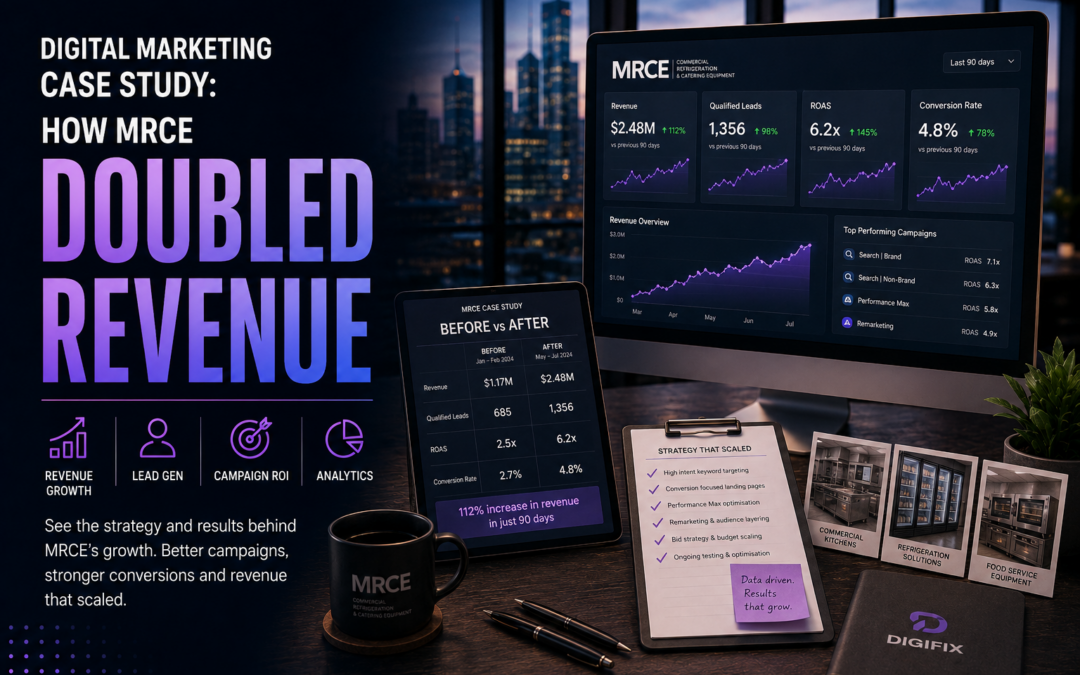
This digital marketing case study examines how DigiFix helped Melbourne Refrigeration and Catering Equipment Pty Ltd (MRCE) double their revenue through a complete overhaul of their website, search visibility and lead management systems.
MRCE has supplied commercial refrigeration and catering equipment to the hospitality industry since 1984. Over four decades, the company built a strong reputation and a loyal customer base across Melbourne’s cafes, restaurants and commercial kitchens. By 2023, however, their digital presence was holding the business back.
The website was outdated and suffered recurring 5xx and 4xx server errors. Customers found it difficult to make product enquiries, and unclear shipping costs at checkout were driving cart abandonment. On top of that, the site was not optimised for search engines, which meant lower traffic and fewer conversions.
In this article, we walk through how we approached the project as a Melbourne digital marketing agency, the decisions we made at each stage, and the measurable results those decisions produced.
Key takeaways
- MRCE came to DigiFix with an established reputation but a website plagued by 5xx server errors, clunky product enquiries and checkout guesswork on shipping.
- We fixed the foundations first: a server upgrade, then a full redesign, then automation of product enquiries and an automated shipping calculator at checkout.
- Ongoing SEO lifted online visibility 20.15% between July 2023 and October 2024, with a 46.74% gain in ranking keywords.
- Google Merchant Center, Google Ads and HubSpot CRM took the project beyond the website, lifting lead conversion by more than 50%.
- The end result: revenue up 100%, plus expansion into premium home equipment and larger corporate orders.
The challenge: an established business with an underperforming website
MRCE came to DigiFix with a problem many established businesses will recognise. The company itself was healthy, with decades of trading history and a customer base built on reliable service. The website representing that business online told a different story.
The most damaging issue was reliability. The server behind the site regularly produced 5xx and 4xx errors, so visitors were frequently landing on error pages instead of product listings. Each failed page load represented a potential customer lost to a competitor, and the errors also sent negative quality signals to Google, dragging down search rankings over time.
The second issue was the enquiry process. Commercial refrigeration is a considered purchase. Before committing to an upright display fridge or a walk-in cool room, buyers typically want answers on dimensions, power requirements, warranty terms and delivery lead times. The old website made asking those questions unnecessarily difficult, and unanswered questions translated directly into lost sales.
The third issue was the checkout. Shipping heavy commercial equipment across Melbourne and interstate is genuinely complex to price, and the old site left shipping costs unclear until late in the purchase process. Customers would add high-value items to their cart, reach the shipping step, receive no clear answer on freight, and abandon the purchase. Cart abandonment driven by unclear shipping costs was costing MRCE sales every week.
These problems were made more urgent by the nature of MRCE’s customers. Hospitality buyers are time-poor and often purchasing under pressure, whether fitting out a new venue against a builder’s deadline or replacing failed equipment while stock spoils. Buyers in that position will not persist with a slow or confusing website. The old site was losing exactly the customers who were most ready to purchase.
Our audit: four connected problems
Every DigiFix engagement begins with a full audit before any work is scoped. With MRCE, the audit identified four distinct problem areas.
The first was infrastructure. The recurring server errors pointed to hosting that could not support the site’s traffic and catalogue size. No design or marketing work delivers value on a site that fails to load reliably.
The second was user experience. The navigation required too much effort to locate products, and the overall layout did not reflect the professional brand MRCE had established offline.
The third was conversion friction. The difficult enquiry process and the lack of transparent shipping costs at checkout were both actively costing sales.
The fourth was search visibility. Product listings were not optimised, metadata was thin, and the ongoing technical errors were suppressing rankings further. For an ecommerce business, weak organic visibility means paying for every visitor through advertising indefinitely.
Importantly, these four problems were compounding each other. Server errors suppressed rankings, which reduced traffic. The visitors who did arrive faced confusing navigation, so fewer reached a product page. Those who reached checkout encountered the shipping uncertainty and left, and that poor engagement data suppressed rankings further still.
For that reason, the sequence of the work mattered as much as the individual fixes. There is little value in investing in SEO for a site that returns server errors, or in paid advertising that delivers visitors to a checkout that turns them away. We structured the project accordingly: infrastructure first, then user experience, then conversion, then growth.
If any of these four problems sound familiar, the interactive checklist below sets out each symptom alongside what it typically costs a business and how we resolved it for MRCE.
Revenue leak detector
Select each symptom that applies to your website. Each one explains what the issue typically costs a business, and how we resolved it for MRCE.
If three or more of these apply, your website is likely costing you sales.
The solution: rebuilding from the server up
The first stage of the project was upgrading the website’s server. This immediately improved page speed across the site and eliminated the recurring errors. Visitors were no longer landing on failed pages, and the technical quality signals that Google relies on began to recover.
With the infrastructure stable, our web development team redesigned the site’s layout. The objective was a modern, brand-aligned design with substantially improved navigation, so that a busy hospitality operator could move from the homepage to the right product in as few clicks as possible. We restructured the navigation around how customers actually shop for equipment, rather than around the internal structure of the old catalogue.
That distinction is worth explaining. A catalogue is typically organised for the people who manage it, while an effective online store is organised for the people who buy from it. Equipment buyers search by the problem in front of them, such as a display fridge for a specific counter length, rather than by internal product categories. Restructuring the site around the buyer’s question significantly improved how far visitors progressed before dropping off.
We then addressed the two conversion issues directly.
To streamline customer interactions, we built a product enquiry feature that automatically forwards each customer question to MRCE by email. Enquiries stopped going astray, response times improved, and conversions rose as answered questions turned into orders.
To reduce cart abandonment, we integrated an automated shipping calculator that provides accurate, transparent shipping costs before the customer commits to the purchase. We also added real-time financing options at checkout, which simplified the purchase decision on high-value equipment and supported larger order sizes. Together, these two features addressed cart abandonment at its source.
If you are weighing up similar issues on your own website, we offer a free consultation in which we review your specific site and identify what is working, what is not, and where the priorities lie. There is no obligation attached.
Ongoing SEO: continuous optimisation of product listings
Our work with MRCE did not end with the website redesign. While the development work was being completed, our SEO services team began a sustained optimisation program across the product catalogue.
Ecommerce SEO for a business like MRCE is detailed, product-level work. Our SEO specialists reviewed the catalogue listing by listing. They researched and selected the keywords buyers actually use, enhanced product descriptions to answer genuine customer questions rather than repeating manufacturer copy, and optimised SEO titles, meta descriptions and image alt text across the range. We have published a separate guide on how to optimise website content for better visibility, and this project applied that methodology at catalogue scale.
Product-level optimisation matters for a business like this because the highest-value search terms are not limited to broad phrases such as “commercial refrigeration Melbourne”. They include hundreds of specific searches for specific products, covering model names, sizes, capacities and configurations. Each optimised listing gives the site another entry point in search results, and the cumulative effect across a full catalogue is substantial.
This has been an ongoing effort rather than a one-off exercise. The team continuously monitors and refines the listings, because search behaviour shifts, competitors publish new content and Google updates its algorithms. Rankings need to be maintained as well as earned.
The results demonstrate the value of that sustained work. Between July 2023 and October 2024, MRCE’s online visibility increased by 20.15%. Average keyword positions improved by 5.67 places, which for many terms is the difference between page two and page one of search results. The site’s collective keyword footprint grew by 46.74%, producing a significant increase in organic traffic and, with it, sales that carry no per-click advertising cost.
Not sure where your website is losing sales?
Book a free 30-minute consultation with Nel. We will review your site the same way we reviewed MRCE's: reliability, enquiries, checkout and search visibility. The findings are yours to keep, whether or not you choose to work with us.
Book your free consultationExpanding reach: Google Merchant Center, Google Ads and HubSpot CRM
Once the website was performing and converting reliably, the next stage was increasing qualified traffic. We implemented Google Merchant Center so that MRCE’s products appear in Google Shopping results with current prices and images, placing the catalogue directly in front of comparison shoppers. Alongside this, our Google Ads management team ran optimised campaigns targeting high-intent buyers, ensuring advertising budget was directed at searches most likely to convert.
For readers unfamiliar with it, Google Merchant Center is the product feed that powers Google Shopping. For a retailer with a large catalogue, it is one of the highest-return integrations available, because it presents the actual product, with its actual price and image, to a shopper searching for that specific item.
These combined efforts expanded MRCE’s reach into markets the business had previously barely touched, including premium home equipment buyers seeking commercial-grade appliances and larger corporate orders from businesses fitting out entire venues. Neither segment was part of the original brief. Both emerged in the data once the products became properly visible, and MRCE was well placed to serve the new demand.
The final component was HubSpot CRM. With enquiries and leads arriving at a volume that manual processes could no longer manage efficiently, we implemented HubSpot to manage the sales pipeline. Lead conversion rates increased by more than 50%, quote generation times fell, and automated workflows took over follow-up communications that previously depended on manual effort. In the equipment industry, where buyers frequently need to purchase quickly, faster quoting directly wins business.
What began as a website project developed into a complete digital system: hosting, design, conversion features, SEO, Google Shopping, paid advertising and a CRM, with each layer building on the one before it. After more than ten years serving Melbourne businesses from our base in Clayton, this is the pattern we see deliver the most durable results. You can read more about how we work on our about page.
The Results, all in one place
| Result | What it means for the business |
|---|---|
| 100% increase in revenue | Turnover doubled through the combined website, SEO and advertising work |
| 20.15% increase in online visibility | Measured July 2023 to October 2024, the site is seen by far more searchers |
| 5.67 point improvement in keyword positions | Average rankings climbed toward page one across the tracked terms |
| 46.74% gain in collective keywords | The site now ranks for nearly half again as many searches, lifting organic traffic |
| 50%+ lift in lead conversion | HubSpot CRM cut quote times and automated follow-ups |
| Expansion into new markets | Premium home equipment buyers and larger corporate fit-out orders |
↔ Swipe to scroll the table on mobile
Key lessons for business owners
The specifics of this project belong to commercial refrigeration, but the underlying principles apply to most established businesses with an underperforming website.
Address the technical foundations before investing in marketing. MRCE’s server errors would have undermined any SEO campaign or advertising spend layered on top of them. If a website is slow, unreliable or confusing, resolving that is the first priority, because marketing budget directed at a broken site is largely wasted.
Identify the single largest point of checkout friction. For MRCE, it was unclear shipping costs. For another business, it may be an overlong form, a missing payment option or pricing hidden behind a contact request. Most websites have one point where the majority of abandonment occurs, and resolving that specific point frequently delivers a better return than a general redesign.
Treat SEO as an ongoing program rather than a one-off project. The 46.74% growth in ranking keywords was not produced by a single optimisation exercise. It came from continuous monitoring and refinement of product listings over more than a year. Sustained effort is what separates businesses that hold page-one positions from those that briefly reach them.
Allow proven results to justify each new investment. MRCE did not adopt Merchant Center, Google Ads and HubSpot from day one. Each addition followed evidence that the previous layer was working: the rebuilt site justified paid traffic, and the resulting increase in enquiries justified a CRM to manage them. This staged approach keeps risk low and ensures new spend lands on infrastructure that already converts.
More from our portfolio
The MRCE project is one example of this approach. Two further case studies, from entirely different industries, show how the same methodology adapts to each client.
PF Advisors
A medico-finance firm stuck with a cookie-cutter template site. We designed a custom website in deep blues and gold, with an awards timeline and podcast library, that finally matched the firm's standing and started converting visitors into leads.
Read the PF Advisors case study333 Collins Street
A heritage Melbourne landmark with a dated website. We rebuilt it with tenant dashboards, room booking and drone videography. 80% of tenants adopted the new systems in the first month, and organic traffic rose 25%.
Read the 333 Collins Street case studyStart a conversation about your website
Every project described in this article began with a straightforward conversation about what was underperforming and what it was costing the business. You can read the full MRCE case study on our website, visit the live site to see the shipping calculator and enquiry features in place, or browse the rest of our portfolio for further examples of our work. If your website is holding your business back, we would welcome the chance to look at it with you.
Ready to find out what your website is really capable of?
Book a free 30-minute consultation with Nel. We will review your current website, SEO and lead flow, identify the quick wins, and map out what a results-driven plan would look like for your business. No obligation, no hard sell.
Book your free consultationPrefer to reach out directly?
+61 38 669 1773 · info@digifix.com.au
Unit A11/2A Westall Rd, Clayton VIC 3168