

Custom e-commerce website design in Melbourne is what separates a store that sells on autopilot from one that just sits online looking tidy. A template can look fine in a screenshot. It rarely holds up once real customers, real stock, and real checkout friction get involved.
Key Takeaways
- Custom e-commerce design is built around how your specific customers shop, not a generic template flow.
- Mobile checkout experience matters enormously, since most online orders now happen on a phone.
- Site speed has a direct, measurable effect on conversion rate for online stores.
- Product pages need their own SEO structure, not just nice photos.
- A custom build costs more upfront but avoids the plugin conflicts that slow templated stores down over time.
Most Melbourne business owners start their online store with a template because it is quick and cheap. That is a fair starting point. The problem shows up later, once the business grows and the template cannot keep up with custom pricing rules, stock syncing, or a checkout flow that matches how customers actually buy.
This guide explains what custom e-commerce website design actually involves, why it matters more than most store owners expect, and how to tell whether your current site is holding your sales back. Full disclosure, this guide is published by DigiFix, though the principles apply whichever agency or developer handles the build.
Not sure if your store needs a rebuild
A short, free consultation can tell you whether a custom build is worth it for your specific store.
What Custom E-Commerce Website Design Actually Involves
Custom e-commerce website design means building a store around your products, your stock system, and your customers, rather than bending your business to fit a theme that was built for everyone else. Every layout decision is made with your actual catalogue in mind.
It usually covers the homepage, category pages, product pages, cart, and checkout, plus any integrations the business needs, such as stock management, freight calculators, or accounting software.
None of this means starting entirely from scratch every time. Custom work often reuses solid, tested components, but assembles and styles them specifically for the store rather than relying on a generic theme’s defaults.
The planning stage matters just as much as the build itself. Mapping out how customers actually move through the catalogue, from browsing to cart to payment, shapes nearly every design decision that follows.
Mobile Checkout Comes First
Smartphones now account for 66% of online orders (Statista, via HubSpot 2024). A checkout that is awkward on a phone is turning away most of a store’s potential customers before they even reach payment.
Product Pages Need Their Own Structure
Good photos matter, but so does the text around them. Clear sizing details, honest stock status, and genuine product descriptions all help both customers and search engines understand what is being sold.
Integrations Shape the Whole Build
Stock syncing, freight calculators, and accounting software connections all need to be planned before the design starts, not bolted on afterwards. This is one of the biggest reasons template stores eventually break down under real use.
Why Melbourne Businesses Choose Custom Over Templates
Melbourne’s online retail market is genuinely competitive, across everything from fashion to trade supplies. Retail e-commerce sales worldwide are projected to pass eight trillion dollars by 2027 (Statista, via HubSpot 2024), and a growing share of that spend is happening through stores that feel fast, specific, and trustworthy rather than generic.
Speed plays a direct role in that trust. An e-commerce site that loads in under a second converts 2.5 times more visitors than one loading in five seconds (Portent, via HubSpot). Templates loaded with unused plugins and bloated code rarely hit that benchmark.
If your current store feels sluggish or looks almost identical to a dozen competitors, it is worth having a quick, free conversation about a custom rebuild before another busy sales period passes you by.
See what a custom store could do for your sales
We will look at your current store and show you exactly where it is losing customers.
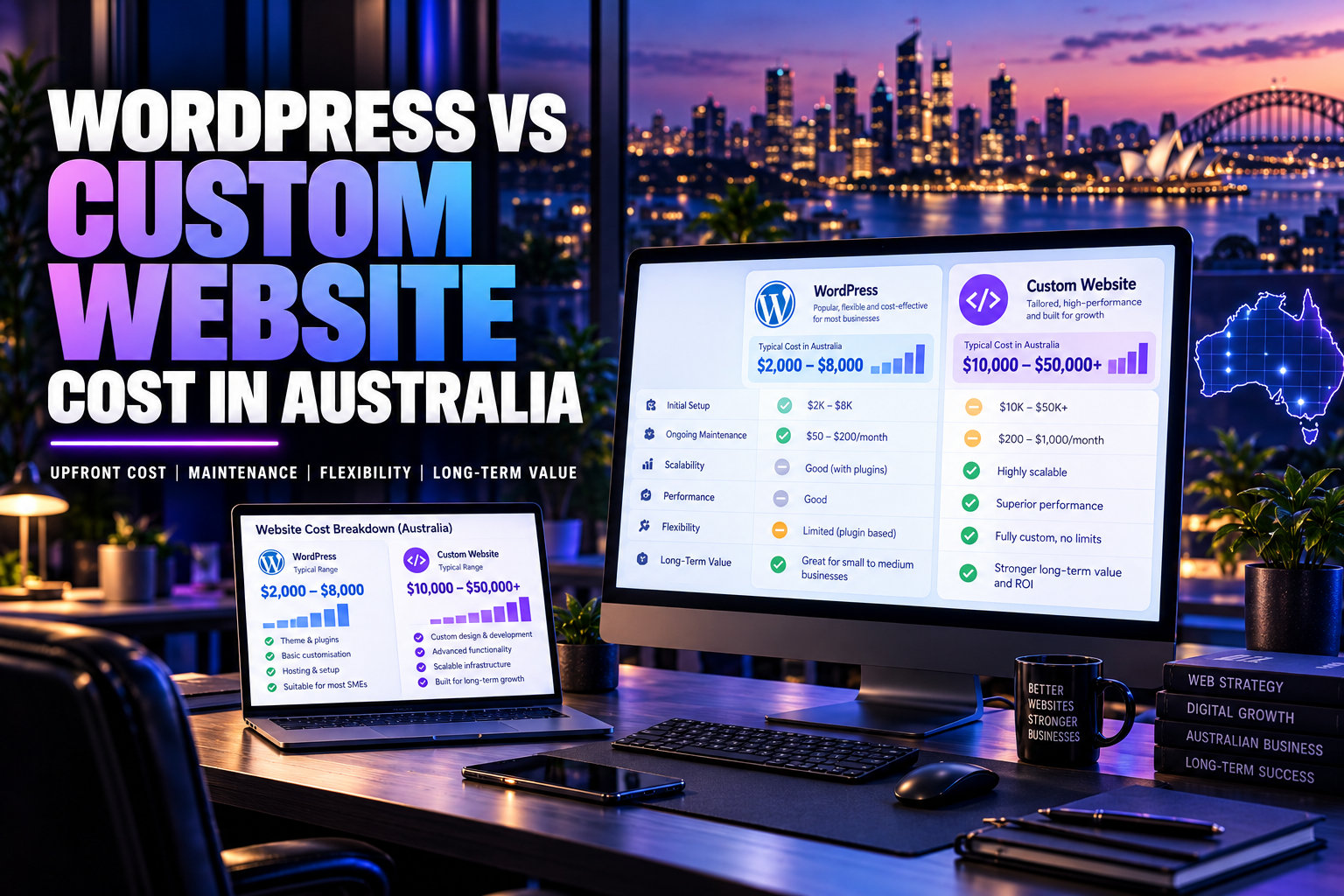
Custom vs Template E-Commerce: A Practical Comparison
Both approaches have a place. The table below sets out where each one tends to work best for a Melbourne online store.
| Factor | Template Store | Custom E-Commerce Design |
|---|---|---|
| Setup cost | Lower upfront | Higher upfront |
| Load speed | Often slower with many plugins | Built lean for speed |
| Flexibility | Limited to theme options | Built around your workflow |
| Long term cost | Can climb with plugin fees | Predictable, fewer dependencies |
Swipe to scroll the table on mobile
Common Mistakes in E-Commerce Website Design
The most common mistake is adding plugin after plugin to a template to make it do things it was never designed for. Each one adds weight and another thing that can break during an update.
Another mistake is copying product descriptions straight from a supplier’s catalogue. Search engines treat duplicate content poorly, and customers can tell when a description was not written with their actual needs in mind.
A third mistake is ignoring checkout analytics entirely. Without knowing where customers abandon their cart, it is almost impossible to know which part of the design actually needs fixing.
A fourth mistake is skipping mobile testing on real devices. A layout that looks fine on a desktop monitor can still break on a smaller screen, and since most orders now happen on mobile, that gap is costly.
What a Smooth Checkout Flow Looks Like
A smooth checkout asks for only the information needed to complete the order. Every extra field is a chance for a customer to give up and leave, especially on a small screen.
Clear progress indicators, visible totals before the final step, and a guest checkout option all reduce friction. None of these are complicated to build, but they rarely come standard in a generic template.
Payment options matter too. Offering the methods your actual customers prefer, rather than whatever the theme includes by default, removes one more reason for someone to abandon their cart at the last step.
What a Well Designed Product Page Looks Like
A strong product page leads with a clear, honest title, several genuine photos, and pricing that is impossible to miss. Stock status should be accurate in real time, since nothing frustrates a customer more than reaching checkout only to find an item is unavailable.
Below the fold, a short, specific description written for that exact product, not a generic category blurb, helps both the customer and search engines understand what makes it worth buying.
Reviews, related products, and a clear path back to the category page round out a page that feels complete rather than rushed.
How DigiFix Approaches Custom E-Commerce Website Design
DigiFix starts every e-commerce project by mapping the store’s product catalogue, stock process, and checkout requirements before any design work begins. The steps below show the usual process.
Map
Document your catalogue, stock process, and checkout needs.
Build
Design and develop the store around that mapped workflow.
Optimise
Test speed and checkout flow, then refine based on real data.
A clear three step process keeps the build focused on your actual customers.
Is Your Online Store Costing You Sales
Tick anything that applies to your store right now.
Measuring Whether a Custom Build Is Worth It
The simplest way to judge a custom build is to compare conversion rate, average load time, and cart abandonment before and after. A custom site that genuinely improves those numbers pays for itself over time.
We generally recommend reviewing these numbers alongside web development work every quarter, so decisions are based on real performance rather than a feeling that the site “should” be doing better. More guidance is available on our web development blog.
DigiFix has applied this same build and measure approach for other Melbourne businesses with complex catalogues, including the Melbourne Refrigeration and Catering Equipment case study, where a custom build helped a large product range feel genuinely easy to shop.
Store owners who delay this review tend to notice slow sales months after a problem first appeared, rather than catching it early when it is far easier to fix.
It also helps to review these numbers against the same period last year, rather than just month to month, since seasonal demand can mask or exaggerate the effect of a design change.
Ready to see what a custom store could do for you
Get a free, no obligation consultation and find out exactly where your current store is losing sales.
A custom rebuild does not need to happen all at once. Many Melbourne stores start by rebuilding just the checkout and top selling product pages, then expand from there once the improvement is proven. That staged approach keeps risk low while still fixing the parts that matter most first.
Over time, the cumulative effect of a faster, better organised store tends to show up clearly in both conversion rate and average order value, even if no single change feels dramatic on its own. Patience and consistent review beat a single big overhaul with no follow up.