

Ads in ChatGPT: A Setup and Strategy Guide for Australian Businesses
Ads in ChatGPT are now live for Australian advertisers, and your customers are already on the platform using them to make buying decisions. Right now, someone in Melbourne is asking ChatGPT which web design agency to hire, which accounting software to buy, and whether their industry is even worth entering. The question is no longer whether AI is reshaping how buyers find businesses — it already is.
The real question is whether you can show up at that precise moment of intent, and what happens to your competitors if they get there first.
OpenAI answered that for advertisers on 5 May 2026, when it opened its self-serve Ads Manager to all businesses in Australia, the US, Canada, and New Zealand. No six-figure commitment. No agency required. Just a business account, a specific offer, and the willingness to move early in a channel where most of your competitors have not even logged in yet.
This guide gives you the complete picture: how ads in ChatGPT actually work, what makes this channel genuinely different from anything that came before it, how to set up your first campaign step by step, what it costs in real money rather than theory, and an honest read on where this platform sits right now for an Australian SMB. Hype without clarity is useless when you’re making budget decisions.
By the end, you’ll know whether ChatGPT Ads belongs in your 2026 marketing plan, and if so, exactly how to start.
Key Takeaways
- ChatGPT launched self-serve ads in May 2026, opening the platform to Australian businesses with no minimum spend requirement.
- Ads reach a majority-share slice of ChatGPT's 900 million-plus weekly users - specifically those on the free tier, actively researching and comparing, not passively scrolling.
- Targeting uses conversation context, not cookies or behavioural profiles, making it more privacy-friendly than Google or Meta.
- Two bidding models are available: CPM (brand awareness, around $25 USD average clearing rate) and CPC (performance, $3–5 USD recommended starting bid).
- Early movers have a real advantage - ad inventory is underpriced relative to intent quality, and competition in Australian verticals is still thin.
- Not every business is ready today, but every Melbourne marketer needs to understand this channel now, before their competitors do.
What Are Ads in ChatGPT? The Plain-English Version
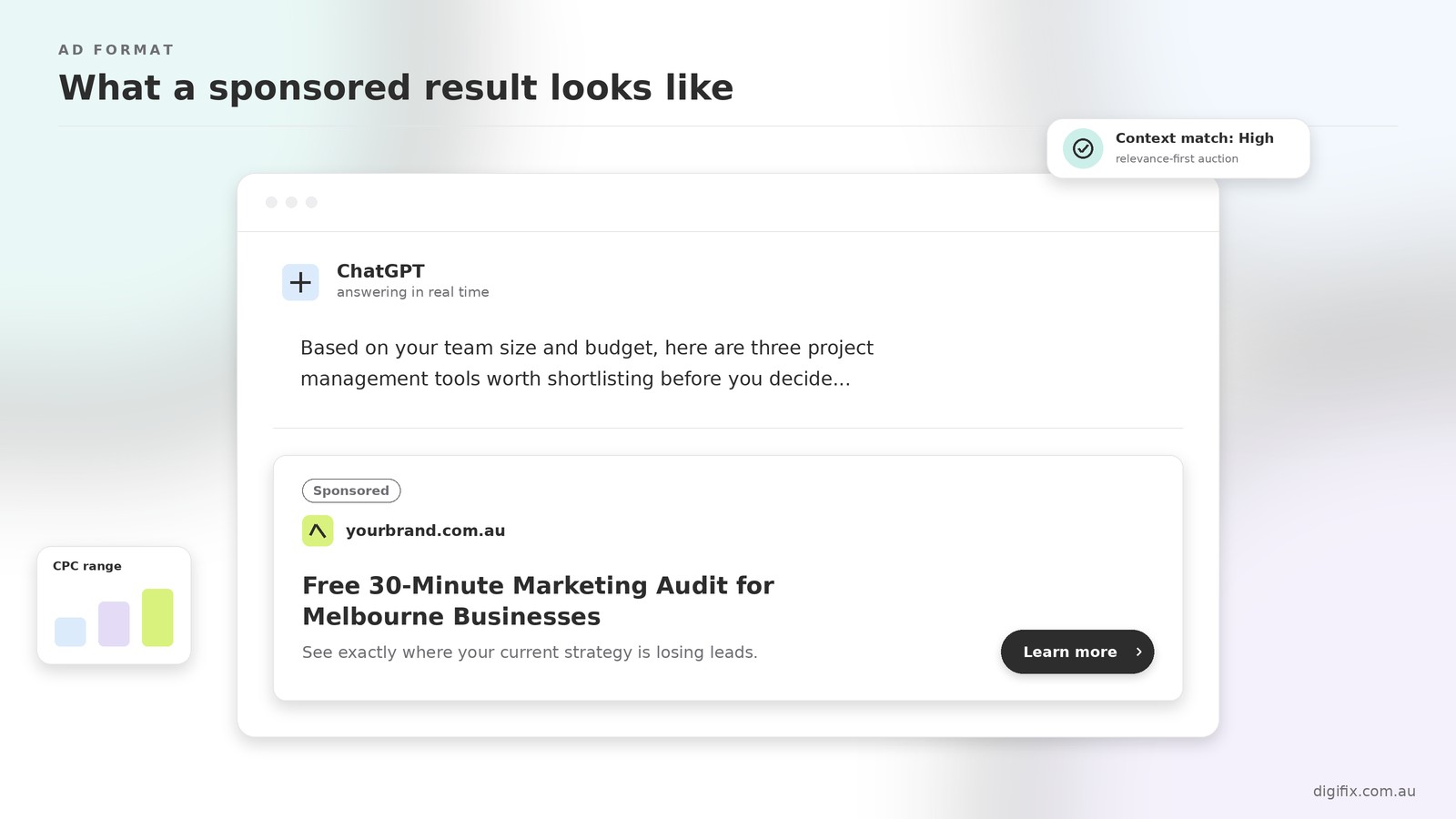
Ads in ChatGPT are sponsored content that OpenAI places inside ChatGPT conversations. When a user asks ChatGPT to compare project management tools, recommend a gift for a runner, or figure out which Melbourne suburb suits a new food business, a clearly labelled “Sponsored” recommendation can appear below the organic response.
A few things matter here. The ads do not influence what ChatGPT says. Advertisers cannot read what users are typing. The AI gives its full, honest organic answer first. Your sponsored unit appears below it in a subtly tinted box with a “Sponsored” label, your brand name and favicon, a headline, body copy, and a click-through link or button.
Ads currently appear only to users on ChatGPT’s free tier (and the lower-cost Go plan). Paid subscribers on Plus, Pro, Business, Enterprise, or Education plans do not see them. That still leaves a very large audience – the free and Go tiers represent the majority of ChatGPT’s user base.
OpenAI began testing ads for logged-in adult users in the US on 16 January 2026, and the platform launched commercially on 9 February 2026. On 5 May 2026, OpenAI opened the self-serve Ads Manager to all businesses including Australian advertisers, dropped the minimum spend requirement, added cost-per-click bidding, and rolled out both a measurement pixel and a Conversions API.
In three months, it went from an enterprise-only pilot to a platform any Melbourne small business can access today for the cost of a test campaign. That’s a faster rollout than any major ad channel in recent memory. As Business Insider reported, the early ad tests inside ChatGPT are already revealing significant new advertising trends – including a shift away from keyword targeting toward full conversational context as the primary signal.
How ChatGPT Ads Are Fundamentally Different from Google and Meta
Most marketers who first hear about ads in ChatGPT ask the same question: is this just Google Ads with a chatbot skin? It isn’t. The differences run deep, and they’re commercially significant for Australian businesses specifically. At DigiFix, we’ve been tracking this platform since the January 2026 announcement, and what we’ve seen in our own testing confirms what industry reporting has flagged from the start: this is a structurally different advertising environment.
The Intent Difference Is Enormous
Users don’t open ChatGPT to browse. They use it to solve real problems in real time – comparing options, weighing trade-offs, asking follow-up questions, making decisions. That means user intent on ChatGPT is qualitatively richer than almost any other advertising surface.
A Google search for “best CRM software” takes eight seconds. A ChatGPT session about choosing a CRM can be a twenty-minute dialogue where the user shares their team size, budget, existing tools, and growth plans, and asks the AI to help shortlist options.
When your Google Ads campaign already captures people searching, ads in ChatGPT can capture them even earlier – while they’re still forming their shortlist. When your ad appears at the end of that conversation, you’re reaching someone who has already done significant research and is ready for a next step.
Conversational sessions run three to five times longer than search queries on average. That sustained attention changes what advertising can do.
No Cookies, No Behaviour Profiles, No Third-Party Data
Targeting is entirely contextual. It’s based on what the user is talking about in that conversation right now, not on who they are or what they’ve done previously across the internet. There are no cookies, no cross-site tracking, no audience segments built from purchase history. Advertisers get aggregate data only – impressions, clicks, conversions. No user chat content is accessible.
For Australian businesses navigating increasingly strict privacy regulation, this is a meaningful advantage. It’s a channel built for a cookieless future, not scrambling to adapt to one. Your SEO strategy and social media marketing already generate intent signals – ads in ChatGPT add a third lane that captures buyers before they even reach a search engine.
Context Hints Instead of Keywords
Instead of bidding on specific search terms, advertisers write “context hints” – short, natural-language phrases describing the conversations and situations where their product is genuinely relevant. You might write “Melbourne small business owner comparing local SEO agencies” or “tradesperson looking for invoicing software with automatic follow-ups.”
OpenAI’s system uses these as interpretive signals, not exact triggers, so your ad can surface in related conversations the system determines are relevant even if the exact phrasing differs. It’s a different mental model from keyword bidding, and it rewards marketers who deeply understand their buyers’ situations rather than just their search terms.
A smaller Melbourne business with a tightly written, genuinely relevant ad will routinely beat a larger advertiser with a lazy creative and a bigger budget. If you’re unsure how ads in ChatGPT fit your current marketing mix, or whether your business category qualifies, book a free strategy session with DigiFix and we’ll work through it for your specific situation – no obligation.
Who Can Advertise on ChatGPT: Eligibility for Australian Businesses
Before you invest time setting up an account, check eligibility. Australia was included in the March 2026 international expansion, and full self-serve access opened on 5 May 2026. The platform is not open to every business category, though – and OpenAI’s public statements to date confirm the exclusions apply at the placement level as much as the advertiser level.
| Status | What This Means |
|---|---|
| Generally eligible | Most standard B2B and B2C service and product businesses, including agencies, SaaS, professional services, retail, hospitality, and trades - provided the business account passes OpenAI's standard verification. |
| Excluded placements | OpenAI has confirmed ads are never shown alongside conversations about health, mental health, or politics, regardless of advertiser category. Your ad simply won't be eligible to appear in those conversation contexts. |
| Standard restricted categories | As with any major ad platform, expect the usual restrictions around regulated or age-gated categories (adult content, illegal goods, and similar). OpenAI's specific category list is set inside Ads Manager and evolves - check current policy there before building creative, rather than assuming your category is cleared. |
One important note for agency owners: if you click the agency option during sign-up, OpenAI blocks you and redirects you to have your client create the account first. The practical workaround is to create an account for your own agency business, run a small test campaign on your own brand, and learn the platform before your first client invites you in.
Every agency succeeding at ads in ChatGPT right now did this before touching a client budget. At DigiFix, that’s exactly how we approached it – our own test campaigns came first.
What ChatGPT Ads Actually Look Like: The Ad Format Explained
Understanding the ad format before you write your first creative is not optional. The format is deliberately unobtrusive, and that’s precisely what makes it work.
Not sure if your ad creative fits the format?
We'll review your first draft against what's actually converting in early ChatGPT Ads tests - free, no obligation.
Book a Free Strategy SessionStep-by-Step: How to Set Up Your ChatGPT Ads Account
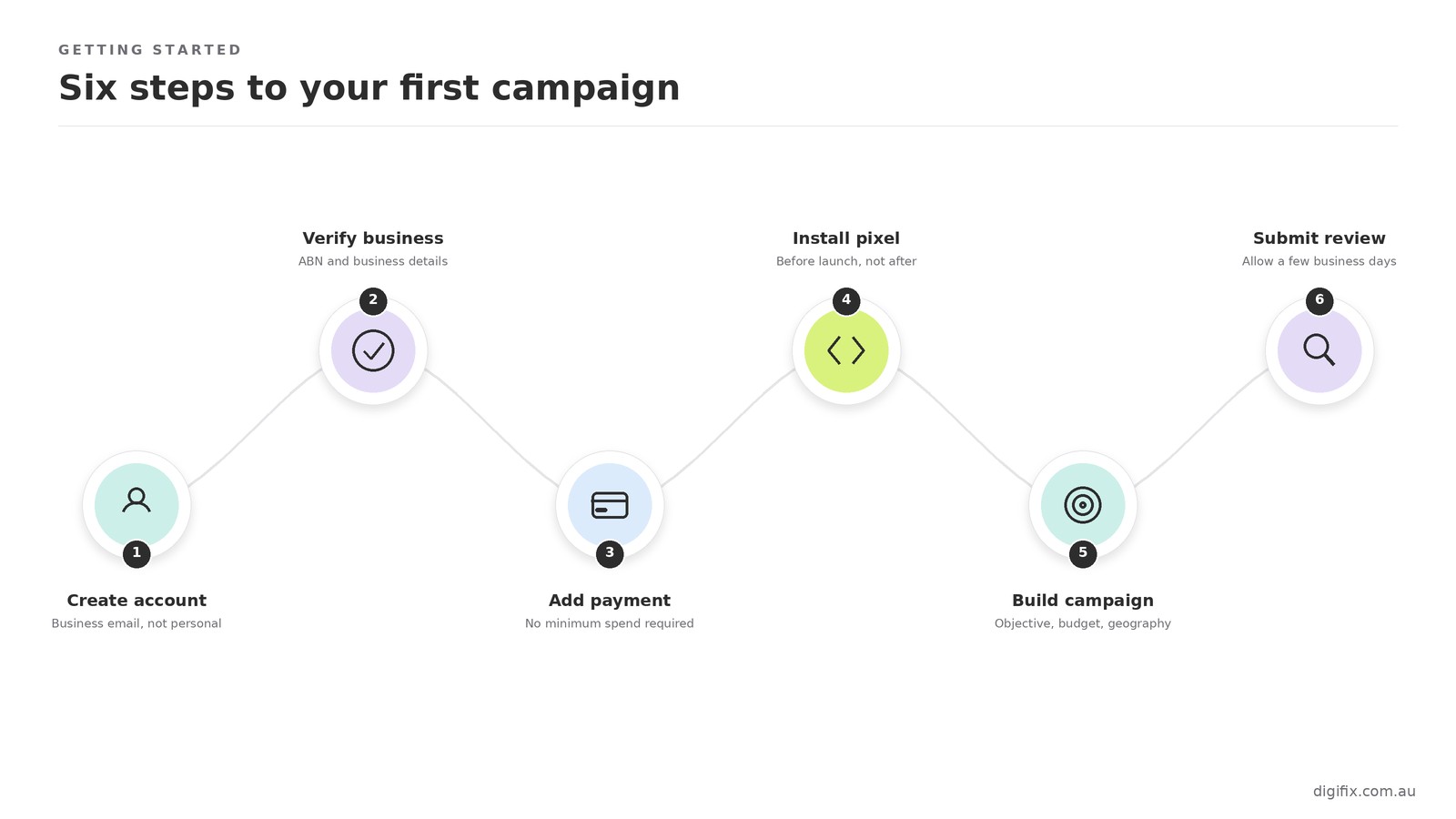
All campaign creation and management happens inside OpenAI Ads Manager Beta at ads.openai.com. Here’s exactly what to expect when you go through setup for the first time.
- Create your business account. Go to ads.openai.com and sign up with a business email - not the personal ChatGPT account you already use day to day.
- Verify your business. OpenAI asks for standard business details (ABN, business name, website). Have these ready to avoid delays.
- Add a payment method. Self-serve accounts no longer require a minimum spend commitment, so you can start with a modest test budget.
- Install the measurement pixel. Add OpenAI's conversion pixel to your thank-you page or booking confirmation before you launch anything - not after.
- Build your first campaign. Set objective, budget, and geography at the campaign level, then move to ad groups.
- Submit for review. Ads go through an approval process before going live - build in a buffer of a few business days for your first campaign.
Building Your First Campaign: What Every Setting Actually Does
Once your account is approved, you build your first campaign inside Ads Manager. Here’s what each part of the campaign structure means and how to set it up without wasting budget.
Campaign Level: Objective, Budget, Dates, and Geography
Your objective is the first decision. Two options exist: a CPM-priced “Reach” objective for brand awareness, and a CPC-priced “Clicks” objective for driving traffic and conversions.
Choose Clicks if you have a specific landing page, booking form, or product page you want people to visit. Choose Reach if you’re in the early stages of building category awareness.
Budget and dates are set here. Geography is country-level only in the current beta – you can select Australia, but not “Melbourne” or “Victoria” specifically. If your business is strictly hyper-local, factor this into your decision. If you have customers or clients anywhere in Australia, it’s less of a constraint.
Ad Group Level: Context Hints and Bids
Context hints are the single most important setting in the entire platform. This is where you describe the conversations where your ad belongs.
OpenAI’s system uses them as interpretive signals, not exact-match triggers – you write them as descriptions of your ideal buyer’s situation at the moment they’d benefit from your product.
Strong context hints are specific and conversational. Weak context hints are generic and keyword-style. Here’s the difference, using examples for a Melbourne digital marketing agency:
| Weak (Keyword-Style) | Strong (Conversational) |
|---|---|
| SEO agency Melbourne | Melbourne small business owner comparing local SEO agencies before committing to a contract |
| Digital marketing services | Business owner unsure whether to hire an agency or run marketing in-house |
| Google Ads management | Tradesperson frustrated with rising cost-per-lead on their current Google Ads account |
Ad Level: Headline, Body, and Destination
Your ad creative is compact but high-impact. The headline is the most important element – it appears as the first thing the user reads after the “Sponsored” label. Write it as if completing the user’s thought. Body copy is one to two lines. Keep it specific and useful. Generic claims (“Australia’s best agency”) perform worse than specific offers (“Free 30-minute SEO audit for Melbourne businesses”).
Your destination URL should point to a page that continues the conversation your context hints started. If you’re targeting users researching CRM tools, don’t send them to your home page – send them to a landing page that speaks directly to the decision they were just making with ChatGPT’s help.
Our digital marketing services pages are built exactly this way: each one speaks to one specific buyer problem, which is why they convert from AI referral traffic better than a generic homepage ever would.
Conversion Tracking: Do Not Skip This
OpenAI provides a conversion pixel you install on your thank-you page, booking confirmation, or purchase completion screen. Without it, you’re spending money with no visibility into what’s actually working. Install it before you launch. The platform also provides a Conversions API for server-side tracking – worth the setup time for e-commerce businesses or anyone running high-budget campaigns.
You can also upload ads in bulk via CSV if you’re running multiple ad groups or testing different creative variants, which Ads Manager supports directly.
Quick Checklist: Is Ads in ChatGPT Right for Your Business?
Tap each question to see what it means for your campaign.
Do you have a specific landing page ready — not just your homepage?
If yes, you're set up for the Clicks (CPC) objective from day one. If not, build one first — sending ChatGPT-referred traffic to a generic homepage wastes the intent you just paid for.
Can you describe your ideal buyer's situation in a sentence, not just a keyword?
Context hints reward conversational specificity. If you can only think in keywords, spend 20 minutes mapping out 3–5 real buyer scenarios before you touch Ads Manager.
Is your target customer anywhere in Australia, not one specific suburb?
Geography targeting is country-level only right now. If you genuinely only serve one suburb, this channel is less efficient for you today than it will be once local targeting rolls out.
Can you install a conversion pixel before launch, not after?
If your team or web developer can do this in the next few days, you're ready to test. If it'll take weeks, fix that first — a campaign without tracking is just spending, not marketing.
Get in Before Your Competitors Do
Ad inventory inside ChatGPT is underpriced relative to the intent quality right now, and most Melbourne businesses in your category haven't touched it yet. We'll help you scope a test budget, write context hints that actually work, and set up tracking properly from day one.
Book Your Free Strategy SessionFrequently Asked Questions
Do ads in ChatGPT work for small Melbourne businesses without a big budget?
Yes — that's actually the point of the May 2026 self-serve rollout. There's no minimum spend requirement, and relevance matters more than budget size in the auction. A tightly written context hint from a small local business can outperform a larger advertiser's generic creative.
How is targeting different from Google Ads or Facebook?
Google and Facebook rely heavily on keywords, cookies, and behavioural history. ChatGPT Ads target based purely on the context of the current conversation, using natural-language "context hints" instead of keyword bidding. No cookies or cross-site tracking are involved.
Will ChatGPT ads reach people outside Melbourne, or only in the CBD?
Geography targeting in the current beta is country-level only — you can target Australia, but not Melbourne or Victoria specifically. If your customer base spans anywhere in Australia, this isn't a major limitation. If you're strictly hyper-local, factor that in before committing budget.
How long before I see results from a ChatGPT Ads campaign?
Expect a short review period before your first ads go live, then treat the first two to three weeks as a learning phase — testing context hints and creative variants rather than expecting immediate scale. Because the platform is new, early data is thinner than on Google or Meta, so give it a genuine test budget and timeframe before judging performance.
How much do ads in ChatGPT cost?
There are two pricing models: CPM (reach-based) sits around $25 USD average clearing rate, and CPC (click-based) has a recommended starting bid of $3–5 USD. There's no minimum spend requirement, so most Melbourne businesses can run a meaningful test for a few hundred dollars. Book a free session with DigiFix and we'll help you scope a realistic test budget for your specific category.