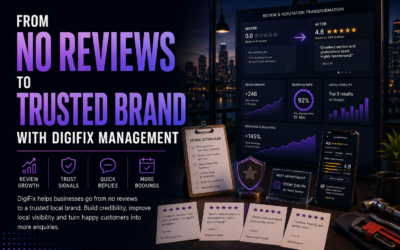

A five star rating does not appear by accident. Understanding how DigiFix helps businesses earn 5-star reviews starts with a simple truth: most happy customers never leave a review unless they are asked, at the right moment, in the right way.
Key Takeaways
- Most satisfied customers need a simple nudge before they leave a review.
- Timing the review request right after a positive interaction lifts response rates significantly.
- Responding to every review, good or bad, builds trust with future customers.
- Review volume and recency both influence how a business ranks locally.
- Negative feedback, handled well, can be turned into a trust building moment.
- A free consultation is available to review your current reputation setup.
Reviews have become one of the first things a potential customer checks before calling a business. A steady flow of recent, genuine five star reviews signals reliability faster than any advertisement ever could.
The numbers back this up. HubSpot research shows that 94 percent of people say negative reviews have convinced them to avoid a business, which makes proactive review management one of the highest leverage activities a small business can invest in.
Not sure how your current reviews stack up against local competitors? Book a free consultation with DigiFix and get an honest read on where you stand.
Why Most Businesses Struggle to Get Reviews
Happy customers are usually busy and simply forget to leave feedback. Unhappy customers, on the other hand, are often motivated enough to write a review the same day. That imbalance is why so many businesses end up with a handful of harsh reviews and very little positive counterbalance.
Fixing that imbalance is not about begging for reviews. It is about building a light, repeatable process that makes leaving feedback effortless for the customers who already had a great experience.
The Moment of Ask Matters
Asking for a review immediately after a positive interaction, such as a completed job or a thank you message, produces far higher response rates than a generic email sent weeks later. Context and timing do most of the heavy lifting.

How DigiFix Helps Businesses Earn 5-Star Reviews
The process starts with a simple audit of every place a customer might already be leaving feedback: Google, Facebook, industry specific directories and any booking platforms in use. From there, a lightweight request system gets built around the natural end of a positive customer interaction.
Making the Ask Effortless
A direct link to the Google review form, sent by text or email right after a job finishes, removes almost every barrier between a happy customer and a finished review. Fewer steps means a far higher completion rate.
Responding to Every Review
Every review gets a thoughtful reply, whether it is glowing or critical. Consistent responses show future customers that the business is attentive and genuinely cares about the experience it delivers.
Want a clear plan for turning happy customers into five star reviews? Get a free consultation from the DigiFix team and start building momentum this month.
Why Review Recency Matters as Much as Star Rating
A business with a perfect rating from three years ago looks less trustworthy than one with a slightly lower rating and reviews from last week. Recency signals that a business is still active, still delivering and still worth calling today.
This is also true from a search engine perspective. Google’s own guidance on Business Profile completeness confirms that customers are far more likely to consider a business reputable when its profile, including reviews, is current and complete.
| Review Habit | Common Approach | DigiFix Approach |
|---|---|---|
| Timing of request | Weeks after service | Right after a positive moment |
| Responding to reviews | Only when negative | Every review, every time |
| Monitoring platforms | Google only | Google, Facebook and directories |
| Negative review handling | Ignored or deleted | Addressed calmly and publicly |
Swipe to scroll the table on mobile

Turning a Negative Review Into a Trust Signal
Not every review will be positive, and that is normal. What matters far more than a single low score is how a business responds. A calm, helpful reply to criticism often reassures future customers more than a wall of five star praise ever could.
A Simple Response Framework
Acknowledge the concern, avoid getting defensive, offer a way to resolve the issue offline, and thank the reviewer for their feedback. This structure works for almost any negative review, regardless of industry.
How Reviews Influence Local Search Rankings
Reviews are not just a trust signal for customers, they also feed directly into how Google ranks a business in local search results and the Map Pack. A steady stream of recent reviews, paired with thoughtful replies, tells Google that a listing is active and well managed.
Businesses often assume rankings are purely a matter of keywords and backlinks, but local search weighs reputation signals heavily. Two businesses with similar websites can see very different placement in the Map Pack based purely on review volume, recency and response rate.
This is one of the reasons review management and local search engine work are usually planned together rather than treated as separate projects. Each one reinforces the other over time.
Building Momentum Month After Month
Audit every platform where reviews already appear
Build a simple request process around positive moments
Respond to every review consistently and promptly
A steady, repeatable rhythm builds trust far more reliably than the occasional review campaign.

Is Your Business Review Ready?
Tick every statement that is true for your business right now.
Common Review Mistakes Melbourne Businesses Make
A handful of habits quietly undo months of good reputation work. Most are easy to fix once a business owner realises they are happening, but they rarely get noticed without someone looking specifically for them.
Only Asking Loyal Regulars
It is tempting to only ask the customers who already love the business, but a broader spread of reviewers, including first time customers, makes the overall profile look more genuine and representative of the actual experience on offer.
Letting Negative Reviews Sit Unanswered
An unanswered negative review reads as confirmation to anyone browsing later. Even a short, professional reply weeks after the fact is far better than silence, and it shows every future reader that concerns get taken seriously.
Treating Every Platform the Same
Google reviews carry different weight than Facebook recommendations or a niche industry directory. A response tone that works well on Google might feel too formal on Facebook, so it pays to adapt slightly to each platform’s audience.
Forgetting to Close the Loop Internally
Genuine complaints raised in a review often point to a real operational issue. Businesses that treat reviews purely as a marketing exercise, rather than useful feedback, miss the chance to fix the underlying problem before it repeats with the next customer.
What a Genuine Review Request Actually Sounds Like
A short, personal message tends to outperform a generic template every time. Mentioning the specific job or service by name, thanking the customer directly, and including a single clear link removes any confusion about what to do next.
Automating the timing of that message, without making it sound automated, is where a lot of the value sits. A message that goes out the moment a job is marked complete feels far more natural than one that arrives out of the blue two weeks later.
Reviews Are Part of a Bigger Reputation Picture
Review management works best alongside a fully optimised Google Business Profile and a website that reflects the same trustworthy image. DigiFix offers online reputation management as part of a broader range of digital marketing services so every part of a business’s online presence tells the same story.
Learn more about DigiFix and how the team approaches reputation work for small and mid sized businesses across Melbourne’s south east.
Ready to Build a Steady Stream of 5-Star Reviews?
The consultation is free and there is no obligation to sign up afterward. It is simply a chance to see exactly where your current reputation stands and what a realistic plan looks like.
A strong reputation is built one review at a time, through small, consistent habits rather than a single big push. Businesses that treat review generation as an ongoing routine, not a one off campaign, tend to see the most durable results over time.
Why This Work Pays Off Slowly, Then Quickly
The first month of a proper review process rarely feels dramatic. A handful of new reviews trickle in, replies go out, and nothing looks transformed overnight. The compounding effect shows up later, once a healthy volume of recent, varied reviews starts appearing whenever someone searches for the business.
By the time a business reaches fifty or a hundred recent reviews with a strong average rating, the effect on enquiry volume tends to be obvious. New customers arrive already trusting the business before the first phone call even happens, which shortens the entire sales conversation.
None of this requires expensive software or a large team. It requires a simple, consistent habit that gets repeated with every single customer, week after week, until it becomes second nature.
Whether a business is just starting to think about reviews or already has a process that needs refining, the underlying goal stays the same: make it easy for real, satisfied customers to say so publicly, and make sure every voice that speaks up gets heard in return.