
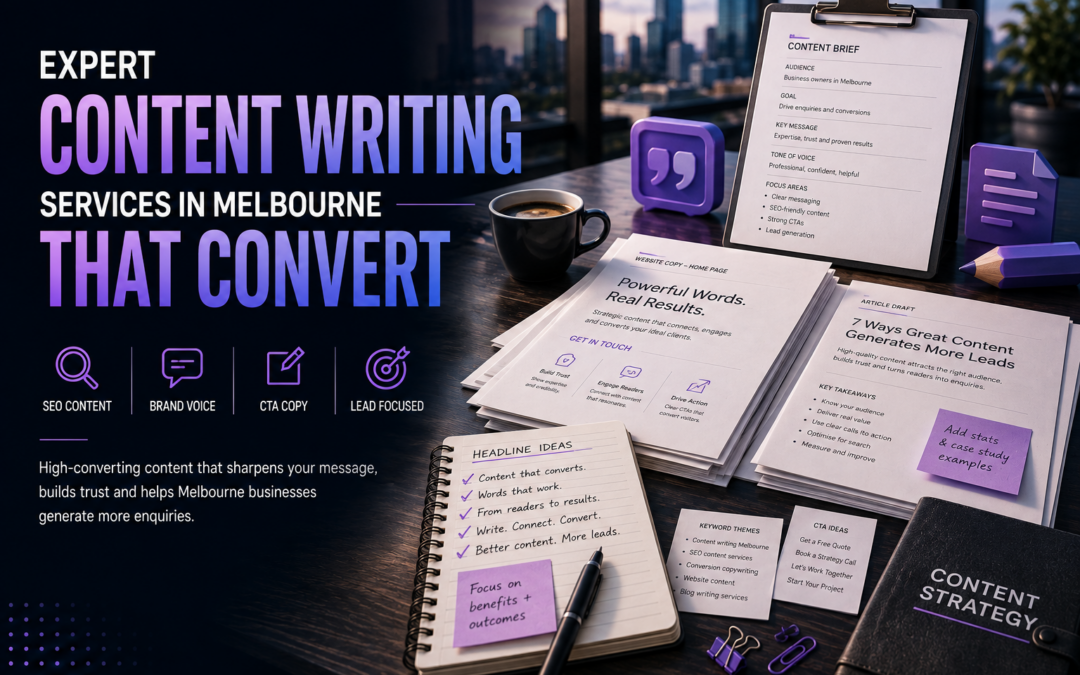
Good content writing services in Melbourne do more than fill a page with words. They turn a blank website into a steady source of enquiries, week after week, without you having to touch a keyboard.
Key Takeaways
- Businesses that blog consistently generate significantly more monthly leads than those that do not.
- Content written for a specific keyword and a specific reader outperforms generic, one size fits all copy.
- Blog posts, service pages and case studies each play a different role in the buying journey.
- Australian English, clear structure and genuine expertise matter more to readers and to Google than clever wordplay.
- A content plan built around real search demand beats publishing whatever feels interesting that week.
Melbourne is full of businesses competing for the same searches, and the ones that show up consistently in Google results are usually the ones publishing consistently too. Content writing support for Melbourne businesses exists to take that ongoing workload off your plate, whether you need a handful of service pages or a rolling monthly blog schedule.
Think about the last time you searched for a product or service yourself. You almost certainly read a page, formed an impression of the business behind it, and either kept reading or clicked away within seconds. That page did more selling in that moment than most sales calls manage in ten minutes, which is exactly why the words on it matter so much.
Not sure what content your website is missing?
Book a free consultation and we will walk through the gaps together.

Why Content Writing Services in Melbourne Matter More Than Ever
Companies with blogs produce an average of 67 percent more leads monthly than companies without one, according to HubSpot’s blogging research. That gap has only grown as more Melbourne businesses realise a static, five page website rarely wins new customers on its own.
HubSpot also reports that brands prioritising blogging see 13 times more return on investment than brands that do not, based on their State of Blogging research. Content is not a nice to have anymore. It is one of the few marketing channels that keeps working long after it is published.
What Separates Good Content From Filler
Plenty of businesses have tried content marketing and given up, usually because the content they published never matched what their customers were actually searching for. Good content writing for Melbourne businesses starts with keyword research and audience understanding, not a blank document and a deadline.
Writing for a real question, rather than a vague topic, changes everything about how a page performs. A page titled around what someone actually types into Google earns clicks that a page written for internal approval never will.
Filler content tends to share a few tell tale signs. It repeats the same point in slightly different words to pad out a word count. It answers a question nobody asked while skipping the question the reader actually came for. And it rarely includes anything a reader could not have guessed before clicking through, which gives them no reason to trust the business behind it.
Strong content does the opposite. It answers the exact question in the title, backs up claims with specifics rather than vague adjectives, and gives the reader a clear next step once they have finished reading. None of that happens by accident, which is why a proper brief matters as much as the writing itself.
The Different Types of Content Your Website Needs
Not all content does the same job. Service pages need to convince a ready buyer. Blog posts need to earn trust with someone still researching. Case studies need to prove you can deliver. Treating all three the same way is one of the most common mistakes we see.
| Content Type | Best For | Typical Length |
|---|---|---|
| Service pages | Ready to buy visitors | 600 to 1,200 words |
| Blog posts | Researching visitors | 1,200 to 2,500 words |
| Case studies | Comparing options | 800 to 1,500 words |
| Product descriptions | On page conversion | 100 to 300 words |
| Email newsletters | Existing customers | 300 to 600 words |
Swipe to scroll the table on mobile
Ready to see a content plan built around your keywords?
Get a free consultation and we will map out what to write first.
How a Melbourne Content Process Actually Works
A reliable process removes the guesswork. It usually starts with keyword research to find out what your customers are actually searching for, followed by a content brief that outlines structure, tone and the questions the page needs to answer.
From there, a writer drafts the piece, an editor checks it for accuracy and readability, and the finished page goes live with on page SEO already built in, things like headings, internal links and a clear call to action.
The brief stage is often the most undervalued part of the whole process. A good brief lists the target keyword, the search intent behind it, the questions competing pages have missed, and any internal pages worth linking to. Writers who work from a solid brief produce far more consistent results than writers left to guess at what the business actually needs.
Editing deserves just as much attention as drafting. A second set of eyes catches claims that need softening, jargon that needs explaining, and gaps where a reader might get lost. Content that skips editing tends to read like a first draft, because that is exactly what it is.
Measuring Whether It Is Working
Publishing content without checking its performance is a bit like running ads without looking at the results. Rankings, organic traffic and, most importantly, enquiries generated from each page all tell you whether the investment is paying off or whether the approach needs adjusting.
A simple monthly check of which pages are climbing, which have stalled, and which are actually converting visitors into calls or form submissions is usually enough to keep a content plan honest and focused on what works.
Research
Find the exact terms your customers are searching for.
Write
Draft the page around a real question, in plain language.
Publish
Add headings, links and a clear next step, then go live.
Skipping any one of these three steps is usually where content plans lose momentum.
Why Local Knowledge Changes the Writing
A writer who understands Melbourne, its suburbs, its seasons and its business culture, produces content that feels genuine rather than generic. Mentioning the right suburb, the right season or a locally relevant example builds trust in a way that generic, imported copy never will.
DigiFix is one of the Melbourne agencies offering content writing services in Melbourne alongside broader SEO support, and one pattern we see repeatedly is that local specificity outperforms generic advice, even when the generic version is technically well written.
Seasonal timing is another advantage local knowledge brings. A landscaping business benefits from content published ahead of spring, while a heating repair company gets more value from a push before winter. A writer without that local calendar in mind can easily publish the right content at the wrong time of year.
Australian English matters here too. Spelling like optimise, colour and organised signals to a local reader that the content was written for them, not translated or imported from another market.
Is Your Website Content Working Hard Enough?
Tick anything that is true right now, then see where you stand.
Content Writing in Melbourne Versus Doing It Yourself
Plenty of business owners write their own content, and some do it very well. The trade off is time. A single well researched blog post can take four or five hours to plan, write and edit properly, time that many owners simply do not have on top of running the business.
Outsourcing does not mean losing your voice. A good writer interviews you, learns your tone and writes in a way that still sounds like your business, just with the research and structure handled for you.
There is also a consistency argument. Businesses that publish on a predictable schedule tend to build momentum faster than those that publish in bursts and then go quiet for months at a time. A dedicated writer or team makes that consistency far easier to maintain.
Cost is the other factor worth weighing honestly. Writing everything yourself is free in dollar terms but expensive in hours, and those hours often come from time that could go toward serving customers or running the business. Outsourcing has a direct cost but frees up that same time, which many owners find pays for itself once they factor in what an hour of their own time is actually worth.
What to Look For in a Content Writer
Ask to see samples relevant to your industry, not just any writing sample. A brilliant travel blog does not necessarily prove someone can write persuasive copy for a plumbing business or a medical clinic.
Ask how they approach keyword research, and listen for a clear process rather than a vague answer. Ask how they handle revisions, and how they measure whether the content is actually working once it is published.
It is also worth asking who actually writes the content. Some agencies outsource to a rotating pool of freelancers with little industry knowledge, while others use a smaller, dedicated team that gets to know your business over time. Neither approach is automatically wrong, but you deserve to know which one you are paying for.
Finally, ask about turnaround times and how far ahead you need to plan. A writer who can only deliver one piece a month will struggle to keep pace with a business chasing rapid growth, while a larger team may be overkill for a business that only needs the occasional page refreshed.
If you want a broader view of how content fits alongside rankings and technical SEO, our SEO services page covers the wider picture, and our SEO blog has further reading on keyword strategy. You can also read more about our team on the About Us page, or browse the full digital marketing services list.
Talk to us about your content, free and no obligation
Content writing services in Melbourne should start with a conversation about your goals, not a generic package. Claim a free, no obligation consultation and we will suggest a realistic starting point for your business.