

Search engine optimization for lawyers, minus the jargon. How law firms choose keywords, build pages that rank, earn links and turn traffic into files.
What SEO for Lawyers Includes
Search engine optimization for lawyers is not the same job as SEO for a plumber or an online store, and the firms that treat it as the same job tend to spend eighteen months finding that out. The stakes per visitor are higher, the competition is better funded, Google is more suspicious of the subject matter, and your marketing sits inside professional conduct obligations that no generalist agency has read.
The upside is that most legal websites are beatable. Not because the firms behind them are bad at law, but because the site was built once, by a designer, five years ago, and nobody has touched the content since. Beating that does not require a huge budget. It requires knowing which twelve pages matter.
This is what we cover: how to pick the keywords that actually produce files, how to structure the site so those pages can rank, what content works in a category Google treats with suspicion, how firms earn links without buying rubbish, and how long the whole thing honestly takes.
Key takeaways
- Search volume is the wrong first filter. Sort keywords by how close they sit to someone opening a file.
- Legal content is the category Google scrutinises hardest, which makes named solicitor authorship a ranking asset rather than a nicety.
- One deep page per practice area beats forty thin blog posts, every time.
- Firms earn links through the things they already do: community legal education, commentary on law reform, sponsorships, industry writing.
- Anyone selling guaranteed rankings or bulk guest posts is selling you a problem to fix later.
- Budget for twelve months. Meaningful movement usually starts somewhere in months four to six.
Practice Area Pages and Local SEO
Three things make it harder than average, and they are worth understanding before you spend anything.
The first is that Google applies more caution to topics that can damage someone’s life if the information is wrong. Legal advice sits in that bracket alongside medical and financial content. Anonymous, thin or clearly outsourced legal content struggles in a way that anonymous content about garden furniture does not.
The second is money. A single commercial litigation or personal injury client is worth more than a hundred product sales, so the firms above you are spending accordingly. You are not competing with hobbyists.
The third is that everyone is writing the same article. Search any legal question and you will find twenty near-identical pages restating the legislation. Which is good news, because the bar for standing out is lower than the competition suggests. Say something the statute does not. What actually happens in the registry. How long the local list is running. What it costs when it goes badly.
Building Trust for Legal Search Intent
The most common error we see in law firm SEO is a keyword list sorted by monthly search volume. That list will be topped by broad research terms that bring in students, journalists and people with no matter at all.
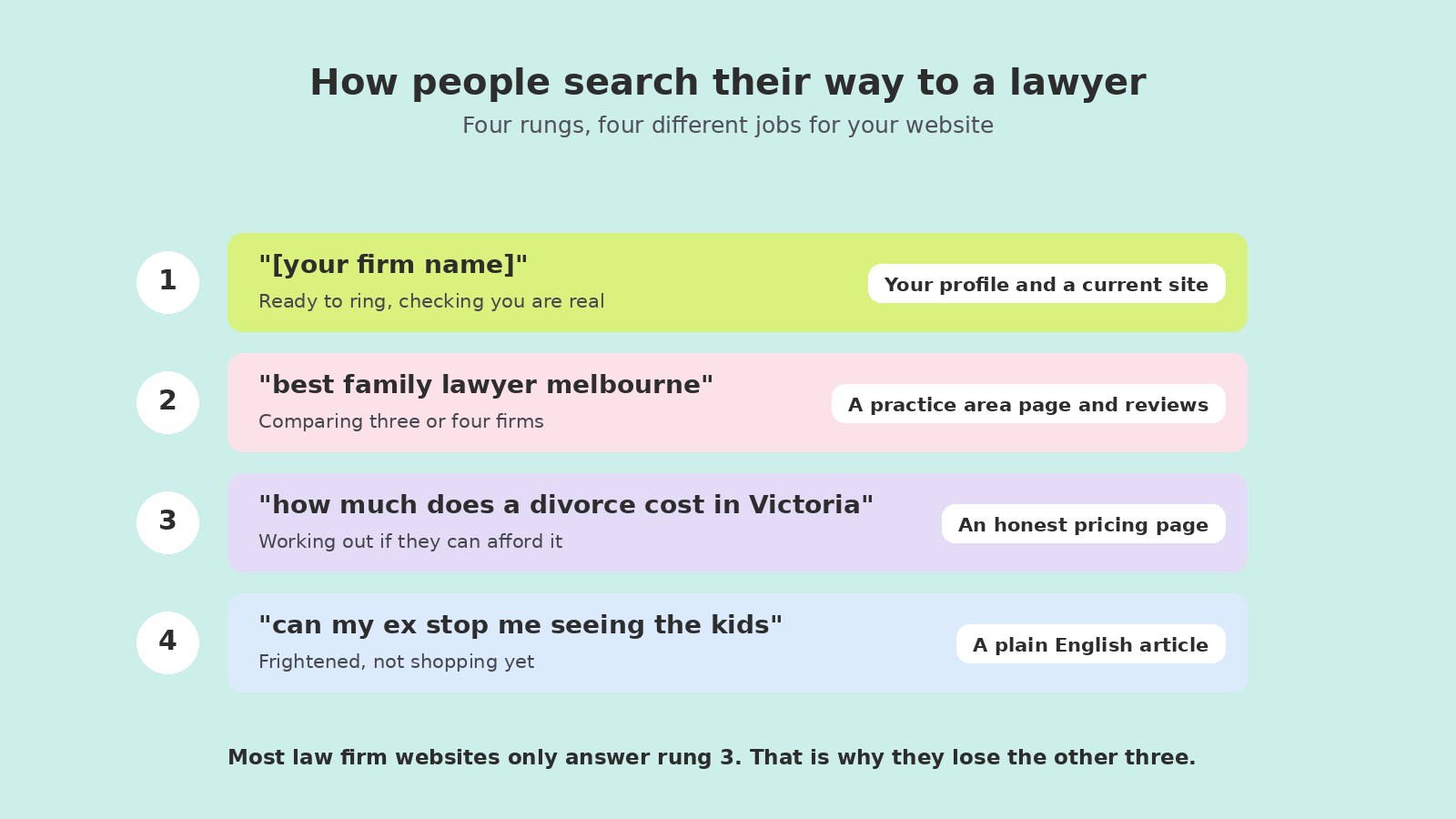
Sort by proximity to instructing a solicitor instead. Someone typing “how much does a divorce cost in Victoria” is closer to hiring you than someone typing “family law”, even though the second phrase has ten times the volume. Cost queries, process queries, and anything with a suburb or “near me” attached are where the files come from.
Then build the list per practice area rather than for the firm as a whole. Family, wills, conveyancing and commercial have almost nothing in common in search behaviour. One combined keyword list produces one confused website.
Two categories firms consistently underrate. Cost and fee queries, because everyone is too nervous to publish numbers, which means the first firm to answer honestly owns the search. And “can I” or “do I have to” questions, which is how people describe a legal problem before they know its legal name. Nobody searches “testamentary capacity”. They search “can my brother contest mum’s will”.
Technical SEO for Law Firm Websites
Measuring Legal Enquiries and ROI
Most law firm sites have one page called Services listing eleven practice areas in bullet points. That page cannot rank for anything, because it is about everything.
The fix is a hub per practice area, with detail pages underneath it. Family law is the hub. Divorce, property settlement, parenting orders, binding financial agreements and intervention orders are the pages beneath it, each one genuinely written rather than three paragraphs of filler. The hub links down to all of them. Each of them links back up.
Two rules keep this from sprawling. Do not create a page you would not be happy for a client to read start to finish. And do not create two pages that answer the same question, because they will compete with each other and both will lose.
Location pages hang off the same structure rather than sitting in their own orphaned corner. A Dandenong family law page links up to the family law hub and across to the divorce page. That is covered properly in our guide to local SEO for lawyers in Melbourne, which is where the map pack and Google Business Profile side of this lives.
Want to know which twelve pages matter for your firm?
We will map your practice areas against what people actually search, and show you where the gaps are before you spend anything.
Book your free consultation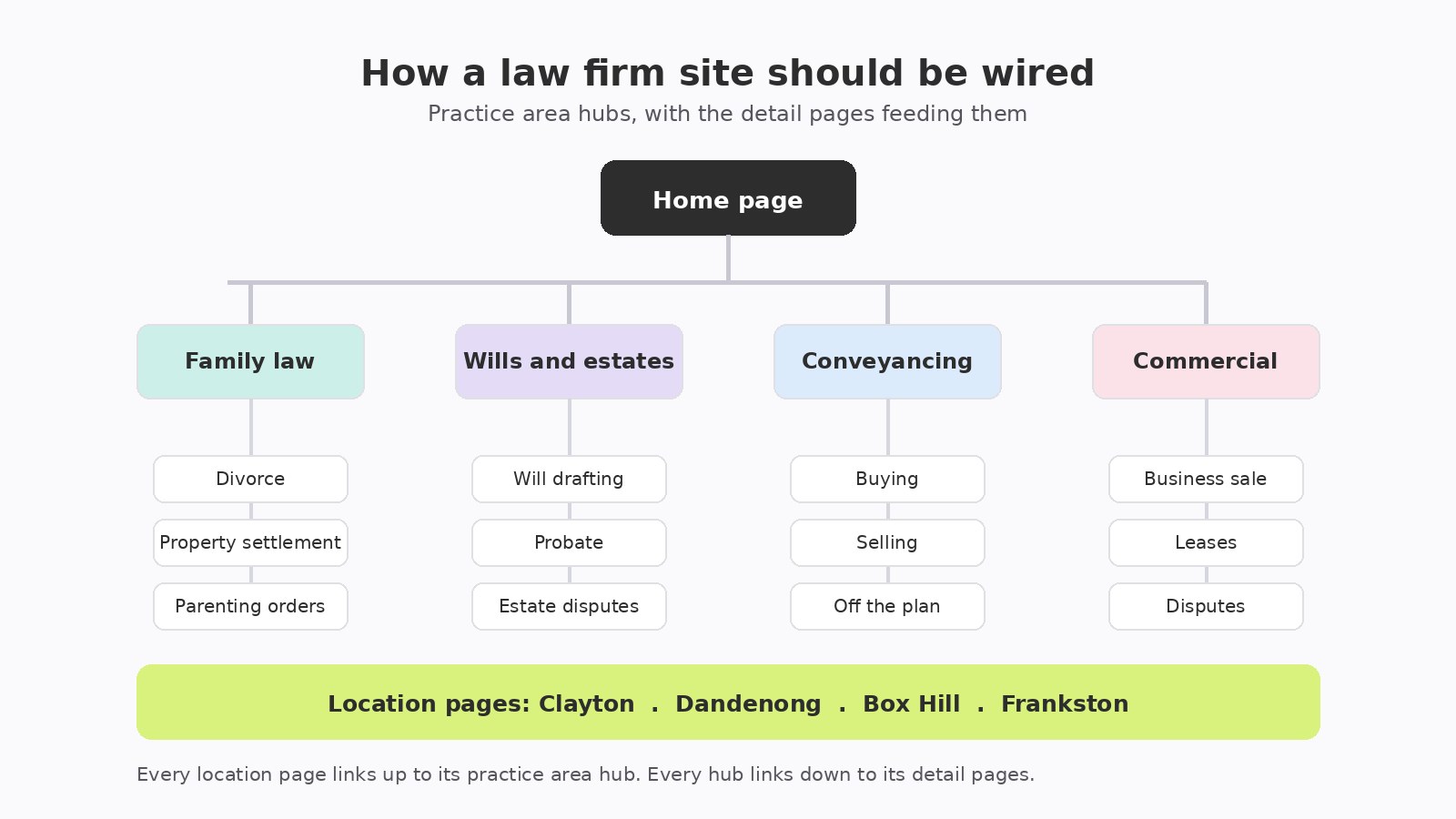
SEO for Lawyers FAQs
Google’s own guidance on helpful, reliable, people-first content asks whether the content demonstrates first-hand expertise and whether a reader would trust it. For a law firm that is not an abstract question. You have the expertise. The problem is that your website usually hides it.
Put the solicitor’s name on the article. Add admission year, jurisdiction, practising certificate details, Law Institute of Victoria membership, accreditations, and a link to their profile page. An article by “the team” on a firm site is competing against articles signed by named practitioners, and it will lose.
Then write things only a practising solicitor could write. Not a summary of the Act, which is already on a government website that outranks you. What the section means when a client is sitting across the desk. What the mediation actually involves on the day. What people get wrong in the first phone call. Where the costs blow out.
Keep it current, and say so. Legal content dates the moment legislation or a threshold changes, and a visible review date does more for a nervous reader than any amount of design polish. Set a calendar reminder to review each major page annually, and update it properly rather than changing the date stamp.
One more thing on volume. Four excellent pages will outperform forty thin ones. If you cannot resource good content monthly, publish quarterly and make it count.
What belongs in the author box on every legal article
- Full name and position at the firm
- Year admitted and the jurisdiction
- Practice areas and any accreditation, worded exactly as the accrediting body permits
- A photograph of the actual person
- A link to their full profile page on your site
- The date the article was last reviewed, not just published
The Technical Work, in plain terms
You do not need to understand this to buy it, but you should be able to tell whether it has been done.
Speed. Legal sites accumulate sliders, stock imagery and forgotten plugins. Test your own site on your phone, on mobile data, away from the office wifi. If you are waiting, so is everyone else, and a person in a legal crisis has three other tabs open.
Mobile. A tappable phone number visible before any scrolling, forms that work with one thumb, and no text that needs pinching.
Structured data. Markup that tells Google you are a legal service, which services you offer and where you are located, using exactly the same name, address and phone number as everywhere else. Character-for-character consistency matters more than people expect.
Indexing. Someone should be able to tell you how many of your pages Google has actually indexed. Plenty of firms have practice area pages that have never been crawled and nobody noticed. Google Search Console answers this in about a minute and it is free.
Housekeeping. Broken links, duplicate pages left over from a rebuild, old staff profiles for solicitors who left in 2022, and two versions of the same practice area page fighting each other. Unglamorous, and often the fastest wins on the whole site.
Our general SEO services cover this same ground for any business. The legal-specific parts are the authorship signals, the regulated language and the practice area architecture.
Would you rather someone else ran this?
DigiFix builds and runs search programmes for Australian law firms, from the keyword map through to the content, the technical work and the monthly reporting.
Book a free 30 minute consultationLinks, and how law firms actually earn them
Links from other websites remain one of the strongest signals in search, and they are where most legal SEO budgets get wasted. Google’s spam policies treat bought links and bulk guest posting as link spam, and the cleanup afterwards costs more than the links did.
The good news is that firms have easier access to legitimate links than almost any other kind of business, because the sources are things you may already be doing.
- Community legal education. Run a session for a neighbourhood house, a migrant resource centre or a local business group, and you tend to get a link from their site.
- Commentary. When legislation changes in your area, write the plain English explainer quickly. Journalists and industry newsletters link to whoever explained it first and best.
- Industry writing. Law association publications, professional bodies, industry association newsletters in the sectors you serve.
- Sponsorship. The junior football club, the school fete, the local chamber of commerce. Small links, but genuinely local and genuinely yours.
- Original data. If you can publish something nobody else has, such as anonymised timelines from your own conveyancing matters over a year, that becomes the page other people cite.
What to avoid: anyone offering a fixed number of links per month for a fixed fee, private blog networks, and directory submissions to hundreds of sites nobody has heard of. If a link seller cannot tell you the specific site before you pay, that is your answer.
Work out which problem you actually have
Firms usually arrive with a symptom rather than a diagnosis, and the wrong diagnosis wastes a year. Find the sentence below that sounds most like your firm, and open it.
Which SEO problem does your firm have?
Tap the symptom that sounds most like you.
Recognised more than one? That is common. Work them top to bottom, because the fixes higher up the list tend to make the ones below easier.
How long it takes, and what to watch
Honest ranges, assuming consistent work rather than a burst followed by silence.
Technical fixes and page improvements can show within four to eight weeks. New content on lower competition queries usually starts ranking somewhere between two and four months.
Competitive practice area terms in a capital city take six to twelve months, and family law and personal injury in the inner suburbs are at the hard end of that. Building enough authority to compete with the large firms on their own terms is a multi year project, which is exactly why targeting narrower queries is the sensible play for most practices.
That gap between month one and month six is the reason many firms run Google Ads management alongside the organic work. Ads buy visibility today at a cost per click that never falls. SEO costs more up front and then keeps producing. Running both, then tapering the ads as rankings arrive, is the usual approach.
Measure four things. Rankings for your target practice area and location terms. Organic traffic to service pages specifically, not sitewide traffic, which is flattered by blog readers who will never instruct you. Enquiries by source. And files opened by source, which is the only number that settles an argument about whether any of this is working.
That last one is a reception discipline, not a software problem. Ask every caller how they found you and record it. Six months of that beats any dashboard.
What search engine optimization for lawyers looks like when we run it
Our SEO services for lawyers in Melbourne follow the sequence below. Most firms start at the first two and add the rest as results come through.
We work with practices across Melbourne and further afield, and the thing clients tell us they value most is being told when something is not worth doing. Plenty of firms come to us wanting forty blog posts. Most of them need four pages rebuilt and a review process that runs every month without being chased. You can read more about how our team works on our About page.
If you want the local search side specifically, meaning the map pack, your Google Business Profile and suburb targeting, start with our guide to SEO for law firms in Melbourne instead. If you want the whole picture, book a call and we will tell you which one your firm needs first.
Find out what is holding your firm back
Book a free 30 minute consultation with Nel. We will look at what you currently rank for, what your competitors are doing that you are not, and which handful of pages would move the most work. No obligation and no hard sell.
Book your free consultation