

Local SEO for lawyers in Melbourne comes down to one moment. Someone in Dandenong opens their phone at nine at night, types “family lawyer near me”, sees three firms on a map, and rings one of them. Usually the first. Whether your firm is in that box has almost nothing to do with how long you have practised and a great deal to do with how your Google Business Profile is set up.
Legal enquiries do not behave like other enquiries. Nobody researches a criminal lawyer for six weeks. They have been charged, or served, or their settlement is in twelve days, and they will call two or three firms in a single sitting and retain one of them. That compresses your entire marketing funnel into about four minutes of someone’s evening.
Most Melbourne firms we speak to are doing one of two things. Either nobody has touched the Google listing since a receptionist claimed it years ago, or the firm is paying a general agency retainer that treats a suburban family law practice exactly like an online shoe store. Neither approach wins the map pack. This guide covers what does, in the order you should do it.
Key takeaways
- Google ranks local results on relevance, distance and prominence. You cannot move your office. The other two are entirely in your hands.
- For enquiries that start with a suburb name, your Google Business Profile does more work than your website does.
- Suburb pages work, but only when they are real pages. Find-and-replace templates get treated as doorway abuse.
- Reviews are the hard part for lawyers, because confidentiality limits what you can safely say in a reply. There is a wording that works.
- Victorian firms need to keep advertising obligations in view, particularly around specialist claims and promised outcomes.
- Realistic timeline for map pack movement is six to twelve weeks, not a fortnight.
Why the Map Pack Decides who Gets the Call
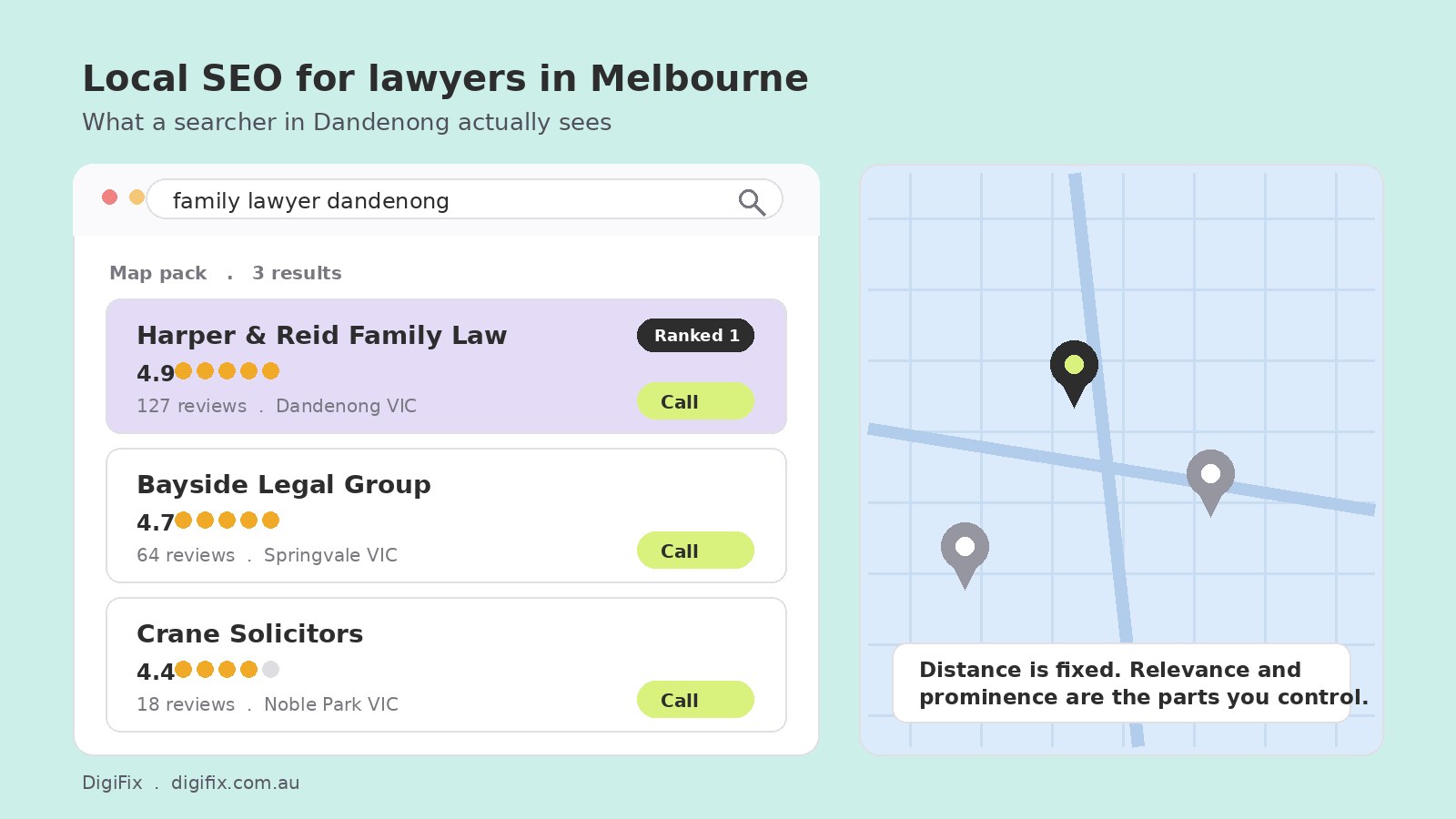
When someone searches for a lawyer with any hint of location behind it, Google shows a map and three business listings above the ordinary blue links. Three. That block gets the calls, the direction requests and the clicks, and everyone below it fights over what is left.
Here is the part that trips up firms with a nice website. The map pack is filtered by where the searcher is standing. A practice in Collins Street can have the strongest domain in Victorian legal and still be invisible to a person searching from Werribee. Meanwhile a two-partner firm above a bakery in Werribee, with a complete profile and sixty reviews, takes the enquiry.
This is the whole reason SEO for law firms in Melbourne works differently to SEO for a national brand. You are not trying to be visible to Australia. You are trying to be visible to the six or seven suburbs your clients actually come from.
Which is why chasing “lawyer Melbourne” is usually the wrong fight. It is expensive, it is dominated by the large firms, and the traffic it sends is scattered across every practice area and every corner of the metro area. The searches worth owning are narrower and closer to home.
How Google Decides which Law Firms Appear
Google publishes this, which saves a lot of guessing. Local results are based mainly on three things: relevance, distance and prominence. Everything in a sensible local campaign is an attempt to improve one of them.
| Signal | What Google means by it | What a Melbourne firm can do |
|---|---|---|
| Relevance | How closely your profile matches what was typed | Correct primary category, every service listed by name, a description that uses the words clients use |
| Distance | How far you are from the searcher or the suburb they named | Verify the address you actually work from. If you have branches, each one needs its own profile |
| Prominence | How well known and well regarded the firm looks, online and off | Steady reviews, consistent listings across Australian directories, links from local and legal sites |
Swipe to scroll the table on mobile
Your Google Business Profile is doing most of the work
If you only fix one thing this quarter, fix the profile. It is free, it takes a couple of hours, and it moves the needle faster than anything else on this page.
Choose the category the way a client would
Your primary category has more influence on which searches you appear in than any other single setting. Most firms pick “Law firm” and stop. That is a category for a generalist, and it tells Google very little.
Google’s category names are American, which throws people off. You are looking for entries like family law attorney, divorce lawyer, criminal justice attorney, estate planning attorney, immigration attorney, personal injury attorney or conveyancer. Set your primary category to the work you most want more of, then add the others as secondary categories.
If sixty per cent of your revenue is family law, do not let “Law firm” sit in the primary slot.
Keep the name clean
Your business name field should hold your business name and nothing else. “Harper & Reid Family Law” is fine. “Harper & Reid Best Family Lawyers Dandenong” is a guideline breach, competitors report it constantly, and a suspension takes weeks to unwind. It is not worth the short-term bump.
Get the address right, including the suite number
Law firms are a storefront listing, not a service area business, because clients come to you. Include the suite or level number. Shared buildings and serviced offices cause most of the verification headaches we see, and barristers working out of chambers often cannot verify at all, which is a separate conversation about whether a profile is the right channel for them.
Fill the parts everyone skips
- List services individually. Not “family law”, but consent orders, binding financial agreements, property settlements, intervention order applications, parenting plans. Each one is a phrase somebody types.
- Real photos. The reception desk, the street frontage so people can find the door, the meeting room, the actual solicitors. Stock images of gavels help nobody, and Australian courts do not use gavels anyway.
- Accurate hours, including public holidays. A wrong closing time costs you the after-hours call.
- Seed the Q&A section with the questions your reception already answers ten times a week. Do you offer a free first appointment. Do you do fixed fees for conveyancing. Do you have parking.
- Post regularly. A short update on a new practice area, a change to hours over Christmas, a plain English explainer. It signals an active business.
- Add your booking or appointment link so someone can act without picking up the phone. Not everyone in a legal problem wants to talk to a stranger at 9pm.
If you would rather have someone walk through your profile with you and point at what is actually costing you enquiries, DigiFix runs a free consultation for exactly that. No pitch, just an honest read of where you sit against the firms ranking above you.
Not sure where your firm ranks right now?
We will run your practice areas against the suburbs you want, and show you exactly who is holding the three map spots you are missing.
Book your free consultationWin suburbs, not the whole city
Melbourne is not one market. A conveyancer in Point Cook and a conveyancer in Camberwell are not really competing, no matter what a keyword tool says. Pick the suburbs you can genuinely service and go after them properly.
Start with the postcodes your existing matters already come from. Pull the last hundred files and count. Firms are often surprised. A Ringwood practice discovers half its family law work comes from Croydon and Bayswater, which changes the whole content plan.
Then look at language. This is the most underused angle in Melbourne legal marketing. “Mandarin speaking family lawyer Box Hill” or “Vietnamese speaking lawyer Springvale” get modest search volume and almost perfect intent. If someone on your team speaks Cantonese, Greek, Arabic, Punjabi or Hindi, that belongs on a page and in your profile attributes, not buried on a staff bio.
Where the doorway page line sits
Someone will offer to build you three hundred suburb pages. Do not buy it. Google’s spam policies name doorway abuse specifically, and templated location pages with the suburb swapped out are the textbook example. They either fail to rank or they drag the rest of the site down with them.
A location page earns its place when it says something only that page could say. The local court you appear at and how listings run there. Median property values if you are a conveyancer. Parking near your office. Which of your solicitors actually covers that area. Build six pages that pass that test rather than sixty that do not.
| What they type | What they want | What should rank |
|---|---|---|
| family lawyer near me | To call someone today | Your Google Business Profile |
| conveyancer Werribee | A local firm with a fixed price | A real Werribee service page, plus the profile |
| how much does a divorce cost in Victoria | A number before they commit | A blog article that answers it honestly |
| Mandarin speaking lawyer Box Hill | To be understood the first time | A language page and a profile attribute |
| [your firm name] | To check you are real before ringing | Your profile, reviews and a current website |
Swipe to scroll the table on mobile
Reviews, and the confidentiality problem
Reviews feed prominence, and prominence is where most Melbourne firms are weakest. A plumber with four hundred reviews is normal. A twelve-partner firm with nine reviews is also normal, and it is a problem, because the person choosing between three listings uses review count as a proxy for whether you are any good.
The reason firms under-ask is understandable. Asking a client to publicly rate the experience of their divorce feels wrong, and for some matters it genuinely is. So be selective rather than silent. Conveyancing, wills, commercial work and completed family matters where the outcome was good are all reasonable places to ask. Ask at file close, when the relief is fresh, and ask by name from the solicitor who did the work. A generic automated blast from an unknown address converts poorly.
Never pay for reviews and never filter them, meaning do not send happy clients to Google and unhappy ones to a private form. Google prohibits both, and the Australian Competition and Consumer Commission has been active on incentivised reviews across every industry.
Replying without breaching anything
This is the bit that stops most firms from replying at all. A response that says “we are sorry your property settlement did not go the way you hoped” has just confirmed publicly that this person was a client and hinted at the matter type. Your duty of confidentiality does not lift because someone else spoke first.
The safe shape of a reply neither confirms nor denies the relationship, stays warm, and moves the conversation off the platform. There is also a category of review peculiar to legal practice: the one star from the other side of a family law or commercial dispute, who was never your client at all. Those can be reported under Google’s policy on reviews from people with a conflict of interest, though removal usually takes more than one attempt and the same wording rules apply while you wait.
The website side of local SEO for lawyers in Melbourne
Your profile gets you seen. Your website decides whether they ring. Most legal sites we audit fail on the same handful of points.
Speed first. Legal sites tend to carry heavy sliders, stock photography and half a dozen plugins nobody remembers installing. A person in distress on a train at Flinders Street will not wait five seconds. Then mobile, properly: a tappable phone number in the header, forms that work with one thumb, and text you can read without pinching.
Then structure. One page per service, one page per location, and internal links that connect them so a person landing on your wills page can find your Frankston office in a click. Our broader SEO services cover the same architecture work for any business, but law firms have one extra requirement.
That requirement is credibility signals. Legal advice sits in the category Google treats most cautiously, because bad information causes real harm. Show your work. Name the author of every article and link to their profile. State admission dates, practising certificate details, Law Institute of Victoria membership and any accreditations. Anonymous legal content from an unnamed “content team” is exactly what Google has spent years learning to discount.
Technical work that quietly matters
Structured data is how you tell Google what you are in a language it cannot misread. For a firm that means LegalService or Attorney markup on the home page, Service markup on each practice area page, and location markup carrying the exact name, address and phone number that appear on your profile. The word “exact” is doing a lot of work there. Suite 4 on one listing and Ste 4 on another is enough inconsistency to muddy things.
Alongside that: Google Search Console and Google Analytics connected and actually read, an indexing check so you know every practice area page is in the index rather than assumed to be, and a broken link sweep. Firms rebrand, merge and drop practice areas, and the dead links pile up.
Directories and Local Links
Citations are the boring, effective half of prominence. Your name, address and phone number, written identically everywhere Google might find them. Australian general directories such as Yellow Pages, True Local and Hotfrog, plus the legal-specific listings your clients and peers actually use, including the Law Institute of Victoria’s referral service and Doyle’s Guide where you qualify.
Links matter too, and lawyers have easier access to good ones than most businesses. Community legal education sessions, the local chamber of commerce, sponsoring a junior football club, a plain English piece for a local paper, a guest article for an industry association. Those links come from places that geographically make sense, which is the whole point.
If your firm has more than one office
Multi-office firms lose ground by treating branches as an afterthought. Each office needs its own verified profile with its own phone number and its own staffed opening hours. A “location” that is a mailbox with nobody in it will eventually be removed, and it can take the parent listing’s trust with it.
Each office also needs its own page on the site with its own address, its own team, its own photos and its own suburb targeting, all linked from a clear locations hub. Done properly, a three-office firm competes in three separate map areas instead of one.
Would you rather this was handled for you?
DigiFix builds and runs local search campaigns for Melbourne practices, from the profile through to the suburb pages and the monthly reporting. Start with a look at where you stand.
Book a free 30 minute consultationMarketing Rules Victorian firms need to keep in view
Everything above still has to sit inside your professional obligations, and the agency you hire is unlikely to know them. A few that come up repeatedly.
- Advertising must not be false, misleading or deceptive. That covers your meta descriptions and your Google Business Profile description, not just your billboards.
- Be careful with the word specialist. Accredited specialisation in Victoria is conferred by the Law Institute of Victoria, and claiming it loosely is the kind of thing that draws a complaint from a competitor before it draws one from a client.
- Do not promise outcomes. “We win 98 per cent of custody cases” is a marketing sentence and a regulatory problem in one line.
- Personal injury advertising is restricted differently across states. If you advertise beyond Victoria, check before you spend.
- Client stories need consent, and identifying details need to go, even when the client is enthusiastic.
None of this stops you marketing well. It just means the copy has to be written by someone who knows the difference. If you are unsure about a specific claim, the Victorian Legal Services Board and Commissioner is the source of truth, not your agency and not this article.
Check your firm against this before you spend a dollar
Ten questions. Open each one and give yourself an honest yes or no. If you answer no to four or more, your problem is not budget, it is groundwork.
Local SEO readiness check for your firm
Tap each item to see what a yes actually looks like.
Scoring: 8 to 10 yes, you are ahead of most Melbourne firms and should be pushing on links and content. 5 to 7, the fundamentals are half built. Under 5, do not buy ads yet, fix this first.
How long it takes and what to measure
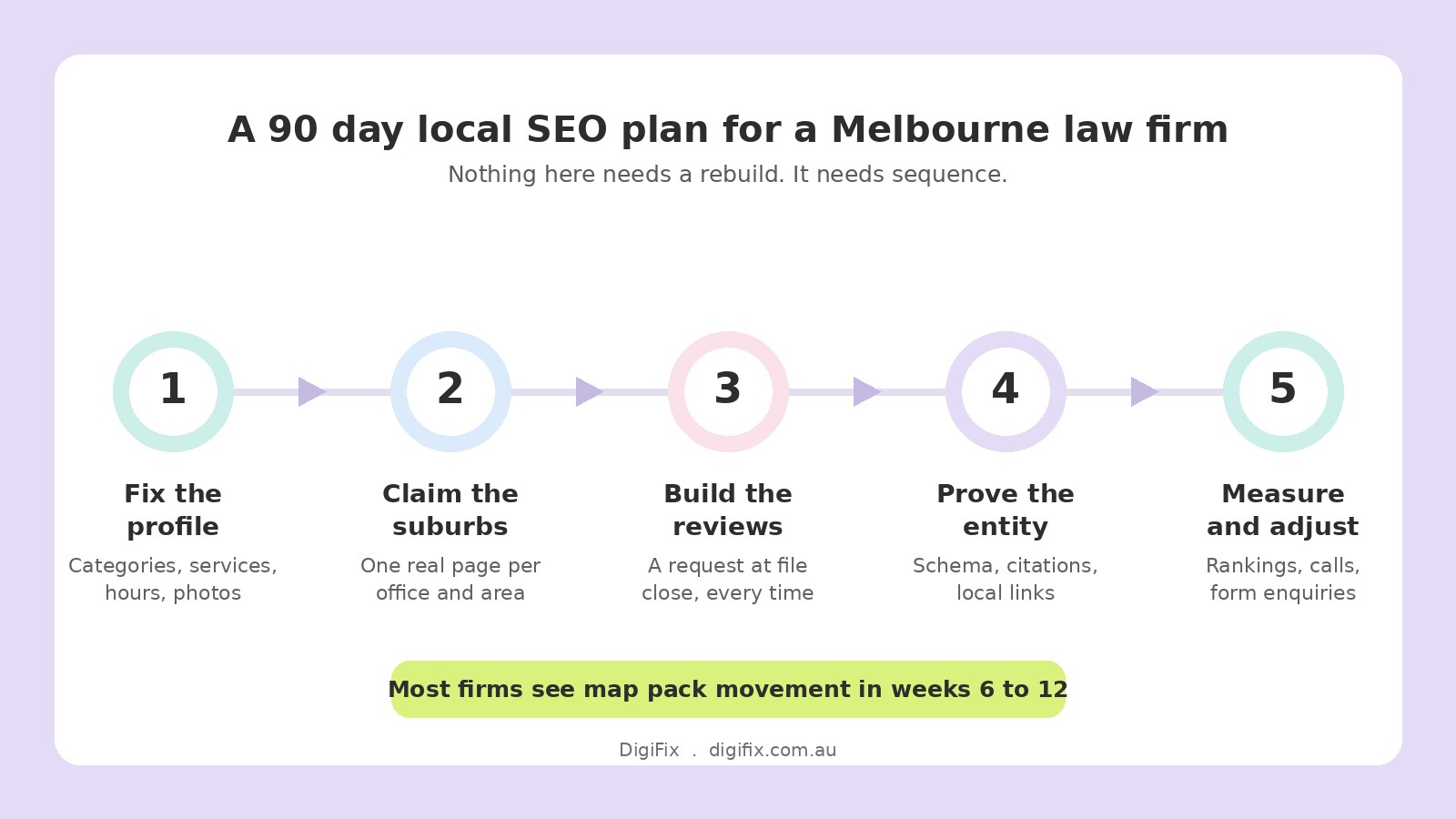
Profile changes can register within days. Map pack movement usually shows in the six to twelve week range. Competitive suburb rankings for busy practice areas take longer, often two to three quarters, and family law and personal injury in the inner suburbs are among the hardest local markets in the state.
Measure four things and ignore the rest. Where you rank for your target keyword and suburb combinations. What your profile produced, meaning calls, direction requests and website clicks. Organic traffic to your practice area and location pages. And the number that actually pays the rent: enquiries that turned into files, with the source attached.
That last one requires discipline at reception. Ask every caller how they found you and write it down. Six months of that data is worth more than any dashboard.
What DigiFix handles for Melbourne law firms
We run local search for practices across the metro area, and our SEO services for lawyers in Melbourne are built around the ten areas below. Some firms take the lot. Plenty start with the profile and reviews and add the rest once the phone starts moving.
We are based in Clayton and most of our clients are within an hour of us, which matters more than it sounds. Knowing that Springvale, Glen Waverley and Dandenong behave like three different markets is not something you get from an offshore report. You can read more about how our team works, or look at the wider digital marketing services we offer if search is only part of the problem.
One caveat worth saying out loud. If your firm needs matters this month rather than this quarter, local SEO alone will not do it. Pair it with Google Ads management for the first few months and let the organic work compound underneath it.
Ready to be the firm they call first?
Book a free 30 minute consultation with Nel. We will look at your Google Business Profile, the suburbs you should be winning and who is currently holding them, then tell you plainly what it would take. No obligation and no hard sell.
Book your free consultation